
Career changes feel scary when you believe you must start over, because that story makes every past year feel like it “doesn’t count” and turns learning into a mountain.
A transferable skills map replaces that fear with evidence, so you can see your core competencies clearly, translate them into resume strengths, and pivot with realism and confidence.
Transferable skills map: why it stops you from “starting over”
Starting over is usually a perception problem rather than a reality problem, because most roles are built on overlapping skills like communication, prioritization, analysis, coordination, and influence that repeat across industries.
Confidence improves when you can name what you already know how to do, since a career change becomes a repositioning exercise instead of a full reinvention story.
Hiring managers reduce risk by looking for proof of capability, so a transferable skills map helps you show that you have done the work before, even if the context or title was different.
Momentum returns faster when you focus on what transfers, because you can build from your strongest competencies while you learn only the few role-specific skills that truly require new training.
Clarity also helps you avoid random applications, because your map becomes a filter that tells you which roles match your strengths and which ones would demand an unnecessary rebuild.
- Fear decreases when your career narrative includes evidence, because evidence is harder to argue with than anxiety.
- Decision making becomes easier when you know your “portable value,” because you can compare options based on fit instead of guessing.
- Interview performance improves when you have structured stories, because you can connect each skill to outcomes in a calm, consistent way.
- Learning becomes efficient when you see gaps precisely, because you stop trying to learn everything and start learning what matters most for the pivot.
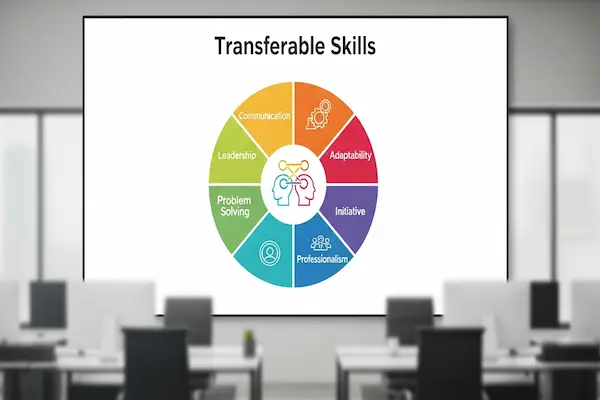
What transferable skills are and what they are not
Transferable skills are capabilities that carry across roles and industries, because they describe how you create value rather than the specific tools or jargon you used in one job.
Core competencies sit underneath tasks, so they explain why you succeed in different situations even when the surface details change.
Role-specific skills still matter, yet they are usually fewer than you think, because many job requirements are simply new vocabulary for familiar behaviors.
Credentials can help in regulated fields, while most pivots succeed through proof, because work samples, project outcomes, and clear stories reduce perceived risk faster than labels.
Identity can get tangled up in titles, so this exercise aims to separate who you are from what you did, because you can do different work without losing your value.
- Transferable skills are not a list of buzzwords, because generic terms without evidence do not change hiring outcomes.
- Transferable skills are not only “soft skills,” because analysis, project management, operations, writing, and process improvement can be both practical and portable.
- Transferable skills are not excuses to avoid learning, because every pivot still requires targeted upskilling and context-building.
- Transferable skills are not fixed traits, because you can strengthen competencies intentionally through projects and feedback.
Simple examples of transferable skills versus role-specific skills
Communication is transferable because it shows up everywhere, while a specific platform or tool is usually role-specific because it depends on a particular environment.
- Transferable: stakeholder management, because aligning people with different priorities is required in most professional roles.
- Transferable: structured problem solving, because breaking ambiguity into steps is valuable in any team.
- Transferable: prioritization, because choosing trade-offs under constraints is universal.
- Role-specific: a particular CRM workflow, because it is tied to one system configuration.
- Role-specific: a niche industry regulation, because it depends on local rules and domain context.
- Role-specific: a proprietary internal tool, because it does not exist outside that company.
Transferable skills map step 1: build a skills inventory that is actually accurate
A strong skills inventory starts with your real work, because titles hide the truth while outcomes reveal what you can do reliably.
Memory is biased toward highlights and pain, so the goal is to capture patterns across weeks and months, because patterns are what translate into credible competencies.
Accuracy matters more than completeness, because a smaller set of well-evidenced skills beats a long list of claims that you cannot prove.
Collect your raw material from four sources
Using multiple sources reduces blind spots, because you will remember different skills depending on whether you look at tasks, outcomes, feedback, or artifacts.
- Tasks you performed repeatedly, because repetition usually indicates a stable skill base you can leverage in a pivot.
- Outcomes you achieved, because outcomes show value creation and help translate your work across industries.
- Feedback you received, because repeated feedback often reveals your most visible strengths.
- Artifacts you produced, because tangible outputs like documents, plans, dashboards, training guides, and analyses make your skills easier to demonstrate.
- Performance reviews are useful when available, because they capture strengths in the language leaders use.
- Project retrospectives help too, because they reveal how you solve problems under constraints.
- Client messages and peer notes can count, because informal feedback often highlights your real impact.
- Your calendar is a clue, because how you spend time shows what you actually do, not what your job description claims.
Skills inventory prompts you can answer quickly
Short prompts reduce procrastination, because starting is often the hardest part when you feel uncertain about your direction.
- Which three problems do people bring to you most often, because that pattern usually reflects your most trusted competencies.
- Which tasks do you complete faster than others, because speed can signal competence and comfort.
- Which outcomes can you describe with numbers or clear before-and-after statements, because measurable results strengthen resume strengths.
- Which tasks drain you even when you do them well, because a pivot should move you toward sustainable fit rather than repeating misery in a new setting.
- Which tasks energize you even when they are hard, because energy is often a sign of long-term career fit.
Skills inventory worksheet
Copy this worksheet into a note and fill it with concrete examples, because concreteness is what makes your transferable skills map credible.
SKILLS INVENTORY WORKSHEET

1) Repeated responsibilities (10–15 items):
-
-
-

2) Outcomes I delivered (5–10 items):
- Outcome:
  Metric or evidence:
  My role in it:
- Outcome:
  Metric or evidence:
  My role in it:

3) Feedback themes (5 items):
- “People say I am good at…”
- “I often get asked to…”
- “My manager praised me for…”

4) Artifacts I produced (5–10 items):
- Document:
- Dashboard:
- Plan:
- Training:
- Analysis:

5) Work I want more of:
-

6) Work I want less of:
-
Transferable skills map step 2: turn your inventory into core competencies
A list of tasks is not yet a map, because tasks are surface-level while core competencies explain the underlying capability that transfers across roles.
Translation is the skill you are practicing here, because you are converting “what I did” into “how I create value,” which is the language of career change.
Clustering prevents overwhelm, because you can group dozens of tasks into a smaller set of competencies you can explain and prove.
Use competency clusters to simplify your story
Clusters work because they create a few memorable themes, so your narrative becomes easier to communicate on resumes, in interviews, and in networking conversations.
- Execution and delivery: planning work, tracking progress, managing dependencies, and finishing projects reliably.
- Communication and influence: writing clearly, presenting, aligning stakeholders, handling conflict, and persuading with evidence.
- Analysis and decision support: researching, modeling, interpreting data, defining metrics, and making recommendations.
- Operations and process: documenting workflows, improving systems, reducing errors, and making work repeatable.
- Customer and user thinking: understanding needs, handling feedback, improving experience, and advocating for outcomes.
- Leadership and development: mentoring, coaching, setting direction, and creating clarity for others.
Turn tasks into competencies using a translation formula
Translation gets easier when you follow a repeatable formula, because your brain stops guessing and starts mapping systematically.
- Start with a task from your inventory, because real tasks ground the process in truth.
- Ask what capability made that task possible, because capability is usually transferable even when the task is not.
- Name the competency in plain language, because clarity beats jargon during a pivot.
- Add the business value created, because value connects your skill to outcomes that matter.
- Attach one evidence example, because evidence turns your competency into a believable resume strength.
- Task: “Updated weekly reports,” becomes competency: “Data synthesis and executive communication,” because the real value is turning information into decisions.
- Task: “Trained new hires,” becomes competency: “Enablement and coaching,” because the transferable skill is accelerating others’ performance.
- Task: “Handled escalations,” becomes competency: “De-escalation and stakeholder management,” because the value is protecting relationships and outcomes under pressure.
- Task: “Coordinated launches,” becomes competency: “Program management,” because the portable capability is sequencing work across teams and timelines.
Evidence matrix: prove your transferable skills with outcomes
Proof is what turns a career pivot from a request into a recommendation, because decision-makers want to know you can deliver results in the new context.
An evidence matrix makes proof easy to access, because you will have specific stories ready instead of trying to remember examples under interview pressure.
Confidence builds when you see your own track record clearly, because anxiety often shrinks when you can point to concrete wins.
How to build your evidence matrix
Each row below should connect a core competency to a real example, because the strongest resume strengths are always backed by evidence.
- Choose 8 to 12 core competencies from your clusters, because most roles can be won with a focused set rather than an endless list.
- Write one example per competency, because one clean story is more useful than five vague memories.
- Add a metric or observable result, because results create credibility even when they are small.
- Include the context and constraint, because constraints show skill under real-world pressure.
- Note the artifact you produced when possible, because artifacts are portable proof for a career change.
Transferable skills evidence matrix table
| Core Competency | Example Situation | Action I Took | Result or Metric | Artifact or Proof | Roles This Supports |
|---|---|---|---|---|---|
| Stakeholder management | Conflicting priorities across teams | Aligned on scope, trade-offs, owners | Reduced delays, improved delivery predictability | Decision log, meeting notes, plan | Program, Ops, Product, Leadership |
| Process improvement | High error rate in a recurring workflow | Mapped steps, removed bottleneck, standardized checklist | Fewer errors, faster cycle time | Updated SOP, checklist | Ops, Quality, Enablement |
| Analytical thinking | Unclear root cause behind performance dip | Segmented data, tested hypotheses, recommended changes | Improved key metric after change | Analysis memo, dashboard | Analytics, Strategy, Product |
| Your competency | |||||
| Your competency |
Review the “roles this supports” column honestly, because your map should reduce options to the best-fitting ones rather than keep everything open forever.
Evidence prompts when you think you have “nothing to show”
Many professionals underestimate their proof, because they equate proof with huge wins while most hiring decisions are made from consistent smaller outcomes.
- Where did you reduce confusion, because clarity is an outcome even when it is not a dollar amount.
- Which problem did you prevent, because risk reduction is value even when it is invisible.
- What did you make easier for others, because operational improvement is often the fastest transferable strength.
- Which decision did you enable, because decision support is a tangible outcome in many roles.
- Where did you increase speed or quality, because efficiency and quality are common cross-industry metrics.
Examples of transferable skills by role family
Role examples help you spot your own strengths faster, because you can recognize patterns even when your background does not match the new title directly.
Use these examples to label your skills in market language, because the goal is to describe your value in terms that make sense to the roles you want.
From customer service to operations, support, or success roles
Customer-facing work builds portable competencies quickly, because it forces real-time communication, prioritization, and problem solving under pressure.
- Transferable skill: de-escalation, because calming tense situations translates to stakeholder management in many roles.
- Transferable skill: pattern recognition, because repeated customer issues become input for process and product improvements.
- Transferable skill: documentation, because clear notes and workflows reduce error and increase speed.
- Transferable skill: ownership, because follow-through and resolution tracking demonstrate reliability and accountability.
From administrative roles to project coordination or program management
Administrative work often contains hidden project management, because scheduling, coordination, and managing details are core delivery skills in disguise.
- Transferable skill: planning, because building timelines and anticipating needs is central to delivery work.
- Transferable skill: communication, because keeping people aligned requires concise updates and clear expectations.
- Transferable skill: prioritization, because protecting time and sequencing tasks under constraints is a universal competency.
- Transferable skill: process discipline, because consistent workflows create reliability across teams.
From teaching or training to enablement, learning, or leadership tracks
Teaching builds influence and clarity, because simplifying complexity and guiding behavior change is valuable in many corporate environments.
- Transferable skill: curriculum design, because creating learning paths maps to enablement and onboarding.
- Transferable skill: facilitation, because leading discussions and managing group energy translates to workshops and alignment sessions.
- Transferable skill: feedback and coaching, because behavior-based feedback is leadership, even without the title.
- Transferable skill: measurement, because assessing learning outcomes resembles measuring program effectiveness.
From finance or accounting to analytics, strategy, or operations
Finance work translates well because it is already outcome-driven, since forecasting, risk evaluation, and decision support are portable across industries.
- Transferable skill: analytical modeling, because data interpretation supports decisions in product, operations, and strategy.
- Transferable skill: stakeholder communication, because explaining trade-offs to non-experts is essential in senior roles.
- Transferable skill: process control, because maintaining accuracy and compliance maps to quality and operations.
- Transferable skill: prioritization under constraints, because budgets are trade-offs made visible.
From engineering or technical roles to product, leadership, or systems operations
Technical backgrounds pivot well when you translate complexity into outcomes, because many adjacent roles need someone who can bridge execution and decision making.
- Transferable skill: structured problem solving, because debugging is essentially hypothesis testing and root-cause analysis.
- Transferable skill: systems thinking, because understanding dependencies maps to program and product planning.
- Transferable skill: communication across functions, because explaining trade-offs is a core leadership competency.
- Transferable skill: quality mindset, because reliability and risk management are valuable beyond technical teams.
How to translate your transferable skills map into resume strengths
A resume is not your biography, because it is a marketing document that highlights proof of value in a way a hiring manager can scan quickly.
Transferable skills become resume strengths when you tie them to outcomes, because outcomes make your claims believable and relevant to the new role.
Clarity improves when you use consistent language, because scattered phrasing makes you look unfocused even when you have strong evidence.
Resume bullet formulas that work for career change
Formulas reduce guesswork, because you can plug in your evidence matrix and create strong bullets without overthinking each line.
- Outcome-first formula: “Improved X by Y% by doing Z, resulting in A,” because hiring managers care about results and then want your method.
- Problem-solution formula: “Solved X by diagnosing Y and implementing Z, reducing A,” because it shows structured thinking and ownership.
- Scope-and-impact formula: “Led X across Y stakeholders to deliver Z by deadline,” because cross-functional delivery is a common seniority signal.
- System-building formula: “Created X process/documentation to standardize Y, improving A,” because operational excellence transfers across industries.
Before-and-after examples of weak versus strong bullets
Weak bullets are vague, while strong bullets are specific and evidence-based, because evidence is what makes transferable skills credible in a pivot.
- Weak: “Responsible for reporting,” becomes strong: “Synthesized weekly performance data into an executive summary that supported prioritization decisions and reduced follow-up questions.”
- Weak: “Helped with projects,” becomes strong: “Coordinated cross-team deliverables, tracked risks, and maintained a decision log that improved on-time completion.”
- Weak: “Good communicator,” becomes strong: “Wrote clear stakeholder updates that aligned expectations, reduced misunderstandings, and sped up approvals.”
- Weak: “Improved processes,” becomes strong: “Mapped and streamlined a recurring workflow, cutting cycle time and reducing errors through standardized checklists.”
Resume strengths checklist for career changers
Checklists keep you honest, because the fastest way to sabotage a pivot is to describe yourself in generic terms without proof.
- Each bullet should include an action and an outcome, because action without outcome sounds like activity rather than value.
- At least half your bullets should include evidence, because numbers, before-and-after changes, or observable results increase trust.
- Language should match the target role, because the same skill can be described in different words depending on the audience.
- Stories should be recent when possible, because recency reduces perceived risk and signals current capability.
- Skills should be clustered, because a cohesive narrative beats a scattered list of unrelated tasks.
Using your transferable skills map to choose a realistic career change or pivot
Choosing a pivot becomes easier when you stop asking, “What could I do,” and start asking, “Where does my proven value fit with minimal friction.”
Risk decreases when you target adjacent roles first, because adjacency allows you to leverage existing competencies while learning fewer new ones.
Exploration becomes smarter when you define the pivot level, because moving sideways at the same level differs from restarting at an entry level, and you deserve to choose intentionally.
The three-pivot options that avoid “starting over”
Most pivots fall into one of three categories, and naming the category helps you plan the right learning path and expectations.
- Industry pivot: same role family, new domain, because your competencies transfer while you learn new context.
- Role pivot: adjacent role family, same industry, because your domain knowledge transfers while you learn new responsibilities.
- Hybrid pivot: adjacent role family and new domain, because it is possible yet usually requires stronger proof and a more staged plan.
Role targeting process using your evidence matrix
A structured process prevents random applications, because randomness tends to amplify rejection and make you doubt yourself unnecessarily.
- Pick two or three role families to test, because focus improves depth and reduces emotional exhaustion.
- Match your top competencies to those roles, because fit increases when you can demonstrate the core work of the job.
- Identify the top two missing skills per role family, because most roles do not require ten new skills and usually require a small set of unlocks.
- Create a proof plan for each missing skill, because learning becomes credible when it produces an artifact or outcome.
- Choose the pivot with the best combination of fit, feasibility, and motivation, because sustainable effort matters as much as technical eligibility.
Skills inventory to proof plan: a simple mapping workflow
This workflow turns reflection into action, because a map is only useful when it produces next steps you can actually execute.
Use the steps below in order, because each step reduces uncertainty and moves you from “I hope I can” to “I can show I can.”
- Inventory your work with concrete examples, because concrete input produces accurate competency output.
- Cluster tasks into core competencies, because clusters create a coherent career narrative.
- Build your evidence matrix, because evidence turns skills into believable resume strengths.
- Select a pivot direction, because focus is what makes the next 60 to 90 days productive.
- Plan proof-building projects, because projects create experience without requiring a job offer first.
- Update your resume language to match the target role, because translation is often the missing link for career changers.
- A proof-building project can be internal, because small ownership opportunities at your current job often provide the most credible experience.
- A proof-building project can be external, because volunteer work, freelance projects, or structured personal projects can create artifacts you can discuss.
- A proof-building project should be scoped, because finishing something small beats abandoning something large.
- A proof-building project should be measurable, because outcomes make your pivot story stronger and easier to remember.
Common mistakes that weaken a transferable skills map
Mistakes are normal, especially when fear is loud, yet avoiding these traps will make your map more realistic and more persuasive.
Overclaiming hurts more than underclaiming, because hiring teams can forgive learning curves while they do not forgive inflated narratives that collapse under questions.
- Listing skills without proof, because proof is what turns a skill into a resume strength.
- Using generic labels only, because “teamwork” and “communication” mean nothing until you attach a specific behavior and outcome.
- Trying to pivot too far too fast, because a hybrid pivot is possible but usually needs a staged plan and stronger evidence.
- Ignoring environment fit, because the same role can feel completely different depending on pace, structure, and management style.
- Assuming tools are the main barrier, because tools can be learned quickly while judgment, communication, and ownership signals take longer to demonstrate.
- Replace vague claims with specific examples, because specificity is persuasive and memorable.
- Choose fewer competencies and strengthen them, because depth creates credibility faster than breadth.
- Build artifacts that match the target role’s outputs, because outputs are the language of hiring.
- Practice telling your story out loud, because confidence grows through repetition and refinement.
Next actions: a realistic 30–60–90 day plan for your pivot
A plan reduces anxiety because it gives you control over the process, and control is what makes a career change feel safe enough to attempt.
Timeframes should respect your life constraints, because consistent progress beats intense bursts that collapse when work or family gets demanding.
First 30 days: build the map and choose a direction
- Complete your skills inventory and competency clusters, because clarity starts with accurate input.
- Build an evidence matrix with at least eight rows, because eight strong examples cover most interview questions.
- Select two role families to explore, because a small shortlist keeps you focused without trapping you.
- Rewrite your resume summary in target-role language, because positioning is often the biggest pivot lever.
- Choose one proof-building project to start, because action creates confidence faster than planning.
Next 60 days: build proof and reduce the “risk” in your story
- Finish one scoped project with a measurable outcome, because completion is the fastest way to build credible momentum.
- Create one artifact you can share or discuss, because artifacts make your skills visible.
- Practice your top five stories using your evidence matrix, because interviews reward clarity and structure.
- Identify two missing skills and build micro-experiments, because small experiments prevent you from wasting months on the wrong learning.
- Refine your resume bullets using outcome-first language, because strong bullets attract better-fit conversations.
By 90 days: apply with confidence and iterate with feedback
- Apply to roles that match your top competencies, because fit increases response rates and reduces rejection fatigue.
- Track which stories land well and which feel weak, because feedback reveals which competencies need stronger proof.
- Adjust your map based on results, because a transferable skills map is a living tool rather than a one-time worksheet.
- Keep building proof even while applying, because ongoing evidence makes your story stronger every week.
- Choose the next project or responsibility upgrade, because higher-scope proof is often what unlocks better offers.
Final note and independence disclaimer
A career change does not have to erase your past, because your transferable skills map can show you exactly how your experience carries forward into a new direction.
Progress becomes faster and calmer when you inventory your strengths, prove your core competencies, and translate them into resume strengths that fit the roles you want.
Notice: This content is independent and has no affiliation, sponsorship, or control over any institutions, platforms, or third parties mentioned.