
Misalignment at work rarely comes from laziness or a lack of talent, because it usually comes from building a career around expectations you never consciously chose.
This professional values exercise will help you identify what genuinely matters, translate it into decision criteria, and use it to make calmer, clearer career decisions.
Professional values exercise: what it is and why it works
A professional values exercise is a structured way to identify the principles that drive your best work, your strongest motivation, and your long-term job satisfaction.
Values are not vague inspirational words when used correctly, because they become practical rules that shape priorities, boundaries, and trade-offs in decision making.
Clarity often arrives quickly once you name your values, because many daily frustrations at work are simply values being violated in small, repeated ways.
Stress can feel confusing when you do not know what you are protecting, yet it becomes easier to address when you can say, “This situation conflicts with my value of fairness,” or “This role blocks my value of learning.”
Self-trust grows when your choices follow a consistent internal logic, because you stop chasing whatever seems impressive and start choosing what fits your purpose at work.
Better boundaries become easier to hold when values are explicit, because you can explain your “yes” and your “no” with calm confidence instead of guilt.
- Career values act like a compass, because they keep you oriented when opportunities look shiny but pull you away from what you actually need.
- Priorities become simpler when you know what matters most, because you stop trying to maximize everything at the same time.
- Job satisfaction becomes more predictable when you understand your values, because you can evaluate roles based on fit rather than hope.
- Decision making improves when values are defined behaviorally, because “integrity” can become “I speak up early, document decisions, and keep commitments.”
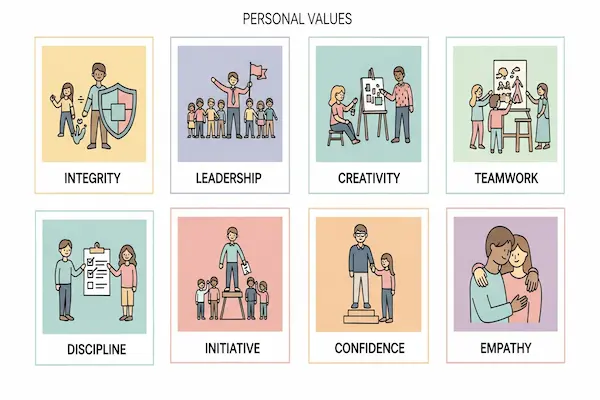
Career values and job satisfaction: the hidden connection
Job satisfaction is often treated like a mood, yet it behaves more like an alignment score between your environment and your values.
Energy tends to drop when a role forces you to betray a core priority repeatedly, because your nervous system reads that compromise as a constant low-grade threat.
Fulfillment tends to rise when your values are expressed daily through your work, because meaning is built from repeated moments of “this matters” rather than from rare big wins.
Purpose at work becomes clearer when values are clear, because purpose is not a single mission statement and is more like a pattern of meaningful contributions you want to keep making.
Confidence can look like competence from the outside, yet internally it often comes from being able to say, “I know what I stand for, and I know what I am building.”
Misalignment can show up even in a “good” job, because compensation and prestige do not automatically translate into values fit.
- Autonomy misalignment often shows up as frustration with micromanagement, because your value is self-direction and your environment is control-heavy.
- Growth misalignment often shows up as boredom, because your value is learning and your role repeats the same problems without increasing complexity.
- Impact misalignment often shows up as cynicism, because your value is contribution and your work feels disconnected from outcomes.
- Fairness misalignment often shows up as resentment, because your value is equity and your workplace rewards feel unpredictable or biased.
- Stability misalignment often shows up as chronic anxiety, because your value is security and your environment is constantly shifting without clear communication.
Signs you are misaligned and why guessing rarely fixes it
Confusion is common when you are misaligned, because your mind tries to solve the discomfort by changing surface details instead of addressing deeper priorities.
Overthinking becomes a coping mechanism when values are unclear, because analysis feels like progress while you avoid making a real choice.
Changing jobs without clarity can repeat the same pain in a new setting, because you may carry the same unspoken priorities into the next role and hope it magically fits.
Burnout can be partly a workload problem, yet it is often also a meaning problem, because effort feels heavier when it serves goals that do not match your values.
Career indecision gets louder when you have many options, because each option carries a different values profile and your brain cannot choose without a clear filter.
- Notice recurring irritations, because repeated triggers are usually pointing to a violated value rather than to a one-off annoyance.
- Pay attention to envy, because envy often reveals a value you want more of, such as autonomy, recognition, creativity, or stability.
- Track what you defend in conversations, because the things you protect tend to reflect what matters most to you.
- Observe what drains you even when you perform well, because competence without alignment can still feel empty.
- Watch what energizes you even when it is hard, because values-linked effort often feels meaningful rather than depleting.
Professional values exercise: the guided step-by-step process
Structure matters because values become useful only when they are specific enough to guide real decisions, especially when trade-offs are painful and ambiguity is high.
Time pressure is not required for this exercise, yet a focused session tends to reveal patterns faster because you stop negotiating with yourself and start writing what is true.
Honesty is the only rule that matters, because the purpose is not to choose “good” values and is to choose your values.
Step 1: Collect real data from your life, not idealized statements
Memory is selective, so the best starting point is to use concrete experiences as evidence, because experiences reveal what you actually respond to rather than what you think you should want.
- Write three work moments when you felt proud, because pride usually signals a value being expressed through your actions.
- Write three work moments when you felt angry or dismissed, because anger often signals a value being violated or ignored.
- Write three moments when time flew by, because flow often signals a combination of strengths and values working together.
- Write three moments when you wanted to quit, because that intensity usually points to a core priority being consistently blocked.
- Underline what mattered in each story, because repeated themes become clues for your career values.
- Keep each story short, because the goal is pattern recognition rather than perfect journaling.
- Focus on what you needed in that moment, because values are often needs expressed as principles.
- Include non-work examples if helpful, because values are human and often show up across relationships, health, and learning.
Step 2: Use a values list to name what you felt
Language creates clarity, so a values vocabulary helps you move from emotion to meaning, because “I hated it” becomes “I hated it because it violated fairness and respect.”
Pick words that feel slightly uncomfortable in their honesty, because the “polite” version of a value is often too vague to guide priorities.
- Autonomy.
- Stability.
- Growth.
- Mastery.
- Creativity.
- Impact.
- Service.
- Recognition.
- Fairness.
- Integrity.
- Transparency.
- Collaboration.
- Belonging.
- Challenge.
- Balance.
- Health.
- Curiosity.
- Excellence.
- Learning.
- Leadership.
- Responsibility.
- Security.
- Adventure.
- Craft.
- Influence.
- Compassion.
- Order.
- Simplicity.
- Innovation.
- Community.
Choose any words that match your stories, because you are building a shortlist rather than committing to a final ranking yet.
Add your own words if none fit, because personal truth beats perfect terminology every time.
Step 3: Narrow to your top 10 career values using forced choices
Forced choice is uncomfortable, yet it is the point, because values only become decision tools when you can rank what matters most when everything cannot be prioritized equally.
- Circle 15 values that feel important right now, because starting wide prevents premature narrowing and missed insight.
- Cross out 5 values you like but can live without in the next 12 months, because real priorities must survive trade-offs.
- From the remaining 10, highlight the 5 that feel essential, because your core values should feel non-negotiable in daily work conditions.
- Write a one-sentence reason for each top value, because the reason becomes the bridge between the word and the behavior.
- Notice the values you hesitate to remove, because hesitation often reveals hidden priorities that you have been minimizing.
- Watch for values that are actually strategies, because “success” is not a value and may hide values like recognition, mastery, or security.
- Separate means from ends, because a big salary might be a means for stability, autonomy, or care for family rather than the end itself.
Step 4: Score your values to reveal your real ranking
Scoring reduces bias, because your mind can romanticize certain values while your daily behavior shows a different hierarchy.
Use a simple scoring sheet so you can repeat the exercise later, because values can evolve as your life circumstances and responsibilities change.
Rate each of your top 10 values from 1 to 5 in the categories below, because each category captures a different angle of job satisfaction and decision making.
| Value | Importance (1–5) | Currently Met (1–5) | Cost When Violated (1–5) | Energy When Expressed (1–5) | Total |
|---|---|---|---|---|---|
| Value #1 | |||||
| Value #2 | |||||
| Value #3 | |||||
| Value #4 | |||||
| Value #5 | |||||
| Value #6 | |||||
| Value #7 | |||||
| Value #8 | |||||
| Value #9 | |||||
| Value #10 |
Calculate the total score for each value, because the highest totals typically reveal your true priorities when you account for both importance and emotional cost.
Review “currently met” scores carefully, because low scores here often explain why you feel restless, disengaged, or emotionally exhausted.
- Importance measures what you want to protect, because it represents your core preference rather than your current reality.
- Currently met measures alignment, because it shows how much your job supports your values right now.
- Cost when violated measures your stress trigger, because certain values produce a disproportionate emotional impact when ignored.
- Energy when expressed measures sustainability, because values that energize you are easier to express consistently over time.
Step 5: Translate each top value into observable behaviors
Words are too flexible to guide action, so behavior definitions make values practical, because they tell you what to seek and what to avoid in a role.
Write each definition in first person, because values become stronger when you can say them out loud as decision criteria rather than as vague ideals.
- Pick your #1 value and complete the sentence, “I feel aligned when I regularly…” because frequency matters more than rare moments.
- Complete the sentence, “I feel misaligned when I often…” because patterns reveal what you should screen out in future roles.
- Define the “minimum viable version” of the value, because perfection makes you rigid while minimums keep you realistic.
- Define the “ideal version” of the value, because ideals help you recognize great-fit opportunities when they appear.
- Autonomy behavior example: I plan my approach, control my calendar blocks, and am trusted to deliver outcomes without constant oversight.
- Growth behavior example: I face new problems, receive feedback, and can see my responsibilities expand in complexity every quarter.
- Fairness behavior example: decisions are explained, expectations are consistent, and rewards feel connected to clear contributions rather than politics.
- Impact behavior example: I can connect my work to outcomes, and I receive feedback that shows how my work changed results or improved lives.
Step 6: Convert values into decision criteria you can actually use
Decision criteria are the final output, because they turn reflection into a tool you can apply to job offers, promotions, projects, and even daily boundaries.
Criteria work best when phrased as questions, because questions force clarity and reduce the temptation to rationalize misfit choices.
- Write three “must-have” criteria based on your top values, because must-haves protect your non-negotiables and prevent repeated misalignment.
- Write three “nice-to-have” criteria based on mid-ranked values, because flexibility here lets you accept trade-offs without betraying yourself.
- Write three “red flag” criteria based on high-cost violations, because red flags are where job satisfaction collapses fastest.
- Choose one “trade-off I will accept,” because naming an acceptable compromise prevents guilt and reduces decision fatigue.
- Must-have example: Will I have at least two uninterrupted focus blocks weekly to do deep work, or will constant meetings erase my autonomy and craft?
- Must-have example: Is feedback regular and specific, or will growth be accidental and dependent on guessing what matters?
- Red flag example: Are decisions explained transparently, or does information get withheld in ways that violate my need for trust and fairness?
- Trade-off example: I will accept slower promotion speed if I can protect health and balance, because sustainable energy is a core priority right now.
Professional values exercise: the quick 20-minute version for busy weeks
Busy periods should not erase self-alignment, because small check-ins can prevent months of drift and help you adjust before frustration becomes burnout.
Use this shorter version when you feel off-track, because it helps you identify what matters without requiring a full scoring session.
- Write one sentence describing what feels wrong, because naming the problem reduces emotional fog and creates direction.
- Choose one value that is likely being violated, because a single value can explain a surprising amount of recurring stress.
- Write one boundary or request that would honor that value, because action is what turns insight into job satisfaction.
- Schedule one conversation or one calendar change to test the fix, because alignment improves when you treat your work life as adjustable.
- When autonomy is missing, a test might be blocking two hours on your calendar and protecting it like a meeting with a client.
- If recognition is missing, a test might be documenting outcomes weekly and sharing them in a concise status update.
- Where learning is missing, a test might be requesting one stretch assignment and defining success criteria upfront.
Decision making with values: a simple filter for choices
Choices become less stressful when you stop asking, “Which option is best?” and start asking, “Which option best matches my values and priorities right now?”
Trade-offs are unavoidable, yet they feel cleaner when values are explicit, because you can choose intentionally instead of feeling like life is happening to you.
Use a consistent filter for career decisions, because repeating the same decision-making process builds self-trust and reduces regret.
The Values Fit Score (0–10) for any opportunity
Scoring is not about perfection, because the goal is to compare options fairly and to notice when excitement is hiding misalignment.
- Rate how well the opportunity supports your top three values from 0 to 3 each, because these values create the foundation of job satisfaction.
- Add 1 point if the opportunity strengthens a priority skill, because skill growth can compensate for a minor value gap in the short term.
- Add 1 point if the opportunity improves your life constraints, because alignment includes your health, finances, and family responsibilities.
- Subtract 2 points for any red flag, because red flags usually cost more than you think once you are living with them daily.
- A score of 8–10 usually signals strong fit, because it supports core values while staying realistic about trade-offs.
- A score of 5–7 can be acceptable with clear mitigation, because you can sometimes redesign the role or set boundaries to protect what matters.
- Anything below 5 is a caution signal, because persistent misalignment often shows up as chronic stress, disengagement, or constant second-guessing.
Decision criteria questions for job satisfaction and priorities
Questions work better than affirmations, because questions force you to gather evidence instead of relying on hope or fear.
- Which daily tasks will dominate my week, and do those tasks express my top values or violate them repeatedly?
- What will I be rewarded for here, and does that reward system match what I want to be known for?
- How are decisions made, and does that process align with my need for transparency, fairness, or autonomy?
- What happens when I say no, and does the culture respect boundaries or punish them?
- Where does growth come from, and will learning be supported by feedback, mentorship, and clear expectations?
Examples: turning career values into real choices
Examples make values feel real, because they show how the same “good” opportunity can be right for one person and wrong for another depending on priorities.
Context matters because values are not universal instructions, and your current life season may elevate certain priorities above others without that being “wrong.”
Example 1: Autonomy versus stability
A fast-growing startup may offer autonomy through wide ownership, yet it may reduce stability through rapid change, unclear processes, and shifting priorities.
A mature organization may offer stability through predictable expectations, yet it may reduce autonomy through layered approvals and slower decision cycles.
- When autonomy is a top value, a good choice might include negotiating clear ownership, decision rights, and fewer approvals before accepting.
- If stability is a top value, a better choice might include prioritizing roles with clear expectations, consistent leadership, and predictable workload rhythms.
- When both values matter, a hybrid strategy might include choosing stability for income while building autonomy through side projects or internal initiatives.
Example 2: Impact versus balance
A high-impact role can feel meaningful, yet it can also consume evenings and weekends if the organization relies on urgency and constant availability.
Balance can protect health and relationships, yet it can feel empty if you crave contribution and cannot see how your work matters.
- Define “impact” as measurable outcomes rather than as emotional intensity, because high drama is not the same as high contribution.
- Define “balance” as a schedule you can repeat, because occasional overtime is different from a culture of chronic overwork.
- Choose a role where impact is built into normal hours when possible, because sustainable impact is the version most people actually enjoy long term.
Example 3: Recognition versus mastery
Recognition values show up when you want your contributions seen and appreciated, while mastery values show up when you want deep competence and craft development.
Both can coexist, yet tension appears when you only get praise for quick wins while the work you care about most requires quiet depth and time.
- If recognition is top-tier, build a plan to document outcomes, share updates, and seek roles where visibility is part of the job rather than a side activity.
- When mastery dominates, prioritize environments with mentorship, time for deep work, and quality standards that reward craft.
- Where both matter, choose proof formats that show mastery publicly, such as clear write-ups, presentations, training, or published internal documentation.
Common mistakes in a professional values exercise and how to avoid them
Mistakes are normal because values work feels personal, and the mind often tries to keep you safe by choosing socially approved answers instead of honest ones.
Accuracy improves when you treat this like a practical tool, because the goal is better decision making and not a perfect self-description.
- Picking values that sound impressive instead of true, because “leadership” might be a value or might be a strategy to earn recognition and security.
- Choosing too many top values, because a list of ten “core” values becomes useless when trade-offs appear.
- Defining values as vague ideals, because “integrity” without behavior does not help you screen a job or set a boundary.
- Ignoring constraints, because values must work inside your real life and not in an imaginary schedule with unlimited energy.
- Forgetting to revisit values, because priorities can shift after life changes, new responsibilities, or major career experiences.
- Force trade-offs by ranking values, because ranking creates clarity when everything feels important.
- Write behavior definitions, because behavior turns words into observable evidence.
- Use scoring, because scoring reveals what matters when you account for emotional cost and energy, not just intellectual preference.
- Test values in real decisions, because a value that never changes a choice is not yet a useful decision criterion.
Worksheet prompts you can copy and reuse
Prompts are helpful when you feel emotionally foggy, because they offer a gentle structure that keeps you moving toward clarity.
Use these prompts weekly or monthly, because small reflection loops often produce better alignment than rare deep dives.
PROFESSIONAL VALUES WORKSHEET PROMPTS

1) Misalignment signal:
- The moment this week that bothered me most was:
- The value that might have been violated was:
- The boundary or request that would honor it is:

2) Alignment signal:
- The moment this week that energized me most was:
- The value that was expressed was:
- The condition that made it possible was:

3) Priorities check:
- The three values I want my next quarter to reflect are:
- The one value I will protect even under pressure is:
- The trade-off I will accept temporarily is:

4) Decision criteria draft:
- My must-have criteria for roles or projects are:
- My red flags are:
- The evidence I will look for before saying yes is:- Answer briefly, because short and honest beats long and polished every time.
- Review answers for patterns, because patterns reveal values more reliably than one emotional week.
- Turn insights into one action, because action is where alignment becomes real and job satisfaction improves.
How to keep your career values alive over time
Values clarity can fade when life gets busy, because urgency crowds out reflection and you start reacting instead of choosing.
Maintenance is simple when it is scheduled, because a small recurring check-in prevents big painful course corrections later.
- Review your top five values every quarter, because quarterly rhythm is frequent enough to catch drift without becoming obsessive.
- Update your scoring sheet after major events, because promotions, layoffs, health changes, and family changes can reorder priorities.
- Choose one value to emphasize each month, because emphasis creates behavior change faster than trying to improve everything at once.
- Practice one boundary that protects a top value, because boundaries are where values stop being ideas and start being lived.
- Collect evidence of alignment, because documenting what works helps you recreate it intentionally in future roles and projects.
- Alignment improves when you share your values with trusted people, because naming them out loud makes them harder to ignore.
- Job satisfaction tends to increase when you negotiate small changes, because you often need fewer changes than you think once the right value is protected.
- Decision making becomes calmer when you accept trade-offs consciously, because conscious trade-offs create less regret than accidental compromises.
Final note and independence disclaimer
Feeling misaligned does not mean you are broken, because it often means your values are asking for attention and your career is ready for a more intentional direction.
Progress becomes easier when you know what matters, because priorities become clearer, options become easier to compare, and your purpose at work becomes something you can actively build.
Notice: This content is independent and has no affiliation, sponsorship, or control over any institutions, platforms, or third parties mentioned.