
If networking makes you cringe, you are not “bad at careers,” you are usually reacting to the pushy, transactional version that feels like pretending.
This networking plan for careers gives you an ethical, consistent system with a weekly routine, message templates, outreach goals, and a simple tracking setup.
Networking plan for careers: what ethical networking actually is
Ethical networking is relationship building that creates mutual clarity and mutual benefit over time, without pressure, manipulation, or pretending you care just to get something.
Healthy networking feels human because it is built on curiosity, usefulness, and follow-through, which means you can show up as yourself and still build real opportunities.
Consistent networking works because trust compounds, so small respectful touches done weekly often beat one intense burst of outreach followed by months of silence.
Professional opportunities frequently move through people long before they move through job postings, so a calm networking strategy increases your access to real role information and real decision-makers.
Practical networking is not about collecting contacts, because the real asset is being remembered for clarity, reliability, and value that is easy for others to describe.
- Ethical networking avoids guilt-based tactics, because nobody should feel cornered into responding, referring, or “helping” to prove they are nice.
- Respectful outreach makes a clear ask, because vague messages create extra work for the other person and reduce the chance of a helpful reply.
- Relationship building is long-term, because the goal is not a quick win and is a stable professional ecosystem you can rely on.
- Networking can be quiet, because you can build strong relationships through thoughtful messages, good questions, and consistent follow-through.
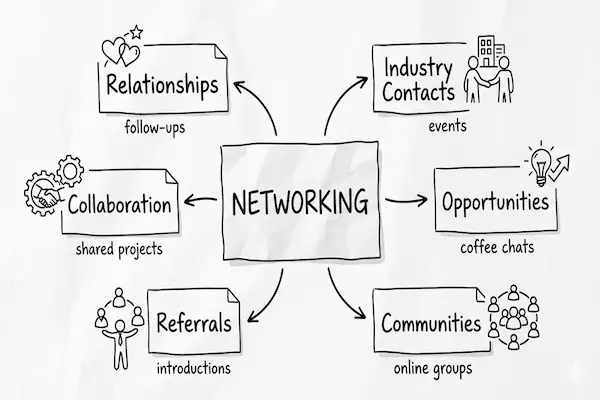
Why a consistent networking strategy beats “salesy” networking
Salesy networking fails because it treats people like vending machines, which triggers defensiveness and makes you feel like you are performing a personality you do not have.
Consistent networking succeeds because it reduces pressure, since each interaction is small and honest and you are not trying to force a single message to carry your entire career future.
Trust builds faster when you show respect for time, because short thoughtful messages are easier to respond to than long emotional essays that demand energy from someone you barely know.
Confidence rises when your plan includes structure, because you can follow steps even when you feel awkward, which removes the need to rely on charisma or spontaneous social energy.
Opportunities increase when you become easier to help, because clarity about your direction and your strengths makes it simple for others to introduce you or share relevant openings.
- A calm weekly routine prevents procrastination, because you stop waiting for the “right mood” and start following a repeatable process.
- Clear outreach goals prevent overreach, because you can aim for small consistent actions rather than unrealistic numbers that burn you out.
- A tracking system reduces anxiety, because you stop wondering whether you are doing enough and start seeing your effort and outcomes in one place.
- Ethics protects reputation, because respectful networking creates goodwill that you carry across teams, companies, and years.
Networking plan for careers: the three principles that keep it human
These principles keep your networking plan sustainable, because they make the process feel like professional relationship building rather than like self-promotion theater.
Principle 1: clarity is a gift
Clarity helps people help you, because it reduces the mental effort required to understand what you want and what you are good at.
- Clarity includes your direction, because “I’m exploring product operations roles” is easier to respond to than “I’m open to anything.”
- Clarity includes your strengths, because “I improve messy workflows and stakeholder alignment” gives others a handle for remembering you.
- Clarity includes your ask, because “Could I ask you three questions about the day-to-day work” is simpler than “Any advice.”
- Clarity includes your boundaries, because “No rush, even a ‘not a good time’ is helpful” reduces pressure and increases trust.
Principle 2: usefulness beats impressiveness
Usefulness builds relationships because it signals respect and competence, while trying to impress often signals insecurity and creates distance.
- Usefulness can be small, because sharing one insight, resource idea, or thoughtful question can be more valuable than a long message.
- Usefulness is contextual, because what helps a recruiter differs from what helps a hiring manager or a peer in the same role.
- Usefulness includes follow-through, because doing what you said you would do is one of the strongest trust signals in any professional environment.
- Usefulness avoids overpromising, because honest expectations protect your reputation and reduce stress for both sides.
Principle 3: reciprocity without keeping score
Reciprocity works when it is offered freely, because relationships strengthen when help is mutual and not transactional.
- Reciprocity can be immediate, because you can offer a concise summary, a thank-you, or a useful connection without waiting months.
- Reciprocity can be delayed, because you can help later when you have something relevant, which makes networking feel natural rather than forced.
- Reciprocity includes respect, because honoring someone’s time and boundaries is a meaningful form of giving.
- Reciprocity avoids pressure, because you can offer value without implying that the other person “owes” you a referral or a response.
The weekly routine: a networking plan for careers you can actually follow
This weekly routine is designed for consistency, because it fits into real life and does not require you to become a different person.
Time-boxing keeps it sustainable, because you can get meaningful relationship building done in short focused blocks instead of waiting for a perfect open weekend.
A simple rhythm also reduces awkwardness, because repetition turns networking into a normal professional habit rather than an emotional event.
Weekly routine overview
- Block 1: outreach and follow-ups, because messages are the highest-leverage action in most networking systems.
- Block 2: relationship maintenance, because staying warm with existing connections is often easier than building everything from scratch.
- Block 3: evidence and positioning, because your networking works better when your direction and proof are clear.
- Block 4: tracking and reflection, because small review loops help you improve without turning it into pressure.
Weekly routine in 45–60 minutes total
- Spend 15 minutes sending 2–3 outreach messages, because small volume with high quality keeps the process human and sustainable.
- Spend 10 minutes following up with 1–2 people from previous weeks, because follow-up is where most real conversations actually happen.
- Spend 10 minutes doing one “give” action, because generosity keeps the system ethical and strengthens your reputation over time.
- Spend 10 minutes improving your clarity asset, because a sharper one-sentence direction makes every future conversation easier.
- Spend 5–10 minutes updating your tracker, because seeing your activity and outcomes reduces anxiety and prevents duplication.
Weekly routine in 15 minutes for busy weeks
- Send one thoughtful message to a warm connection, because consistency matters more than intensity when life is full.
- Send one short follow-up, because polite persistence often creates replies that a single message never would.
- Log your actions in two lines, because even minimal tracking prevents your networking plan from fading.
Outreach goals: realistic targets that build opportunities without burnout
Outreach goals should be small enough to sustain, because a networking plan that collapses after two weeks creates more stress than no plan at all.
Quality matters more than quantity, because thoughtful relevance produces better conversations than high-volume messaging that feels generic.
Your best goal is usually consistency, because networking rewards repetition and follow-through more than occasional heroic effort.
Simple outreach goals by comfort level
- Low energy season: 2 new messages per week, 1 follow-up per week, and 1 relationship maintenance touchpoint per week.
- Moderate energy season: 4–6 new messages per week, 2–3 follow-ups per week, and 2 maintenance touchpoints per week.
- Active job search season: 8–12 new messages per week, 4–6 follow-ups per week, and 3 maintenance touchpoints per week.
What counts as a meaningful networking touchpoint
- A message that asks a clear question and respects time, because clarity reduces friction for the other person.
- A thank-you with a concrete takeaway, because it signals that you listened and that their time mattered.
- A helpful introduction with context, because introductions are valuable when they are thoughtful rather than random.
- A short update that closes the loop, because follow-through is one of the easiest ways to stand out positively.
Relationship building map: who to contact first, second, and third
Most networking anxiety disappears when you stop guessing who to contact, because a clear map turns vague discomfort into a simple next action.
Starting warm is usually easiest, because warm connections reduce the social friction that makes outreach feel “salesy.”
Then you expand outward gradually, because gradual expansion keeps your plan ethical and emotionally sustainable.
Tier 1: warm connections you already have
- Former coworkers and managers, because shared context makes your message easier to trust and easier to answer.
- Current colleagues in other teams, because internal relationships can reveal opportunities and role reality quickly.
- Friends in adjacent industries, because adjacency often produces the best pivot paths without requiring you to start over.
- Alumni or community connections, because shared affiliation creates a natural reason for contact without pressure.
Tier 2: lukewarm connections with a light bridge
- Second-degree connections where you share a domain or role interest, because relevance increases response rates without needing a deep relationship.
- People who posted something you can respond to thoughtfully, because responding to real content reduces the “cold” feeling.
- Peers in similar transitions, because shared goals can create mutual support rather than one-sided asking.
- Cross-functional partners you have interacted with lightly, because they already have some evidence of how you work.
Tier 3: cold contacts you approach respectfully
- Professionals doing your target role, because role reality conversations reduce risk before you commit to a move.
- Team leads and managers in your target area, because they can clarify what “good” looks like and what skills matter most.
- Recruiters for your niche, because they can share how candidates are evaluated and what evidence stands out.
- Subject-matter experts you genuinely want to learn from, because curiosity-led outreach feels human and respectful.
LinkedIn outreach: message templates that do not feel gimmicky
LinkedIn outreach works best when it is short and specific, because people scan quickly and decide whether replying will be easy or exhausting.
Templates reduce stress, because you can focus on choosing the right person and the right ask instead of reinventing language every time.
Personalization should be small and real, because one honest sentence about why you chose them beats a paragraph of generic compliments.
Template 1: role-reality question for career exploration
Hi [Name],

I’m exploring [role theme] and I’m trying to understand the real day-to-day work before I make any big moves.

Would you be open to a quick 15-minute chat where I ask 3–4 questions about what the role is actually like at your level.

No worries at all if now isn’t a good time.
Template 2: warm reconnection without asking for anything big
Hi [Name],

I was thinking about our time at [shared context] and wanted to say I appreciated how you handled [specific thing you respected].

I’m currently focusing on [direction in one sentence] and I’m doing it steadily, not urgently.

If you’re ever up for a short catch-up, I’d enjoy hearing what you’re working on lately.
Template 3: asking for targeted insight, not “any advice”
Hi [Name],

I’m building skills toward [role/theme], and I’m trying to choose the most important next step.

If you had to pick one skill that separates “okay” from “strong” in this work, what would you choose, and what proof would you look for.

If it’s easier, a short reply here is perfect.
Template 4: referral-style ask that stays ethical
Hi [Name],

I saw an opening for [role] and it looks aligned with my background in [relevant strengths].

If you’re comfortable, could you tell me whether this team’s environment is a good one for [what you care about], and whether a referral is appropriate.

If it’s not a fit or you’d rather not, I completely understand and appreciate any quick guidance.
Template 5: follow-up that is polite and low-pressure
Hi [Name],

Quick follow-up in case my note got buried.

If now isn’t a good time, no worries at all, and I appreciate you seeing it.

Either way, wishing you a smooth week.
Interview-adjacent networking: questions that reveal culture and scope
Networking becomes safer when it focuses on learning, because you reduce the pressure to “sell” yourself and instead gather evidence about fit and risk.
Culture and scope questions are especially useful, because toxic environments and unclear expectations are common reasons people regret a move.
Good questions focus on concrete examples, because examples reveal reality better than slogans.
Questions that reveal team environment
- “What does a normal week look like when things are going well, and what changes when the team is under stress.”
- “How are priorities decided when multiple stakeholders want everything, and how do trade-offs get communicated.”
- “What happens after a mistake, and what is the most common failure mode for new people.”
- “How does feedback work here, and how often do people get clear signals about performance.”
Questions that reveal role scope and growth
- “What outputs matter most in this role at the first 90 days, and what outputs matter most after a year.”
- “Which skills make someone effective quickly, and which skills take longer but create the biggest leverage.”
- “What does ‘senior’ look like here in behaviors, not just in tenure.”
- “If you were starting again, what would you build as proof in the first three months.”
Referrals without awkwardness: how to ask in a way that preserves trust
Referral asks feel awkward when they are too early or too vague, because the other person fears risking their reputation without enough information.
Trust increases when you first build clarity, because people refer candidates who make them feel confident and safe.
Ethical referral requests give an easy exit, because respect is not only about what you ask and is also about how you allow “no” without punishment.
Referral ask structure that stays respectful
- Confirm relevance, because the other person needs to see a clear match between your strengths and the role.
- Offer proof, because a short evidence snapshot reduces their perceived risk.
- Make the ask specific, because “Would you refer me” is heavier than “Would you be comfortable pointing me to the right recruiter.”
- Give a graceful exit, because pressure damages relationships and reputation.
- Close the loop later, because follow-through is what makes future referrals more likely.
Proof snapshot you can paste into a referral message
Quick proof snapshot (optional):

- Strength 1: [evidence in one line]
- Strength 2: [evidence in one line]
- Strength 3: [evidence in one line]
- Why this role fits: [one line connecting to the job’s core output]
Tracking system: the simplest way to stay consistent and avoid spammy behavior
Tracking prevents accidental ghosting, because you can see who you contacted, what you asked, and what you promised to do next.
A tracking system also keeps your outreach ethical, because it discourages random mass messaging and encourages thoughtful follow-up instead.
Simplicity matters more than sophistication, because a tracker you use beats a tracker you admire.
Networking tracker table you can copy
| Name | Where you know them from | Tier | Purpose | Last contact date | Next step | Status | Notes |
|---|---|---|---|---|---|---|---|
| [Name] | [Context] | 1 / 2 / 3 | [Role reality / Referral / Catch-up] | [Date] | [Follow-up / Call / Send artifact] | [Waiting / Scheduled / Done] | [Key insight / Next idea] |
| [Name] | [Context] | 1 / 2 / 3 | [Role reality / Referral / Catch-up] | [Date] | [Follow-up / Call / Send artifact] | [Waiting / Scheduled / Done] | [Key insight / Next idea] |
Statuses that keep the system calm
- Waiting: you sent a message and you will follow up once, because polite persistence is fine and repeated nudging is not.
- Scheduled: a conversation is on the calendar, because scheduled conversations reduce uncertainty and reduce mental load.
- Done: you completed the interaction and you recorded the insight, because insights are the main value of networking beyond immediate opportunities.
- Parked: timing is not right, because you can pause without guilt and return later respectfully.
Documentation tips: how to turn conversations into opportunities ethically
Notes are career leverage because they turn informal chats into structured learning, which helps you make better decisions and communicate your direction more clearly.
A short notes template keeps it practical, because you want consistent capture without writing a novel after every call.
Closing the loop builds trust, because it shows you listened and it turns networking into a real relationship rather than a one-time extraction.
Conversation notes template
NETWORKING CONVERSATION NOTES

Person:
Role / team:
Date:

1) What I learned about the day-to-day work:
-
-

2) Skills that matter most in this role:
-
-

3) Proof or artifacts that stand out:
-
-

4) Culture and workload signals:
-
-

5) Next action I will take:
-

6) Follow-up I owe them:
- Thank-you message by:
- Resource / intro (if appropriate):
- Update later (date):
Weekly “give” actions: relationship building that feels natural
Giving keeps networking ethical, because it signals that you value the other person beyond what they can do for you in this moment.
Giving also makes you memorable, because people remember professionals who make their lives easier in small respectful ways.
Simple is enough here, because you are building consistency and not performing generosity theater.
Easy give actions you can do in under 10 minutes
- Send a concise thank-you with a specific takeaway, because specificity shows you listened and it reinforces trust.
- Share a relevant job-reality insight with a peer also exploring, because mutual support makes networking feel less lonely.
- Offer a short introduction when it is clearly relevant, because thoughtful introductions can create real opportunities for both sides.
- Share a practical template you created, because reusable tools are valuable and feel sincere when they match the conversation.
- Amplify someone’s work with a meaningful comment, because thoughtful recognition can strengthen relationships without asking for anything.
Pitfalls to avoid: how networking gets “salesy” by accident
Most people do not intend to be salesy, yet they become salesy when anxiety drives urgency and urgency drives pressure.
These pitfalls are preventable when you follow a process, because structure reduces emotional improvisation.
Common pitfalls
- Asking for too much too soon, because big asks require trust and context that you have not yet built.
- Sending long messages, because long messages create work for the other person and often get postponed indefinitely.
- Being vague about your direction, because vagueness forces the other person to do the thinking you should do.
- Following up repeatedly, because persistence is fine while pressure damages relationships and reputation.
- Only contacting people when you need something, because one-way relationships feel transactional even when your intentions are good.
Practical fixes that keep it human
- Reduce the ask to a 15-minute role-reality chat, because small asks are easier to say yes to without stress.
- Write messages that can be answered in under a minute, because ease increases replies and reduces resentment.
- Offer an easy “no,” because the absence of pressure is one of the strongest trust signals you can send.
- Use your tracker to time follow-ups, because systems prevent you from acting on insecurity.
- Balance asks with gives, because reciprocity keeps your networking strategy ethical and sustainable.
Worked example: a 30-day networking plan for careers
This 30-day plan is designed for professionals who dislike salesy networking, because it prioritizes learning, clarity, and small consistent actions.
Week 1: set up your system and send warm messages
- Write your one-sentence direction, because clarity makes everything else easier.
- List 15 warm connections, because warm outreach is the lowest-friction start.
- Send 3 reconnection messages, because small starts reduce avoidance.
- Start your tracker, because tracking prevents chaos and ghosting.
Week 2: run role-reality conversations and tighten your story
- Schedule 1–2 short conversations, because real role reality reduces uncertainty faster than reading descriptions.
- Ask consistent questions, because comparable answers reveal patterns.
- Write one proof snapshot, because proof makes future referral asks safer for others.
- Send thank-you follow-ups, because follow-through turns a chat into a relationship.
Week 3: expand to lukewarm contacts and ask for targeted insight
- Send 3 messages to Tier 2 contacts, because relevance plus a light bridge often produces replies.
- Ask one targeted question per message, because single-question messages feel respectful and easy.
- Do one give action, because generosity keeps the system human.
- Log insights and update your next steps, because learning should change what you do next.
Week 4: test a referral-style ask where appropriate
- Choose one role or team you genuinely fit, because referral asks should be grounded in relevance.
- Ask for team reality first if needed, because evidence of fit includes culture and workload, not only skill match.
- Offer your proof snapshot, because it reduces risk for the person considering referring you.
- Close the loop later with an update, because updates build long-term trust even if nothing immediate happens.
Refinement checklist: make your networking plan ethical and consistent
This checklist helps you keep your plan simple, because simplicity is what makes consistency possible without burnout.
Weekly checklist
- I sent 2–3 relevant messages, because small volume keeps quality high and anxiety low.
- I followed up once where appropriate, because polite persistence is different from pressure.
- I offered one give action, because reciprocity keeps relationships healthy.
- I updated my tracker, because tracking reduces stress and prevents duplication.
- I improved one clarity asset, because clarity makes every future interaction easier.
Monthly checklist
- I reviewed which messages got replies, because patterns show you what works without guessing.
- I updated my direction sentence if needed, because your plan should evolve as you learn.
- I strengthened my proof snapshot, because evidence builds credibility and reduces awkwardness.
- I checked my energy and boundaries, because sustainable networking should support your life rather than consume it.
Final note and independence disclaimer
This networking plan for careers is designed to help you build relationships ethically and consistently, and it does not depend on gimmicks, pressure, or pretending to be someone you are not.
Notice: This content is independent and has no affiliation, sponsorship, or control over any institutions, platforms, or third parties mentioned.