
Salary negotiation feels stressful when the rules are unclear.
That uncertainty is what turns a good offer into anxiety.
This guide helps you negotiate salary with confidence by replacing guesswork with structure.
You will build a simple range, price the full offer, and ask for changes with a calm tone.
You will also see realistic counteroffer scenarios, including what a “win” often looks like in practice.
Reality check: employers budget for total compensation, not only wages.
In the BLS Employer Costs for Employee Compensation (ECEC) release for September 2025, private industry employers averaged $32.37 per hour in wages and $13.68 per hour in benefits.
That means benefits can represent roughly 30% of employer compensation cost in that period.
Source: BLS ECEC (Employer Costs for Employee Compensation).
Why Negotiation Feels Risky (Even When You Are a Strong Candidate)
Negotiation triggers emotion because it mixes money, identity, and power dynamics.
Technical interviews rarely feel personal.
Compensation conversations often do.
Confidence does not come from “being bold.”
Confidence comes from reducing unknowns before the conversation starts.
Common reasons people avoid asking
- They do not know a credible market range for the role.
- They do not understand which parts of the offer are negotiable.
- They fear sounding difficult or ungrateful.
- They worry the offer will disappear if they ask.
In many companies, a respectful negotiation is expected unless the employer explicitly says the offer is nonnegotiable.
Source: Harvard Program on Negotiation (job offer negotiation guidance).
When to Negotiate (Timing That Protects Goodwill)
The cleanest timing is after you receive a written offer.
At that point, the employer has chosen you and the details exist.
Negotiating too early often creates friction because nothing is defined yet.
Best windows
- After the written offer is sent.
- After scope changes are confirmed (internal move or promotion discussion).
- After a major deliverable (when impact is visible and recent).
Risky windows
- Before the employer aligns on level and scope.
- During a hiring freeze or layoffs.
- During an artificial “respond today” pressure moment.
If the deadline is tight, ask for time to review first.
Time is not confrontation.
Time is professionalism.
The 3-Part Preparation That Makes You Sound Calm
Most negotiations fail in the prep stage.
People try to negotiate with vibes instead of inputs.
Use these three items as your “negotiation folder.”
Part 1) A credible wage range (percentiles, not a single number)
Percentile wages help you talk about ranges in a grounded way.
The 50th percentile is the median.
The 75th and 90th percentiles often align with higher scope, stronger experience, and higher responsibility.
Source: BLS: Percentile Wages (how percentiles work).
Part 2) Location and level context
The same title can pay differently across metro areas.
Scope matters even more than titles.
When your responsibilities match a higher level, your range should reflect that reality.
Part 3) A short impact summary (3 bullets)
Use outcomes, ownership, and complexity.
Avoid long stories.
Make it easy for a recruiter or hiring manager to repeat your logic internally.
Price the Whole Offer Before You Ask for More Money
Base salary is only one lever.
Total value comes from the full package.
Once you map the package, you can negotiate intelligently instead of randomly.
Total compensation worksheet (copy and fill)
| Component | What to capture | Offer A | Offer B |
|---|---|---|---|
| Base salary | Annual base | ||
| Bonus | Target %, payout terms, realistic probability | ||
| Equity | Type, vesting, refresh, liquidity reality | ||
| Health plan | Premium share, deductible, out-of-pocket max | ||
| Retirement | Match %, vesting, eligibility timing | ||
| PTO | Vacation, sick, holidays, carry rules | ||
| Remote / hybrid | Policy vs contractual terms, required office days | ||
| Professional growth | Learning budget, conference support, certs | ||
| One-time items | Sign-on, relocation, equipment stipend | ||
| Notes | What you will actually use |
After this step, many “I need a higher salary” feelings turn into a more precise ask.
Precision is what keeps the tone friendly.
Set Your Boundaries First (So You Don’t Negotiate Emotionally)
Write three numbers before any call.
Do not invent them live.
The three numbers
- Target: what you want to land near.
- Minimum: what you can accept without resentment.
- Walk-away: the point where declining is rational.
If you do not want to walk away, you still need a minimum.
Scripts That Sound Professional (Not Confrontational)
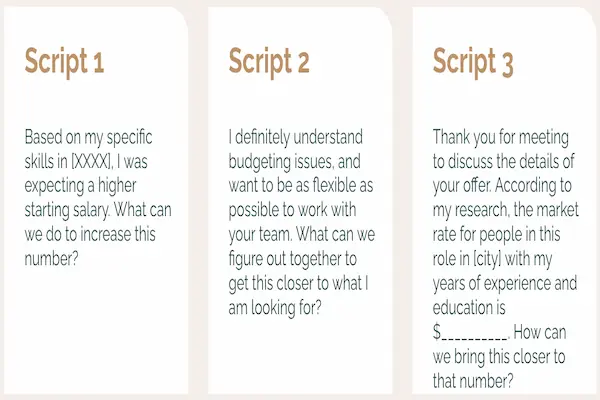
Scripts prevent awkward improvisation.
They also stop you from overexplaining personal finances.
1) Ask for review time
Thank you for the offer.
I’m excited about the role.
May I take 24–48 hours to review the full package and come back with questions?
2) Ask whether there is flexibility
I appreciate the offer and I’m enthusiastic about joining.
After reviewing the details, can we discuss whether there is flexibility in compensation?
I want the package to align with the scope and expectations of the role.
3) Reference market context using a range
Based on role scope and the typical range for this occupation in this area, I was expecting something closer to [range].
Is there room to move the base salary toward that range?
If base salary is constrained, could we explore alternatives like a sign-on bonus, PTO, or an earlier review?
4) When you hear “this is our best offer”
Thanks for clarifying.
What is constrained right now?
Which parts of the package are still flexible?
5) Close cleanly
I appreciate the transparency.
If you can confirm any updates in writing, I will review and respond by [date].
Three Realistic Counteroffer Scenarios (Including Outcomes)
These examples are illustrations of structure and tone.
They show how negotiations often resolve in the real world.
Scenario A: Entry-level offer with limited room
Offer: $70,000 base.
Ask: move toward $78,000 or add a sign-on.
Result: $73,000 base + $5,000 sign-on + 6-month review date confirmed in writing.
Scenario B: Mid-level offer with a band cap
Offer: $110,000 base + 10% bonus target.
Ask: $120,000–$125,000 range based on scope.
Employer constraint: band cap at $118,000.
Result: $118,000 base + $7,500 sign-on + 5 additional PTO days.
Scenario C: Senior offer where base is fixed
Offer: $160,000 base + equity.
Ask: improve long-term value instead of base.
Result: base unchanged + equity increased + remote terms confirmed + learning budget added.
The pattern stays consistent.
Start with a clear range.
Trade levers when base is constrained.
Document the final package.
What to Negotiate When Base Salary Is Locked
Some organizations protect internal equity with strict ranges.
That does not mean everything is fixed.
High-impact levers
- Sign-on bonus.
- Earlier performance review (and written criteria).
- Additional PTO days.
- Remote or hybrid terms confirmed in writing.
- Learning budget and certification reimbursement.
- Title alignment when scope is clearly higher.
- Relocation support or commuting stipend.
Ask for what you will actually use.
One strong lever is better than five weak ones.
Follow-Up Email (Copy and Send)
Subject: Offer follow-up and compensation alignment
Hi [Name].
Thank you again for the offer.
I’m excited about the role and confident I can contribute.
After reviewing the package, I wanted to ask if there is flexibility in [base / sign-on / PTO / review timeline].
If base salary is constrained, I’d love to explore alternatives that keep the overall package aligned with scope.
Thank you for considering this.
Best regards,
[Your Name]
Final Checklist
- I have a credible range (percentiles and location context).
- I mapped the full package, not only base pay.
- I wrote a target, minimum, and walk-away.
- I prepared a primary ask and two backup levers.
- I will confirm the final terms in writing.
This is how you negotiate salary with confidence without turning the conversation into conflict.