
“Most requested certifications” sounds simple, yet it only becomes useful when you define requested, define your field, and define the outcome you need.
This guide shows you a neutral, criteria-based way to identify relevant certifications by field, so you can build credibility without wasting time or money.
Most requested certifications: what “requested” really means in job markets
Employers “request” certifications in different ways, because some postings list them as required while others list them as preferred, and those two words create very different levels of urgency for your decision.
Job ads also bundle certifications into screening language, because recruiters often use credentials as a quick filter when many applicants look similar on paper.
Request frequency is not the same as value, because a credential can appear often due to compliance rules while offering limited differentiation for senior roles.
Role level matters immediately, because entry-level roles may request foundational certifications while senior roles may reward portfolio evidence and leadership outcomes more than badges.
Industry context changes the list, because healthcare, trades, IT, and corporate roles each have credential ecosystems shaped by regulation, vendor platforms, and hiring habits.
- A “most requested” certification is often a baseline signal, because it helps you pass screening rather than prove deep expertise.
- A “most valuable” certification can be different, because differentiation usually comes from proof, scope, and outcomes layered on top of the credential.
- A “most relevant” certification is the one that matches your target role outputs, because relevance is what converts study time into employability.
- A “most credible” certification is the one with clear standards, because credibility depends on exam rigor, maintenance rules, and market recognition.
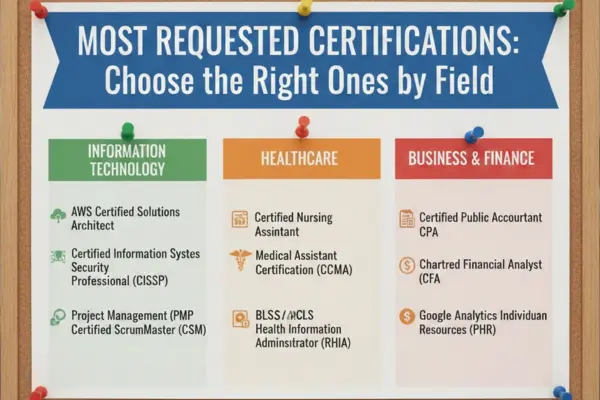
How to identify most requested certifications by field without guessing
A reliable process beats opinions, because certification advice is noisy and often influenced by affiliate marketing, training providers, or personal bias.
Your goal is not to find a universal top list, because relevance is field-specific and also role-specific, which means you need a repeatable method you can run for your situation.
This process is designed to be lightweight, because busy professionals need a system that can be completed in hours, not a research project that drags on for weeks.
Step 1: pick a target role theme before you research certifications
Certifications only make sense relative to a role, because a credential is a signal about your capability to do a certain kind of work, not a general “smart person” badge.
- Choose a role theme you can explain in one sentence, because clear direction reduces the chance you buy credentials that do not fit your goals.
- Define your level target honestly, because the right credential for a beginner is often different from the right credential for someone aiming at senior scope.
- Clarify your constraints upfront, because budget, schedule, and life responsibilities should shape your plan rather than being treated as afterthoughts.
Step 2: sample job postings to find what employers actually request
Job postings are imperfect, yet they are still one of the most direct signals of requested credentials, because employers put screening language in postings when they want applicants filtered.
- Collect 20 to 30 job postings for your target role theme, because patterns show up quickly when you stop relying on a single posting.
- Highlight certifications that appear repeatedly, because repetition across companies is a stronger signal than one company’s preference.
- Separate required from preferred, because required credentials often act like gates while preferred credentials often act like differentiators.
- Write down the exact spelling employers use, because matching the language in postings improves how your resume is parsed and understood.
Step 3: validate the credential’s legitimacy and recognition
Legitimacy matters because the credential market includes low-quality programs, because it is easy to print a certificate and hard to build an exam with clear standards and widespread trust.
- Confirm the issuing organization is recognized in the field, because vendor and association credibility often determines whether a credential is respected.
- Check whether the credential has an exam or objective assessment, because pay-to-earn certificates rarely carry the same weight as assessed certifications.
- Verify continuing education or renewal rules, because maintenance requirements often signal that the credential is designed to stay current.
- Review the exam outline to understand what is being tested, because outlines show whether the credential matches your target role’s real work.
Step 4: estimate ROI using time, money, and proof value
ROI is not only salary, because a good credential can also increase employability by improving screening pass rates, interview confidence, and project opportunities.
- Estimate total cost including exam fees, prep materials, and time, because time is part of the price and often the scarcest resource.
- Define what proof you will create while studying, because a credential paired with a portfolio artifact tends to be more persuasive than a credential alone.
- Choose a credential that you can complete and maintain, because an unfinished certification plan creates guilt without delivering employability gains.
Trustworthy sources to find most requested certifications by field
Trustworthy sources are those that use job-posting data, professional association research, or clearly stated methodology, because methodology is what separates insight from guesswork.
A good research habit is triangulation, because one list can be wrong or biased while repeated signals across sources tend to point to durable demand patterns.
- Job board data summaries can show cross-industry demand, because they aggregate employer postings at scale and report frequently mentioned certifications.
- Field-specific labor market dashboards can show credential demand within a domain, because cybersecurity and similar fields often publish certification demand metrics.
- Professional associations can clarify what competencies matter, because they shape standards and often influence how employers define role expectations.
- Large professional networks can reveal skill and learning trends, because workforce learning data can point to categories employers are investing in.
- Government occupational data can provide baseline role clarity, because stable role definitions help you map credentials to real job families.
Most requested certifications by employers: what broad job-posting data reveals
Broad job-posting lists are useful as a first pass, because they show what employers request across the whole market, which helps you understand whether your field is credential-heavy or credential-light.
These lists also prevent tunnel vision, because many “most requested” credentials are tied to compliance, safety, and regulated work rather than to corporate prestige.
Use broad lists as a starting point, then narrow by field, because the credential that appears frequently overall may not be the credential that matters in your target role.
- Healthcare and safety credentials often show up near the top of cross-market lists, because many roles require certifications like CPR or related safety training.
- Trade and operations credentials also appear frequently, because licenses and safety certifications are often required to work legally in certain roles.
- Tech credentials can appear in broad lists, yet tech demand is more role-specific, because cloud, security, and networking credentials tend to show up differently by job family.
- Corporate credentials can be less visible in broad lists, because many corporate roles rely more on demonstrated outcomes than on formal certifications.
By-field list framework: map certifications to job families without getting lost
The safest way to build a by-field list is to use a framework, because a framework helps you avoid collecting random certifications that do not connect to employability.
This framework is designed to be filled using your own job-posting sample, because your location, level, and niche can shift what is truly requested.
By-field certification mapping table
| Field | Typical certification families | What employers often use them for | Your target role | Top 3 requested credentials (from postings) | Proof you will build alongside it |
|---|---|---|---|---|---|
| Cybersecurity | Foundational security, audit, management, specialized | Baseline screening, compliance signals, role readiness | Incident write-up, risk memo, lab project | ||
| Cloud / DevOps | Vendor cloud certs, infrastructure, platform engineering | Platform familiarity, architecture readiness | Architecture diagram, deployment project, runbook | ||
| Project Management | Project, agile, delivery, governance | Delivery credibility, standardized methods | Project plan, risk register, stakeholder updates | ||
| Healthcare | Safety, clinical, compliance, role-specific licenses | Legal eligibility, patient safety | Competency checklist, supervised hours log | ||
| IT Support / Networking | Core IT, networking, vendor admin | Baseline technical competence | Troubleshooting log, home lab documentation | ||
| Data / Analytics | Tool certifications, analytics methods, cloud data | Tool screening, evidence of applied analysis | Dashboard, analysis memo, case study |
Worked example: cybersecurity certification demand with real job-posting signals
Cybersecurity is a useful example because credential demand is tracked and discussed widely, which makes it easier to validate what is requested rather than relying on opinions.
Within cybersecurity, certification demand varies by role type, because governance and audit roles request different credentials than hands-on defensive operations roles.
Credential value also depends on region and sector, because government and regulated industries often request specific certifications more consistently than some private-sector teams.
A practical cybersecurity shortlist you can validate against postings
- Foundational security certifications are commonly requested as entry signals, because they show baseline understanding of security concepts and terminology.
- Management and audit certifications appear frequently in postings, because many security roles involve governance, risk assessment, and compliance responsibilities.
- Advanced or specialized certifications often show up for senior roles, because senior roles require proof of depth and trusted judgment under higher stakes.
How to use cybersecurity certification-demand data responsibly
- Start with job openings requesting certifications rather than holders, because openings reflect employer demand while holders reflect supply.
- Compare multiple certifications at once, because your goal is to identify which credentials appear repeatedly for your target role type.
- Use demand numbers as a directional signal, because demand can shift with regulations, threat landscape changes, and hiring cycles.
- Pair the certification with an evidence plan, because hands-on proof makes your credential more credible in interviews.
Worked example: healthcare and safety credentials as “most requested” signals
Healthcare and safety certifications often rank highly in broad job-posting lists, because many roles require safety training as a baseline condition of employment.
These credentials are useful to understand even if you are not in healthcare, because some non-medical roles still request safety training when the work involves public responsibility.
Safety credentials can be requested across industries, because employers value readiness for emergencies, compliance, and workplace safety obligations.
- CPR and basic life support credentials can appear frequently, because emergency readiness is a common requirement in many public-facing and care-related roles.
- First aid training can show up as a requested credential, because it reduces risk and supports compliance in workplaces where incidents are possible.
- Field-specific clinical licenses dominate in regulated roles, because legal eligibility is not optional when patient care and compliance are involved.
Criteria checklist: choose certifications that improve employability and credibility
A criteria checklist prevents impulse buying, because certification marketing often sells certainty while the real value depends on relevance, recognition, and execution.
Use the checklist below to evaluate any credential, because the same principles apply across tech, healthcare, business, and skilled trades.
Certification evaluation checklist
- Relevance is high when the certification maps to common job outputs, because employers care about what you can deliver, not what you collected.
- Recognition is strong when hiring managers know the issuer, because unknown issuers often create extra explanation burden that weakens your resume signal.
- Assessment is meaningful when there is a proctored exam or clear performance evaluation, because pay-to-complete certificates tend to carry less weight.
- Currency is maintained when renewal exists, because renewal signals the credential is designed to stay aligned with changing tools and standards.
- Prerequisites are transparent when they are stated clearly, because hidden prerequisites are a common way professionals waste money and confidence.
- Cost-to-benefit is reasonable when you can explain ROI in one paragraph, because vague ROI is usually a sign you are buying hope instead of a plan.
- Proof potential is high when the certification aligns with portfolio artifacts, because evidence turns credentials into credible stories.
- Opportunity alignment is clear when your manager or target employers value it, because certifications have different value in different cultures and sectors.
Decision template: score certifications by field with a simple matrix
A scoring matrix works because it turns fuzzy trade-offs into visible choices, which reduces overthinking and helps you commit to a plan.
Weights keep the matrix honest, because a busy professional should prioritize completion feasibility and employer recognition over impressive-but-impractical options.
Certification decision matrix template
| Criteria | Weight (1–3) | Cert A Score (1–5) | Cert A Weighted | Cert B Score (1–5) | Cert B Weighted | Cert C Score (1–5) | Cert C Weighted | Evidence notes |
|---|---|---|---|---|---|---|---|---|
| Appears in target job postings | 3 | |||||||
| Issuer recognition in the field | 3 | |||||||
| Assessment rigor and clarity | 2 | |||||||
| Completion feasibility for my schedule | 3 | |||||||
| Portfolio evidence I can produce | 2 | |||||||
| Total cost and renewal cost | 3 | |||||||
| Optionality after completion | 2 | |||||||
| Total |
Red flags: avoid credentials that look credible but deliver weak ROI
Red flags protect you because the credential market includes programs that are designed primarily to sell, not to teach or assess, and that difference shows up later when employers do not recognize the certificate.
One red flag does not always mean no, yet multiple red flags together usually mean you should keep searching and invest elsewhere.
- Guaranteed job claims are a red flag, because no training provider controls hiring outcomes or employer screening standards.
- Vague curriculum promises are a red flag, because “mastery” language without clear objectives often hides shallow teaching.
- No assessment is a red flag, because learning without evaluation makes it hard to prove competence and easier to waste time.
- Hidden prerequisites are a red flag, because surprise difficulty increases dropout and creates unnecessary self-doubt.
- Pressure-based sales tactics are a red flag, because urgency often substitutes for evidence and can push you into impulsive spending.
- Issuer obscurity is a red flag, because unknown issuers force you to explain your credential rather than letting the credential carry the signal.
- Portfolio avoidance is a red flag, because programs that do not produce outputs often fail to convert into employability improvements.
Build credibility faster by pairing certifications with proof
Certifications can help you pass filters, while proof helps you win decisions, because hiring managers and stakeholders prefer evidence that you can apply skills in real situations.
Proof also protects you from sunk-cost regret, because even if a certification is less valuable than you hoped, your artifacts remain reusable evidence of capability.
Proof ideas that match many certification paths
- Create a one-page case study describing the problem, constraints, approach, and results, because compact storytelling is a transferable credibility skill.
- Build a simple project artifact aligned with your field, because artifacts demonstrate that you can do the work beyond passing an exam.
- Write a decision memo with trade-offs, because decision hygiene signals maturity and readiness across many business functions.
- Document a repeatable workflow or playbook, because systems thinking and clarity often differentiate strong professionals from average ones.
- Track a measurable improvement, because even small measurable results make your resume and interviews more convincing.
30-day action plan: find your field-relevant certification shortlist quickly
This plan is designed to reduce paralysis, because a short timeline forces you to move from browsing to deciding, which is essential when you want credibility and skill proof without endless research.
Week 1: collect job-posting signals
- Save 20 to 30 postings for your target role theme, because that sample size usually reveals repeated credential patterns.
- Write a simple list of certifications and how often they appear, because frequency is your first demand signal.
- Mark each as required or preferred, because that label changes priority.
Week 2: validate issuers and exam outlines
- Check issuer legitimacy and renewal requirements, because credibility depends on standards and maintenance.
- Skim exam objectives to confirm role fit, because a credential that teaches the wrong skills wastes time even if it is popular.
- Remove anything that fails your red-flag screen, because protecting ROI means saying no early.
Week 3: score options and plan proof
- Use the decision matrix to rank your top three credentials, because ranking turns options into a plan.
- Choose one proof artifact to build alongside the credential, because evidence accelerates credibility.
- Schedule study blocks on your calendar, because unscheduled learning disappears first.
Week 4: commit, start, and set a review cadence
- Enroll or register for the chosen credential path, because commitment reduces the temptation to keep browsing.
- Complete a small first deliverable within seven days, because early completion builds momentum and reduces dropout risk.
- Set a weekly review routine, because consistency is how credentials convert into employability gains.
Monthly review ritual: keep your certification plan realistic and healthy
Monthly reviews reduce burnout, because they help you adjust scope and pacing before you spiral into guilt or overwork.
A realistic plan respects life constraints, because the goal is sustainable progress and not heroic intensity that collapses midstream.
- Review what you completed and what proof you produced, because outputs are the clearest sign that learning is transferring.
- Check whether the certification still matches job-posting demand, because demand signals can shift and your plan should stay aligned.
- Adjust your weekly time budget if needed, because consistent smaller effort beats inconsistent larger effort.
- Decide the next month’s single focus, because focus reduces overwhelm and improves completion rates.
Final note and independence disclaimer
Certifications can be useful career tools when you choose them with evidence, field relevance, and a clear proof plan, because credibility is built through both signals and outcomes.
Notice: This content is independent and has no affiliation, sponsorship, or control over any institutions, platforms, or third parties mentioned.