
When you do not have a clear “north star,” every opportunity can look equally tempting, and every decision can feel like a gamble you will later regret.
This guide shows how to write a career mission that creates focus, acts as a decision filter, and supports goals without becoming vague inspirational fluff.
How to write a career mission by understanding what a mission statement does
A career mission statement is a short declaration of the kind of value you want to create, for whom, and in what way, so your professional purpose becomes actionable instead of abstract.
A useful mission is not a personality slogan, because it should guide choices about roles, projects, learning priorities, and boundaries in real life.
Clarity matters because your mission becomes a decision filter, which means it helps you say yes to the right opportunities and no to distractions that look good but pull you off course.
Focus increases when you know what you are building, because you stop reacting to urgency and start choosing goals that compound into a coherent career story.
Confidence improves when your mission is specific, because specificity makes your direction easier to explain to managers, interviewers, and even to yourself during uncertain seasons.
Professional purpose becomes practical when it is tied to behaviors, because values without behaviors can’t steer daily work, while mission with behaviors becomes a plan you can execute.
- A mission statement helps you choose between offers, because it clarifies which environment lets you do your best work consistently.
- A mission statement helps you choose what to learn, because learning becomes aligned with the kind of impact you want to create.
- A mission statement helps you position yourself, because your story becomes clearer when it has a consistent theme.
- A mission statement reduces burnout risk, because it can reveal when you are repeatedly violating your own priorities and pretending it is normal.
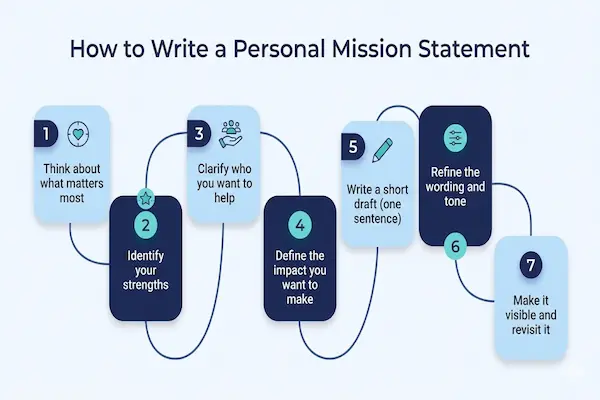
Career mission statement versus goals: why you need both
Your mission is the direction, while your goals are the milestones, because one defines why and how you want to contribute, and the other defines what you will achieve within a time frame.
Goals can change when life changes, yet a mission can remain stable, because mission is about the kind of work and value you want to create across different roles.
Mission without goals can feel inspiring but vague, while goals without mission can feel productive but empty, because activity can grow without meaning if you never define your purpose.
Decision-making becomes easier when mission and goals align, because your short-term actions support your long-term professional purpose instead of pulling you in conflicting directions.
- Mission answers: “What kind of value do I exist to create professionally, and what do I want to be known for.”
- Goals answer: “What will I accomplish next, and what evidence will prove progress.”
- Mission is stable across roles, because it describes contribution patterns rather than job titles.
- Goals are time-bound, because milestones are how you measure movement and avoid drifting.
How to write a career mission that is specific without being restrictive
Many professionals avoid writing a mission because they fear it will trap them, yet a good mission creates direction while still allowing flexibility in industry, title, and context.
The key is to write at the “role theme” level rather than at the “single job” level, because themes give you focus without locking you into one narrow label.
A mission should be narrow enough to guide decisions, while broad enough to travel with you as you grow, because your influence and scope will expand over time.
Specificity comes from naming value and audience, not from naming a single company, because your purpose should not depend on one organization’s brand.
- Define the value you want to create, because value is what employers and teams actually reward.
- Define the audience you want to serve, because audiences clarify what kinds of problems you want to solve.
- Define the method you use, because method turns your mission into a recognizable pattern of work.
- Define the impact you want to leave, because impact gives your mission emotional meaning without losing practicality.
Simple formulas: how to write a career mission in one sentence
Formulas reduce overthinking because you can fill blanks instead of staring at a blank page and trying to sound profound.
Pick one formula that feels natural, because the best mission statement is one you can actually say out loud without cringing.
Short missions work better than long ones, because you should be able to remember it during stressful moments when you need a decision filter most.
Formula 1: value + audience + method
This formula is the most practical, because it forces specificity while staying flexible about job titles.
I help [audience] achieve [valuable outcome] by [method / strengths], so [impact / why it matters].- Example: “I help teams reduce operational chaos by building clear processes and communication rhythms, so work becomes sustainable and predictable.”
- Example: “I help leaders make better decisions by translating complex data into clear recommendations, so resources go to what matters most.”
- Example: “I help customers succeed by simplifying complicated systems into usable guidance, so they can adopt solutions with confidence.”
Formula 2: problem + principle + contribution
This version works when you have strong values, because it makes professional purpose feel grounded in a principle rather than in vague motivation.
I’m committed to solving [problem type] with [principle], by contributing [skills / behaviors] in [environment conditions].- Example: “I’m committed to solving messy, cross-team delivery problems with clarity and fairness, by building alignment and systems that reduce surprises.”
- Example: “I’m committed to helping teams grow with empathy and accountability, by coaching, documenting expectations, and making feedback actionable.”
Formula 3: identity-free mission for career changers
This version helps when you are changing fields, because it focuses on transferable value rather than on industry labels.
I create value by [core competencies], especially when [conditions], and I want to apply that to [role theme / outcome].- Example: “I create value by simplifying complexity and aligning stakeholders, especially when priorities conflict, and I want to apply that to operational and program delivery work.”
- Example: “I create value by explaining ideas clearly and building repeatable systems, especially in fast-moving environments, and I want to apply that to enablement and training.”
Formula 4: mission + decision filter built in
This version is useful if you want your mission statement to immediately guide career choices, because it includes an explicit “yes/no” boundary.
I pursue roles where I can [value] for [audience] through [method], and I avoid roles that require [non-negotiable violation].- Example: “I pursue roles where I can improve systems and outcomes through clear communication and process design, and I avoid roles that normalize chronic overtime.”
- Example: “I pursue roles where I can build evidence-based strategies with collaborative teams, and I avoid roles where decision-making is opaque and political.”
Prompts: write your career mission statement from real evidence
Mission statements become believable when they reflect your lived patterns, because you will naturally execute a mission that matches what you already tend to do well and enjoy.
Reflection becomes practical when you focus on moments, because moments reveal what matters more clearly than abstract traits.
Answer quickly, because speed reduces the temptation to write what sounds good instead of what is true.
Prompt set A: identify your recurring value
- When have you felt most proud at work, and what value did you create in that moment.
- Which problems do people bring to you repeatedly, and what does that suggest you are trusted for.
- What do you do that makes other people’s work easier, faster, or clearer.
- Which outcome do you like being responsible for, even when it is stressful.
- What kind of success do you want to repeat, because repeated success becomes your professional theme.
Prompt set B: identify the audience you want to serve
- Whose work do you enjoy supporting, because audience fit influences your daily satisfaction.
- Which stakeholders do you communicate with most naturally, because some people prefer customers while others prefer internal teams.
- Who benefits most from your strengths, because your mission should match the people who value your contribution.
- Which group do you want to advocate for, because advocacy often reveals deeper professional purpose.
Prompt set C: identify your method and environment fit
- Which skills do you rely on when things are messy, because your “messy moment” behavior is often your core competency.
- Which working conditions help you thrive, because even meaningful work can feel unbearable in the wrong environment.
- Which constraints you must honor, because a mission should support sustainable career choices rather than heroic self-sacrifice.
- Which behaviors you refuse to compromise, because boundaries clarify what your mission will not require from you.
Examples by profile: career mission statements that feel real
Examples help because they show different levels of specificity, and they demonstrate how mission can stay flexible while still giving you focus.
Use the examples as structure, not as copy, because your mission works best when it sounds like you.
Profile 1: analytical problem solver
- “I help teams make better decisions by turning complex data into clear recommendations, so effort goes to the highest-impact work.”
- “I reduce uncertainty by diagnosing root causes and defining measurable next steps, so teams can move forward with confidence.”
- “I create clarity in ambiguous situations by structuring problems and communicating trade-offs, so stakeholders can align and act.”
Profile 2: operator and systems builder
- “I help teams work sustainably by building simple processes and documentation that reduce confusion, errors, and rework.”
- “I create operational leverage by improving workflows and ownership, so delivery becomes predictable and less stressful.”
- “I help organizations scale by turning messy work into repeatable systems that make outcomes easier to achieve.”
Profile 3: communicator and educator
- “I help people learn and apply complex ideas through clear teaching and practical tools, so they feel confident and capable.”
- “I enable teams to perform better by translating knowledge into playbooks, training, and habits that stick.”
- “I build clarity and confidence by explaining, simplifying, and creating reusable guidance, so others can move faster.”
Profile 4: relationship builder and facilitator
- “I help teams align by facilitating honest conversations and resolving trade-offs, so collaboration becomes smoother and outcomes improve.”
- “I build trust across stakeholders by communicating clearly and following through, so projects move forward without politics.”
- “I reduce friction by understanding people’s needs and creating shared clarity, so decisions and delivery become easier.”
Profile 5: career changer seeking a north star
- “I want to apply my strengths in structured problem-solving and communication to roles where I can improve outcomes and build trust across teams.”
- “I create value by simplifying complexity and building alignment, and I want to use that to support teams doing meaningful work.”
- “I’m building a career focused on clarity and impact, using evidence-based thinking and respectful collaboration to solve real problems.”
Refinement checklist: make your career mission statement useful as a decision filter
Refinement matters because a mission statement should be actionable, and actionable statements require clarity and specificity.
Use this checklist to tighten your mission until it guides career choices, because a “north star” only works when it is bright enough to see.
Mission refinement checklist
- Is it one sentence you can say naturally, because a mission you cannot speak will not guide real decisions.
- Does it name a type of value you create, because value is what makes your mission credible.
- Does it name an audience or context, because context helps you choose the right roles and environments.
- Does it hint at your method, because method makes you recognizable and repeatable.
- Is it flexible across job titles, because your mission should travel with you as you grow.
- Does it avoid vague words without examples, because “passionate” is not a decision filter.
- Could it help you say no, because missions should reduce distraction and protect focus.
- Does it align with your constraints, because sustainability is part of a good career mission.
Red flags that mean your mission is too vague
- It could apply to almost anyone, because generic statements do not help you choose between options.
- It includes only feelings, because feelings matter but do not tell you what work to pursue.
- It is full of buzzwords, because buzzwords hide uncertainty and make your mission hard to live.
- It names a title instead of value, because titles change while contribution patterns persist.
How to use your career mission statement to set goals and make decisions
Your mission becomes powerful when you actually use it, because the mission is only useful as a decision filter when it changes your behavior.
Using it does not require big rituals, because small consistent check-ins before major choices can reshape your career direction quickly.
Mission-guided goals feel clearer, because goals become “proof I’m living my mission” rather than random achievements.
Mission-to-goals mapping method
- Write your mission at the top of a page, because visibility makes it easier to use as a filter.
- List three skills that support your mission, because skill building becomes more focused when it serves purpose.
- Choose one proof project that demonstrates your mission, because proof accelerates credibility faster than intention.
- Set one 90-day goal tied to that project, because short horizons create execution momentum.
- Schedule a monthly mission review, because drift happens slowly and reviews catch it early.
- Decision filter question: “Does this opportunity let me express my mission weekly, or will it pull me away from it.”
- Decision filter question: “Will this role build skills that strengthen my mission, or will it build skills I do not want to rely on long term.”
- Decision filter question: “Will this team environment support the behaviors my mission requires, or will it force compromises I will regret.”
Common mistakes when writing a career mission
Mistakes are common because writing a mission touches identity, yet the goal is not perfection and is usefulness.
These pitfalls tend to create missions that sound nice but do not guide career choices, which defeats the purpose of having a north star.
- Trying to sound impressive, because your mission is a tool for you, not a performance for others.
- Being overly broad, because broad missions do not help with decision-making when trade-offs appear.
- Being overly narrow, because narrow missions can feel restrictive and reduce your flexibility unnecessarily.
- Ignoring constraints, because missions that require an unrealistic life become sources of guilt.
- Writing it once and forgetting it, because missions guide choices only when you revisit them.
- Replace buzzwords with behaviors, because behaviors are what you can actually execute.
- Anchor the mission in evidence, because real examples keep you honest and grounded.
- Test the mission against a decision, because the mission should make at least one choice easier immediately.
- Refine every month for three months, because iteration helps you find the wording that truly fits.
Final note and independence disclaimer
A career mission statement is not about predicting your whole future, because it is about choosing a direction you can live and then using it as a decision filter for goals and opportunities.
Write it simply, ground it in evidence, refine it with the checklist, and use it monthly, because clarity that gets used is what becomes a true north star.
Notice: This content is independent and has no affiliation, sponsorship, or control over any institutions, platforms, or third parties mentioned.