
Bad courses are expensive in a way receipts do not show, because they cost time, confidence, and momentum long after the refund window closes.
Course quality becomes predictable when you evaluate evidence instead of marketing, because the same few signals reliably separate real learning from polished fluff.
How to vet course quality by defining what “quality” means for your goal
Course quality is not the same as popularity, because a course can be entertaining, well-produced, and widely purchased while still failing to build usable skills.
Quality is best defined as skill transfer, meaning you can perform the target task independently after practice, rather than merely recognizing concepts while watching someone else do them.
Relevance matters as much as teaching skill, because a beautifully taught curriculum is still a poor investment if it does not map to your learning goals or your real job outputs.
Consistency is part of quality, because a course that demands a perfect schedule will collapse the first week your work or life gets heavy.
Support also influences outcomes, because the difference between “I’m stuck forever” and “I learned fast” is often one timely correction or one clear example.
Before any checklist, the fastest clarity move is writing a one-sentence “after statement,” because the ability you want should guide every comparison.
- Quality means you can do the thing, not just describe the thing, and that difference becomes obvious when you require outputs and proof.
- Quality includes structured practice, because practice is how knowledge becomes behavior under real constraints.
- Quality includes clear standards, because learners improve faster when “good” is defined rather than implied.
- Quality includes honest leveling, because mismatched difficulty creates shame even when the course design is the real problem.
Write your “after statement” in 60 seconds
A single sentence reduces overwhelm, because it forces you to pick one outcome instead of collecting endless topics.
- Choose a capability you want to demonstrate, such as “build a dashboard,” “write a case study,” “run a stakeholder meeting,” or “ship a small project.”
- Name where you will use it, because workplace use, interview use, and portfolio use can require different emphasis.
- Define what proof will exist, because proof is what turns learning into credibility and keeps you from feeling stuck.
- Example after statement: “Within six weeks, I will produce one portfolio-ready project case with measurable results and a clear decision narrative.”
- Example after statement: “Within four weeks, I will execute the core workflow independently and explain trade-offs in plain language.”
How to vet course quality with an evidence stack, not a gut feeling
Strong decisions come from stacking small signals, because any single signal can be misleading while multiple aligned signals are harder to fake.
The goal is not to reach perfect certainty, because the goal is to reduce the risk of wasted time and money with a consistent method.
Think of course vetting like hiring, because you are evaluating claims, verifying proof, and checking fit under constraints.
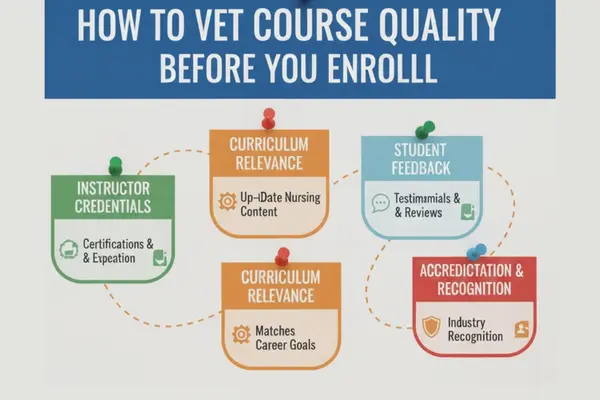
Four evidence layers cover most of what matters, because they capture curriculum reality, instructor credibility, learner outcomes, and support design.
- Layer 1: Syllabus review, because the syllabus shows the structure of learning rather than the marketing of learning.
- Layer 2: Instructor credibility, because teaching quality and real-world judgment are often tied to the instructor’s depth and clarity.
- Layer 3: Student feedback patterns, because repeated complaints and repeated wins reveal reality faster than testimonials.
- Layer 4: Support and experience, because even great content fails when learners cannot get unblocked or cannot sustain the pace.
Syllabus review: the fastest way to evaluate course quality before enrolling
A syllabus is a promise about sequence, practice, and standards, so reading it carefully is one of the most cost-effective steps in online course selection.
Course pages often highlight outcomes without showing the path, which is why a structured syllabus review keeps you from buying confidence instead of learning.
Good syllabi are specific, because specificity signals real instructional design rather than vague ambition.
Weak syllabi are often broad and fuzzy, because fuzziness lets a course “cover everything” while teaching little deeply.
Syllabus quality checklist
- Clear learning objectives appear per module, because module-level objectives predict whether the course builds progressively or wanders.
- Prerequisites are stated plainly, because hidden prerequisites are a common source of frustration and dropout.
- Practice is frequent, because skills are built by repetition, not by exposure.
- Projects increase in difficulty, because progression requires variation and constraint, not just repetition of the same easy task.
- Assessment criteria exist, because learners improve faster when rubrics and standards are visible.
- Realistic outputs are included, because toy projects rarely transfer cleanly to professional work.
- Time estimates include assignments, because underestimating practice time is how busy learners fail.
The “output audit” for syllabus review
Outputs reveal reality, because a course that produces nothing concrete cannot easily produce confidence or employability.
- List the promised outputs, because naming them turns marketing language into testable deliverables.
- Check whether outputs match your after statement, because alignment is the foundation of ROI.
- Verify that outputs require independent work, because copy-along projects can create fragile competence.
- Confirm that outputs include feedback or checking, because uncorrected practice can lock in mistakes.
- Strong output example: “Write a decision memo with trade-offs, then revise using a rubric and sample high-quality versions.”
- Weak output example: “Watch me build something, then download the files,” because downloading is not the same as producing.
Curriculum red flags you can spot in two minutes
- “Intro to everything” structure dominates, because depth is what creates real skill transfer.
- Assignments are missing or optional, because optional practice is often skipped by busy learners.
- Objectives are vague, because vague objectives usually signal vague assessment and weak outcomes.
- Projects are identical in pattern, because no variation means you are learning memorization rather than judgment.
- Module order feels random, because random order often indicates content dumping instead of instructional sequencing.
Instructor credibility: how to evaluate the teacher without being fooled by charisma
Instructor credibility is not about fame, because clarity, real examples, and accurate judgment matter more than follower counts.
Teaching skill is distinct from doing skill, because some experts cannot teach and some teachers can create strong competence even without celebrity status.
Credible instructors show thinking, not just steps, because step-following collapses when conditions change and real work always changes conditions.
Good instructors also show mistakes and debugging, because learning how to recover is often more useful than watching a perfect demo.
Instructor credibility checklist
- Relevant experience exists, because examples are stronger when they come from real constraints rather than from theory alone.
- Teaching is structured, because clear explanations usually reflect a clear internal model of the topic.
- Trade-offs are discussed, because mature competence is choosing between imperfect options, not following one rule.
- Language is plain, because unnecessary jargon often hides unclear thinking or weak pedagogy.
- Scope honesty appears, because trustworthy teachers say what the course will not cover and why.
Quick credibility test using one sample lesson
One sample lesson can reveal the teaching style quickly, because your brain can detect whether the instructor is building understanding or only presenting steps.
- Listen for definitions, because good teaching defines terms before using them at speed.
- Watch for examples that include constraints, because constraints mirror real work and build judgment.
- Notice whether the instructor explains why, because why is what you need when you are alone later.
- Check whether the instructor anticipates mistakes, because anticipating mistakes shows empathy and expertise.
Student feedback: how to read reviews like an investigator, not a fan
Student feedback is useful when you treat it as pattern data, because individual reviews are often emotional snapshots rather than reliable quality assessments.
Positive reviews can be misleading when they describe excitement without outcomes, because excitement is not the same as competence.
Negative reviews can also be misleading when the learner ignored prerequisites, because mismatched level is not always course failure.
The most valuable reviews mention outputs, friction points, and support response, because those details predict whether you will finish and apply what you learn.
How to sort reviews into useful categories
- Separate outcome reviews from vibe reviews, because “I built X” is more actionable than “I loved it.”
- Scan for repeat complaints, because repeated issues signal structural problems rather than personal preference.
- Search for reviews from your level, because beginner needs differ from advanced needs in pacing and support.
- Look for comments about assignments, because practice design often explains learning success or failure.
- Identify support references, because slow responses and unclear help often create dropout.
Review phrases that usually mean something real
- “I shipped a project” usually signals real transfer, because shipping requires integration and independent work.
- “The assignments were hard but doable” often signals good progression, because productive difficulty builds competence.
- “I got stuck and couldn’t recover” often signals weak support or weak scaffolding, because good design anticipates common failures.
- “It was outdated” often signals low ROI for fast-moving topics, because stale content can teach the wrong defaults.
- “Too much fluff” often signals weak curriculum density, because high-quality courses respect time and reduce filler.
Support and learning experience: the quiet factor that decides completion
Support matters because most learners quit when they get stuck, not when the content becomes intellectually impossible.
Even independent learners benefit from minimal support, because one clarification can prevent hours of confusion and self-doubt.
Support is also about design, because well-designed courses reduce the need for rescue through clear instructions, examples, and checklists.
Busy learners need predictable pacing, because inconsistent workload creates missed weeks and missed weeks create quitting.
Support checklist before enrolling
- Office hours, Q&A, or feedback options exist, because feedback accelerates learning and reduces repeated errors.
- Response expectations are stated, because “we respond eventually” is not support when you are blocked today.
- Community moderation exists, because unmoderated communities often become noise rather than help.
- Clear submission or review rules exist, because vague rules create anxiety and wasted effort.
- Accessibility and format details are clear, because good experience design respects real constraints and diverse learning needs.
Experience design checks that predict whether you will finish
- Lesson length matches your schedule, because a perfect curriculum is useless if you cannot fit sessions consistently.
- Assignments are sized realistically, because overly large tasks create avoidance and stall the whole study plan.
- Templates and examples exist, because starting from scratch every time increases friction unnecessarily.
- Milestones are visible, because visible progress keeps motivation stable during long learning arcs.
Warning signs: how to spot low-quality courses before you pay
Warning signs matter most for learners with past bad course experiences, because repeated disappointment often comes from the same predictable traps.
No single red flag guarantees a course is bad, yet multiple red flags usually mean your risk is high and your ROI is likely low.
Pressure-based marketing is especially relevant, because urgency tactics often replace evidence of outcomes.
Marketing and claim red flags
- Guaranteed job or income promises appear, because no course controls hiring outcomes and honest providers avoid certainty claims.
- Scarcity pressure is aggressive, because real quality usually sells through clarity and proof rather than panic.
- Testimonials are vague, because “life-changing” without specifics rarely predicts your results.
- Curriculum details are hidden, because secrecy often masks weak structure or thin content.
- Results are framed as effortless, because real learning requires practice and honest effort.
Instructional design red flags
- Assignments are missing, because passive watching creates fragile competence and low retention.
- Assessment is absent, because improvement requires standards and feedback rather than vibes.
- Prerequisites are unclear, because confusion created by misleveling often becomes self-blame.
- Projects are purely copy-along, because copying builds familiarity without independent problem-solving.
- “Everything is advanced” tone is constant, because intimidation is not rigor and often hides weak teaching.
Support and policy red flags
- Refund terms are confusing, because confusion increases financial risk when you discover misfit early.
- Support channels are vague, because “community” is not support when nobody answers hard questions.
- Instructor disappears after enrollment, because teaching without presence can be fine for self-study but risky for complex skill building.
- Upsells appear immediately, because constant upsells can signal the core product is intentionally incomplete.
Research script: what to check, what to ask, and how to stay objective
Research becomes manageable when you follow a script, because scripts prevent overthinking and turn curiosity into a repeatable process.
A simple rule keeps the script ethical and practical, which is asking for clarity, asking for examples, and then making your decision without arguing with the evidence.
Research steps you can complete in 30–45 minutes
- Read the syllabus and write the promised outputs in a list, because outputs are easier to evaluate than buzzwords.
- Watch or read a sample lesson if available, because teaching quality is best judged by direct exposure.
- Scan reviews for patterns and outcomes, because patterns reveal structural truth faster than single anecdotes.
- Verify the support model and expectations, because support affects completion more than you think.
- Estimate total cost in time and money, because time is the hidden cost that causes regret.
Questions to ask the provider or instructor before enrolling
- “What are the three most common reasons learners struggle, and what do you provide to help them recover.”
- “What does a strong submission look like, and do you provide a rubric or examples.”
- “How much time do successful learners actually spend weekly, including assignments.”
- “What prior knowledge do you assume, and how can a learner test whether they are ready.”
- “What kind of feedback is available, and what response time should learners expect.”
How to ask for proof without sounding hostile
Proof requests can be respectful, because serious educators usually welcome serious learners who want clarity.
- Frame the question around fit, because “I want to make sure this matches my level and goal” sounds professional and reasonable.
- Ask for examples, because examples reduce ambiguity and protect you from misinterpretation.
- Ask about outcomes, because outcome clarity is the most reliable indicator of ROI.
How to vet course quality with a scoring rubric that prevents impulse decisions
A scoring rubric helps when you feel emotionally tempted, because numbers force you to confront trade-offs instead of letting excitement choose for you.
Weights keep the rubric honest, because busy learners often need feasibility and practice quality more than brand prestige.
Unknowns should not be scored as high, because uncertainty is risk and risk should trigger follow-up questions.
Scoring rubric instructions
- Choose 2–4 courses to compare, because too many options creates noise and analysis paralysis.
- Score each criterion from 1 to 5, because a simple scale makes honest scoring easier.
- Apply weights from 1 to 3, because small weights reduce the temptation to manipulate the outcome.
- Add evidence notes, because notes keep you grounded in facts rather than feelings.
- Re-score the next day if you feel uncertain, because a short delay often reveals whether your decision is stable.
Course quality scoring table
| Criterion | Weight (1–3) | Course A (1–5) | A Weighted | Course B (1–5) | B Weighted | Evidence notes |
|---|---|---|---|---|---|---|
| Outputs match my “after statement” | 3 | |||||
| Practice and projects quality | 3 | |||||
| Assessment clarity (rubrics, standards) | 2 | |||||
| Instructor credibility and teaching clarity | 2 | |||||
| Level fit and prerequisite honesty | 3 | |||||
| Support model and response expectations | 2 | |||||
| Time feasibility for my schedule | 3 | |||||
| Student feedback patterns (outcomes, friction) | 2 | |||||
| Price-to-value fit and refund clarity | 3 | |||||
| Total |
Worked example: comparing two courses without getting distracted by marketing
Examples help because the method becomes clearer when you see how evidence changes the decision, especially if you previously chose a course based on vibes and regretted it.
Imagine Course A has a polished landing page, many reviews, and broad promises, while Course B has fewer reviews yet offers a specific project sequence with clear assessment criteria.
Course A might score high on production quality and excitement, while Course B might score higher on practice density, output relevance, and feasibility.
When your goal is skill transfer and proof, Course B often wins even if it looks less glamorous, because proof and structure create real competence faster than polish.
- If Course A cannot show assignments and standards, the risk is that you will feel inspired but still stuck when you try to do the work alone.
- If Course B provides progressive practice with feedback, the likely outcome is fewer wasted hours and more credible results.
- If your schedule is tight, the course with realistic weekly pacing will outperform the course with big weekend demands.
- If you fear wasting money, clear refund terms and transparent time estimates reduce financial and emotional risk simultaneously.
Decision checklist: choose confidently, then protect your ROI after enrolling
Choosing well is only half the outcome, because even a strong course can fail if you do not schedule it, practice consistently, and save proof.
A simple execution plan protects ROI, because it prevents the common pattern of buying a course for reassurance and then never finishing it.
Final pre-enrollment checklist
- My after statement is written, because unclear goals create expensive browsing loops.
- The syllabus includes frequent practice, because practice is the engine of skill growth.
- Outputs match what I want to prove, because proof drives credibility and career leverage.
- Prerequisites match my level, because mismatch creates stall and self-doubt.
- Support expectations are clear, because getting stuck without help is a predictable failure mode.
- Total time cost fits my calendar, because feasibility determines completion.
- Refund and policy terms are understandable, because clarity reduces financial risk.
First-week execution plan that prevents regret
- Schedule two study blocks immediately, because scheduling converts intention into action.
- Identify the first artifact you will save, because saved evidence is how learning becomes confidence.
- Define a minimum viable week, because busy weeks are guaranteed and your plan must survive them.
- Write one five-line reflection after the first session, because reflection turns experience into strategy without overthinking.
- A weekly “proof habit” keeps momentum, because one small output per week is easier to maintain than a perfect study streak.
- A monthly review keeps the plan realistic, because pacing and scope often need adjustment as real life changes.
- A single feedback loop prevents repeated errors, because early correction reduces wasted practice time dramatically.
Final note and independence disclaimer
This guide is independent and is not affiliated with, sponsored by, or controlled by any institutions, platforms, or third parties that offer courses or certifications.
Course quality becomes less mysterious when you use syllabus review, instructor credibility checks, student feedback patterns, support evaluation, and a scoring rubric to choose based on evidence rather than hope.