
Considering freelancing as a main income stream or a structured side activity usually comes from real-life pressure and priorities.
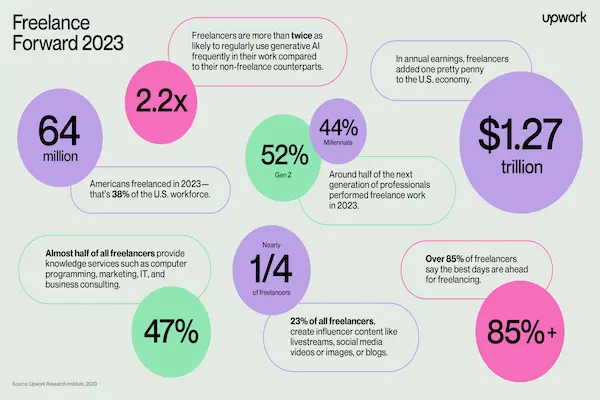
The freelancing market in US is big, but it is not evenly distributed.
Some services attract strong budgets and repeat work.
Other services attract price-only buyers and unstable demand.
This guide helps you evaluate opportunities realistically and move forward with a plan that is sustainable.
You will get a niche selection framework, a portfolio checklist, a simple outreach plan, and pricing basics that prevent undercharging.
The goal is not to sell freelancing as a shortcut.
The goal is to treat independent work like a business decision with clear steps and honest expectations.
Understanding the Freelancing Market in the US
The freelancing market in the US is not one single arena.
It includes high-skill consulting, project delivery, ongoing retainers, and task-based services.
Because the range is wide, “freelancing” is better defined by the work structure than by a job title.
What independent work often looks like
- Project-based delivery with a fixed scope.
- Short-term contract support for a team.
- Monthly retainers tied to ongoing outcomes.
- Specialized advisory work that complements internal staff.
In practice, you win faster when you choose a problem you can scope clearly and deliver consistently.
Why Companies Hire Freelancers
Clients do not hire freelancers because freelancing is popular.
They hire because they need a specific outcome under real constraints.
The four most common buyer reasons
- Skill gaps: a needed capability is missing in-house.
- Speed: hiring takes too long for the timeline.
- Flexible workload: the work is seasonal or bursty.
- Risk control: the buyer wants defined deliverables and boundaries.
This is why the best offers are framed around outcomes, not vague “help.”
Freelancing Demand vs Traditional Employment
Freelance demand usually complements full-time roles.
It tends to show up when companies need speed, specialized execution, or short-term capacity.
This changes how you should think about stability.
Key differences you should expect
- Sales cycles can be shorter than hiring cycles.
- Buyers focus on results and delivery clarity.
- Work volume can fluctuate more frequently.
- Autonomy increases, but planning becomes your responsibility.
The trade is not “freedom vs work.”
The trade is often “control vs variability.”
Evaluate Demand Realistically Before You Commit
Popularity is not demand.
Demand means buyers are willing to pay sustainable rates for a clear outcome.
Practical demand criteria
- Repeated requests for similar deliverables.
- Clear buyer urgency tied to revenue, cost, or risk.
- Evidence that businesses pay for the outcome already.
- A problem that happens again and again, not once in a decade.
Volume alone can be misleading if the work is low budget or high churn.
The “Signal Stack” to Validate a Freelance Niche
A signal stack keeps you from building a niche based on opinions.
It also helps you choose work that has budgets and repeat patterns.
| Question | Best signal | Where to check | What “good” looks like |
|---|---|---|---|
| Is the space active enough to support this service? | Independent work participation + broad market research | Industry research reports + government labor context | Multiple sources point to sustained participation over time |
| Do buyers have budgets for this skill? | Wage anchors and percentiles | BLS OOH / OEWS occupation pages | Clear median pay and meaningful range above entry level |
| Are target industries “moving” right now? | Openings and hiring activity signals | BLS JOLTS by industry + Employment Situation by industry | Stable activity across multiple months, not one spike |
| Is the offer easy to buy? | Clarity of scope and deliverables | Job posts, agency pages, competitor offers | Repeated language and standard deliverables appear everywhere |
Your goal is not perfection.
Your goal is to reduce guesswork before you invest weeks building a portfolio.
Common Freelance Niche Families in the US
Niches tend to work best when the output is scannable and the success criteria are clear.
Digital and technical services
- Web performance and conversion fixes.
- Automation, CRM setup, and workflow cleanup.
- Analytics tracking, dashboards, and reporting reliability.
- Security basics and compliance support for small teams.
Creative and content delivery
- Copywriting for landing pages and email sequences.
- Brand design packages with defined assets.
- Short-form video systems for paid traffic tests.
- Editorial production with consistent standards and turnaround.
Business operations and support
- Bookkeeping support and monthly reporting workflows.
- Project coordination and SOP documentation.
- Customer support processes and knowledge base setup.
- Recruiting assistance and onboarding documentation.
Advisory and training
- Process improvement workshops.
- Enablement training for tools and workflows.
- Compliance readiness support with clear boundaries.
The best niche is not the loudest niche.
The best niche is the one you can deliver with confidence and verify with real signals.
A Simple Niche Selection Framework That Prevents “Generic” Offers
Use this framework to move from broad categories to a sellable offer.
The P-B-P-D-P method
Problem: What pain is costly enough that businesses pay to fix it?
Buyer: Who owns that problem and has budget authority?
Proof: What evidence can you show that you can deliver?
Delivery: What is the smallest scope that still produces a meaningful outcome?
Price: What pricing model matches the work and protects your time?
If you cannot answer these in plain language, your niche is probably still too wide.
Portfolio: The Asset That Reduces Buyer Risk
Clients do not want a freelancer.
They want a confident path to an outcome.
Your portfolio should make the decision feel safe.
A strong portfolio usually includes
- A one-paragraph service definition.
- Two to three focused samples that match the target buyer.
- Context for each sample explaining the situation and the result.
- A short “how I work” section outlining your process.
Portfolio checklist
- Each sample has a clear goal.
- Each sample shows the approach, not just the output.
- Each sample includes boundaries and scope clarity.
- Your offer describes deliverables, timeline, and exclusions.
Clarity beats volume.
How to Build a Portfolio Without Freelance Clients
Many people start without official freelance projects.
You can still build proof ethically.
Ethical proof options
- Work examples from past employment, with sensitive details removed.
- Practice projects that replicate real buyer constraints.
- Pilot work with clear terms and transparent expectations.
- Audits that produce a real deliverable, even before implementation.
Honesty is part of positioning.
Misrepresenting work destroys trust faster than any pricing mistake.
Outreach That Does Not Feel Pushy
Early freelancing often fails because outreach is too broad.
Targeting makes outreach feel respectful.
It also increases response rates.
A simple 7-day outreach plan
- Choose one buyer type and one offer.
- Build a list of 40–60 targets that fit the buyer type.
- Write one message that references a specific observation.
- Send 10 messages per day for 5 days.
- Follow up once, politely, with a single question.
Message template you can copy
Hi [Name].
I help [buyer type] improve [outcome] with a clear, fixed-scope process.
I noticed [specific observation].
If it helps, I can share a short audit outline and what deliverables you would receive.
Would you like me to send it?
Pricing Basics That Prevent Undercharging
Pricing is not only math.
It is also positioning and boundaries.
Three common models
- Hourly: useful for uncertain scope, but can punish efficiency.
- Project: easier to buy when scope is clear.
- Retainer: stable when the outcome is ongoing.
A planning “floor rate” formula
Floor rate = (income goal + overhead + buffer) ÷ realistic billable hours.
This protects you from forgetting admin time, sales time, and unpaid work.
Common mistakes to avoid
- Charging low to “get experience” and getting stuck there.
- Copying another freelancer’s price without matching context.
- Ignoring revisions, meetings, and non-billable tasks.
Side Income vs Full-Time: A Practical Decision Lens
Starting part-time reduces pressure.
It also gives you space to test demand without urgency.
When part-time makes more sense
- You have limited savings.
- You are still learning delivery speed.
- You need proof before committing fully.
When full-time becomes realistic
- You have repeat work or a pipeline that is forming.
- You can forecast 60–90 days with reasonable confidence.
- You have boundaries and systems to prevent burnout.
Operational Basics That Protect You
Independent work includes admin responsibilities.
Simple structure prevents common problems.
Minimum operational checklist
- A written scope and deliverables list.
- A payment schedule and invoicing routine.
- Basic records for income and expenses.
- Clear communication rules for revisions and timelines.
Tax note: if you work as self-employed in the US, you may deal with Schedule C and self-employment tax rules.
Always confirm details with official IRS guidance or a qualified professional.
Risk Management: Make Freelancing More Stable
Risk is not a reason to avoid freelancing.
Risk is a reason to design systems.
Stability habits that matter
- Avoid dependency on a single client.
- Build retainers only when the outcome is truly ongoing.
- Set boundaries to protect delivery quality.
- Keep a simple pipeline even when you are busy.
Stability is built, not found.
14-Day Launch Plan (Low Risk, High Learning)
- Pick one niche and one buyer type.
- Validate demand using the signal stack.
- Write one fixed-scope offer with boundaries.
- Create two proof pieces using ethical alternatives.
- Send 50 targeted messages over 5 days.
- Book 3 discovery calls and learn buyer language.
- Deliver one paid audit or one small fixed-scope project.
This is how you test the freelancing market in US without betting your entire life on day one.
Frequently Asked Questions
Is the US freelance space saturated?
General services are crowded.
Specific, outcome-based offers are less crowded because they reduce buyer risk.
Can freelancing be stable?
Stability depends on diversification, repeatable delivery, and pipeline habits.
Is independent work a fit for everyone?
It fits best when you can self-manage, communicate clearly, and deliver within boundaries.
Final Thoughts and a Practical Next Step
The freelancing market in the US rewards clarity more than ambition.
When you choose a niche with real demand, build honest proof, and run targeted outreach, freelancing becomes a structured path instead of a risky leap.
Next step: pick one niche, write one fixed-scope offer, and run the 7-day outreach plan to test demand before expanding.