
Choosing between a course and a certification feels confusing when both promise “skills” and “credibility,” yet they solve different problems and lead to different outcomes.
This guide explains the difference in a practical way, so you can invest effort where it actually matches your learning goals and career needs.
Course versus certification: the simplest difference you can remember
A course is primarily a learning experience designed to teach you knowledge and skills through instruction, practice, and projects.
A certification is primarily a credential designed to validate competence against a defined standard, usually through an exam or formal assessment.
Courses are often about building capability, while certifications are often about proving capability to someone else.
That difference matters because many people buy a certification when they really need practice, or they buy a course when they really need a recognized signal for screening.
When your goal is skill acquisition, the best choice is usually the option that forces practice and produces evidence you can show.
When your goal is credibility in a hiring or compliance context, the best choice is usually the option that is recognized and verifiable in your target field.
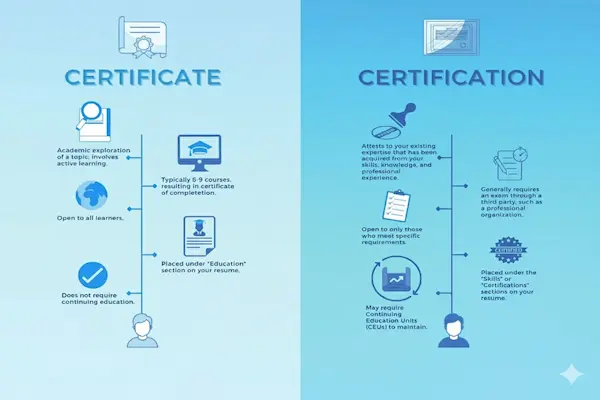
Course vs certification: what each one is designed to do
Courses are designed to move you from “I don’t know” to “I can do,” using explanations, examples, and repetition that builds usable ability.
Certifications are designed to move you from “I claim I can do” to “I can prove I meet this standard,” using assessments that third parties can trust.
Courses can be created by individuals, companies, universities, or training providers, which means quality varies widely and your research matters.
Certifications are typically issued by organizations that define exam objectives and verification rules, which means the credential’s value depends heavily on the issuer’s reputation.
Course completion certificates exist, yet those are not the same as professional certifications, because a completion certificate often signals attendance while a certification signals assessed competence.
Diplomas and degrees sit in a different category, because they usually represent structured, longer programs with broader curriculum scope and institutional accreditation standards.
The eight differences that decide the right investment
Most decisions become clearer when you compare courses and certifications across a small set of practical criteria, instead of comparing marketing promises or popularity.
Each difference below is a decision lever, because it affects your ROI, your time-to-results, and how others will interpret your effort.
Difference 1: learning versus validation
Courses are optimized for learning progression, which means the curriculum often starts with foundations and builds toward applied skills over time.
Certifications are optimized for validation, which means you are measured against a standard and expected to already have competence at test time.
That is why a course can be your best first step when you are starting from zero, while a certification can be your best step when you need a recognized signal for employers or clients.
Difference 2: assessment rigor and feedback
Strong courses include practice, assignments, and feedback loops that help you correct mistakes early, which is where real skill growth happens.
Many certifications include a high-stakes exam with pass or fail outcomes, which can validate your knowledge but may not teach you how to apply it on the job.
Feedback is often richer inside courses, while feedback is often minimal in certifications unless the certification program includes labs, graded tasks, or structured learning paths.
Difference 3: recognition and signaling power
Course value depends on content quality and your ability to demonstrate what you learned, because many employers will not recognize every training provider equally.
Certification value depends on issuer recognition and the consistency of the standard, because hiring managers often interpret a known certification as a quick risk-reduction signal.
Signaling power matters most when you face screening, competitive applicant pools, regulated requirements, or client trust barriers.
Difference 4: specificity and scope
Courses can be narrow and practical, like learning one tool or one workflow, which is useful when you need a quick capability upgrade.
Certifications can be broad or specialized, yet they often map to a defined body of knowledge rather than to a single tool tutorial.
Scope matters because you can waste time by choosing a broad certification when you only need a narrow job-specific skill, or by choosing a narrow course when your field expects standard credential signals.
Difference 5: time-to-value and effort profile
Courses can produce value quickly when they include projects you can ship in days or weeks, which is helpful for low-energy seasons or urgent role needs.
Certifications can take longer because you often need sustained study, practice tests, and exam scheduling, which can be worth it when the credential unlocks roles or contracts.
Effort profile matters because some learners thrive in structured lesson progression, while others prefer self-study guided by an exam blueprint.
Difference 6: proof you can show
A course becomes far more valuable when it produces artifacts, such as a project case, a dashboard, a plan, a write-up, or a portfolio-ready output.
A certification becomes far more valuable when you can also show applied proof, because a credential alone can look theoretical unless paired with examples of how you use the knowledge.
Proof is the bridge between learning and employability, which is why the best investments often include both a signal and an artifact plan.
Difference 7: cost structure and ongoing maintenance
Courses often have a clear up-front cost, while certifications often have layered costs like exam fees, prep materials, retakes, and renewals.
Some certifications require continuing education or periodic renewal fees, which can be a positive sign of currency but also a long-term cost you should plan for.
Budget decisions become healthier when you include time as part of cost, because a cheaper option that you abandon can be more expensive than a pricier option you complete and apply.
Difference 8: compliance and eligibility constraints
In regulated fields, certifications, licenses, or mandated credentials can be non-negotiable, which means a course is helpful but not sufficient for eligibility.
In non-regulated fields, certifications are often optional signals, which means proof of work and outcomes may matter more than badges for many roles.
Compliance constraints should be checked early, because no amount of learning replaces a credential that is required to legally or formally perform a role.
Course versus certification comparison table
| Factor | Course | Certification | Best when you need |
|---|---|---|---|
| Primary purpose | Learn skills | Validate competence | Capability vs credibility |
| Assessment | Assignments, projects, quizzes | Exam or formal evaluation | Feedback loops vs standard proof |
| Recognition | Varies by provider | Depends on issuer reputation | Internal growth vs external screening |
| Output | Often portfolio artifacts | Credential verification | Work proof vs standardized signal |
| Time-to-value | Often faster | Often longer | Quick upskill vs gate-clearing |
| Cost profile | Usually upfront | Exam + prep + renewals | Simple budget vs long-term plan |
| Risk of mismatch | Course may be low quality | Cert may not be requested | Need strong research either way |
| Best success strategy | Ship artifacts weekly | Pair credential with proof | Evidence-based credibility |
When a course makes the most sense
A course is usually the best choice when your main bottleneck is capability, meaning you need to learn how to do the work confidently and repeatably.
Course value increases when the curriculum forces applied practice, because you want to exit with skills you can demonstrate rather than notes you can only reread.
Busy learners often benefit from courses when the structure reduces decision fatigue, because the plan is baked into the learning experience and you spend less time figuring out what to do next.
High-ROI course use cases
- Skill exploration when you are unsure, because a short course can help you test interest and fit without committing to an exam path.
- Tool or workflow learning when your job requires immediate execution, because a targeted course can upgrade performance faster than a broad certification track.
- Portfolio building when you need proof for a pivot, because project-based courses can help you ship artifacts and write credible case studies.
- Foundational learning when you are starting from zero, because structured progression reduces overwhelm and prevents skipping basics.
- Internal development plans when your manager values outcomes more than credentials, because a course can directly support performance improvements on your current team.
Signs a course is the right investment
- Your goal includes doing, building, or producing something specific, because courses can be selected based on output alignment.
- You do not yet have the baseline knowledge needed to pass an exam, because certifications can become expensive stress tests when foundations are missing.
- You need feedback and practice more than you need a badge, because feedback accelerates competence and reduces repeated mistakes.
- You want fast momentum and low-risk proof, because completing projects weekly can rebuild confidence and clarify direction.
When a certification makes the most sense
A certification is usually the best choice when your main bottleneck is credibility, meaning you need a recognized signal that helps you pass screening or meet expectations in your field.
Certification ROI is highest when the credential appears frequently in your target job postings or client requirements, because that is a direct indicator that the market will interpret the signal.
Professional certifications can be especially useful when roles are standardized, because standardized roles often use standardized credentials as shorthand for competence.
High-ROI certification use cases
- Compliance and eligibility requirements, because some roles legally or formally require credentials to practice or to bid on work.
- Screening-heavy fields where recruiters use certification filters, because a recognized badge can move you into the interview stack faster.
- Client-facing consulting or contracting, because clients often want quick validation and may prefer credentialed professionals for risk reduction.
- Vendor ecosystems where tools dominate hiring, because vendor certifications can signal familiarity with a specific platform that employers depend on.
- Career transitions where you need a credible baseline signal, because a certification can complement your transferable skills narrative and reduce perceived risk.
Signs a certification is the right investment
- Job postings in your target field repeatedly mention the credential, because repetition is a strong demand signal.
- Your peers or leaders in the field recognize and respect the issuer, because issuer credibility is the real value behind the badge.
- You already have enough foundations to prepare without panic, because exam prep is more effective when you are building on real competence.
- You can commit to renewal requirements if they exist, because the credential’s long-term value depends on staying current and verifiable.
Course vs certification vs certificate vs diploma: clear credential types
Confusion often comes from similar words, so separating credential types makes your decision cleaner and prevents you from buying the wrong signal.
Course completion certificate
A course completion certificate typically means you finished a course, which can signal commitment and learning activity but does not necessarily prove assessed competence.
That certificate can still be useful when paired with portfolio artifacts, because proof of work makes the learning credible even if the certificate itself is not widely recognized.
Professional certification
A professional certification typically means you passed an exam or assessment against a defined standard, which can be verified by an employer or client.
That credential can carry market recognition when the issuer is respected, the assessment is rigorous, and the certification is relevant to requested job outputs.
Diploma
A diploma often represents completion of a structured program, frequently with institutional standards, yet the meaning varies by country and education system.
Diplomas can be valuable when they align with regulated requirements or provide broad foundations, though they usually require more time than a short course.
Degree
A degree is typically a longer academic program with broader curriculum scope, which can signal foundational knowledge, persistence, and formal training standards.
Degrees can be necessary for certain professions, yet in many fields degrees are complemented by projects, experience, and role-relevant proof rather than replacing them.
How to decide using an ROI lens that fits real life
ROI becomes clearer when you separate learning ROI from signaling ROI, because you may need one more than the other depending on your situation.
Learning ROI asks whether you will build usable skills and outputs, while signaling ROI asks whether others will interpret the credential as valuable and relevant.
Time and energy are part of ROI, because a plan that causes burnout can destroy the benefits of even high-quality learning content.
Learning ROI questions
- What will I be able to do that I cannot do now, because capability is the core output of learning.
- What will I ship as proof, because artifacts convert learning into credibility and reduce self-doubt.
- How quickly can I apply this in real work, because application is where retention and performance improvements happen.
- What feedback loop will I have, because feedback is the fastest way to correct errors and accelerate progress.
Signaling ROI questions
- Does my target market recognize this credential, because unknown signals rarely improve employability.
- Does the credential appear in my target job postings, because job-posting demand is a practical proxy for hiring expectations.
- Is the assessment meaningful, because meaningful assessment reduces skepticism and increases trust.
- Will this credential help me pass screening or win trust faster, because speed-to-opportunity can justify the effort.
Decision checklist: course versus certification in 10 minutes
This checklist is designed to be quick, because over-research can become a way to avoid commitment while your career goals keep waiting.
Course-versus-certification decision checklist
- Define your primary goal as either capability or credibility, because one word often reveals the correct starting point.
- Check whether your field has non-negotiable credential requirements, because required credentials override preference and convenience.
- Assess your current baseline honestly, because exams punish missing foundations while courses can rebuild them safely.
- Decide whether you need portfolio evidence soon, because project-driven courses often create usable proof faster than exam prep alone.
- Decide whether you need screening leverage soon, because certifications can move you into consideration when recruiters use filters.
- Estimate your weekly time budget, because feasibility determines completion and completion determines ROI.
- Choose the path that produces the next best evidence, because evidence is what turns learning effort into opportunity.
Simple decision matrix template
Use this scoring method when you feel torn, because numbers make trade-offs visible without pretending your situation is purely emotional.
| Criteria | Weight (1–3) | Course Option Score (1–5) | Course Weighted | Certification Option Score (1–5) | Cert Weighted | Evidence notes |
|---|---|---|---|---|---|---|
| Matches my immediate goal | 3 | |||||
| Produces proof I can show | 3 | |||||
| Recognized by my target market | 3 | |||||
| Fits my time and energy | 3 | |||||
| Clear assessment and standards | 2 | |||||
| Total cost is acceptable | 3 | |||||
| Total |
Use cases: what to choose in common real situations
Use cases help because many decisions become obvious once you see the pattern, since courses and certifications serve different constraints and different decision-makers.
Use case 1: you are starting from zero in a new field
A course usually comes first because you need foundational skills and practice before you can validate competence through an exam.
Certification can come later as a credibility layer once you can perform the tasks and explain your decisions confidently.
- Choose a foundational course that includes projects, because projects create proof and accelerate learning transfer.
- Ship one small artifact weekly, because consistent outputs create confidence and reveal real gaps.
- Then choose one certification that appears in your target job postings, because relevance turns the badge into real screening leverage.
Use case 2: you already do the work, but you lack a recognized signal
A certification often makes sense because you may already have the competence, so the exam becomes a fast way to validate what your experience already shows.
A short targeted course can still help if there are known weak spots, because filling gaps reduces exam stress and improves job performance.
- Start by reviewing the certification exam objectives, because the objectives reveal exactly what you will be assessed on.
- Use a short course to close only the gaps that are truly missing, because targeted learning beats broad browsing.
- Schedule the exam date early, because a fixed deadline increases follow-through and reduces endless preparation.
Use case 3: your goal is a promotion, not a job change
A course can be the better investment when the promotion depends on outcomes and scope, because a course that improves performance creates immediate workplace value.
A certification can help when your company uses credentials as promotion criteria, though many organizations care more about impact and leadership behaviors than badges.
- Choose a course that teaches outputs your team values, because workplace relevance increases both ROI and visibility.
- Pair learning with a work project, because real outcomes are stronger than hypothetical exercises.
- Use a certification only if it is recognized internally as a meaningful signal, because irrelevant badges rarely change promotion decisions.
Use case 4: you are seeking client trust as a freelancer or consultant
A certification can reduce client hesitation because it is a recognizable signal, especially when clients cannot easily evaluate your competence before hiring you.
A portfolio of outcomes is still the strongest credibility driver, because clients often decide based on proof of similar results and clear communication.
- Use a certification as a baseline trust signal, because it can reduce the “unknown professional” risk.
- Use courses to build specific service capabilities, because targeted skills increase the value you can deliver.
- Use case studies to demonstrate outcomes, because outcome stories often close deals faster than credentials alone.
Examples: turning vague plans into clear choices
Examples make the difference tangible, because “course versus certification” becomes easier when you can see how the same person might choose differently based on timing and goals.
Example A: career switcher aiming for entry-level credibility
A career switcher often starts with a project-based course to build foundations, then adds one targeted certification to pass filters and increase interview chances.
That sequence reduces risk because the course creates capability, while the certification creates a recognized signal that supports employability.
Example B: experienced professional with stalled growth
An experienced professional might choose a course that targets a specific bottleneck skill, like stakeholder management or executive communication, because those skills increase scope and visibility quickly.
A certification could still be useful if the industry signals it strongly, yet the course may deliver faster workplace ROI through better outcomes and clearer leadership behaviors.
Example C: technical learner chasing a tool-heavy role
A tool-heavy role often rewards both practice and platform familiarity, so a blended approach works well when the course provides hands-on labs and the certification provides a recognized platform signal.
That approach is strongest when the learner builds a small artifact library, because artifacts show applied competence beyond a pass score.
How to combine course and certification for the highest ROI
The most reliable strategy in many fields is not choosing one forever, because courses and certifications can work together in a staged plan that builds both capability and credibility.
Path 1: course first, certification second
This path works when you are building new skills, because you learn by doing first and validate later once competence is stable.
- Pick a course that produces artifacts, because artifacts become proof you can reuse for interviews and performance discussions.
- Use the artifacts to identify gaps, because gaps become clearer when you try to build something real.
- Then choose a certification that maps to your target roles, because the credential is more valuable when paired with proof of applied work.
Path 2: certification first, course as gap-filler
This path works when you already have experience and want a fast signal, because the certification validates competence while a course closes only the missing pieces.
- Start with the exam blueprint, because the blueprint is the most honest curriculum for a certification path.
- Identify weak domains early, because targeted learning prevents wasted study hours.
- Use a course only for weak domains, because selective courses reduce cost and speed up readiness.
Path 3: course plus portfolio, then certification only if needed
This path works in fields where outcomes matter more than badges, because your portfolio and stories can be stronger than a credential for many hiring decisions.
Certification becomes optional when your proof is strong enough and the market does not demand a standard badge for eligibility.
Common traps that waste time or money
Most mistakes happen because people buy a credential to feel progress, while progress actually comes from practice, proof, and the right signal for the right audience.
Trap 1: buying a certification when you need practice
Exam prep can feel like progress, yet it can create fragile confidence when you have not practiced the real tasks you will need on the job.
Switching the plan toward project-based practice fixes the issue, because building something forces integration and reveals what you truly understand.
Trap 2: collecting courses without shipping proof
Course libraries can become a comfort blanket, because “I’m learning” feels safe while shipping evidence feels vulnerable.
Requiring one weekly output fixes the pattern, because outputs convert learning into credibility and reduce stalling.
Trap 3: choosing credentials for prestige rather than relevance
Prestige can be tempting, yet relevance wins, because the credential that your target market recognizes and requests is usually more valuable than a credential that looks impressive but is rarely mentioned.
Job-posting sampling fixes this, because repeated demand signals remove guesswork and reduce bias.
Trap 4: underestimating maintenance and renewal costs
Renewals can be manageable, yet they should be planned, because a credential you cannot maintain can become a recurring stressor and a sunk cost.
Checking renewal requirements early fixes the risk, because you can choose a path that matches your long-term capacity.
Final decision checklist: choose confidently and move
This final checklist is designed to end indecision, because the highest cost in many learning plans is not the course or the exam fee and it is the months spent waiting.
- Choose your primary goal for the next 90 days, because short horizons make decisions practical and reduce overwhelm.
- Pick the option that best matches that goal, because a good choice for now is better than a perfect choice later.
- Define the proof you will produce, because proof is the real currency of employability and growth.
- Schedule your first two study blocks immediately, because scheduling is the fastest way to convert intention into consistency.
- Set a weekly review ritual, because review prevents drift and keeps your investment aligned with outcomes.
Final note and independence disclaimer
A course makes sense when you need to learn and practice, while a certification makes sense when you need to validate and signal competence, and the strongest path often combines both with a proof-first mindset.
Notice: This content is independent and has no affiliation, sponsorship, or control over any institutions, platforms, or third parties mentioned.