
Tracking growth can either build confidence or create pressure, depending on whether you measure what matters and ignore what turns your career into a constant performance test.
This guide gives you career progress indicators that are realistic and healthy, so you can track career progress, skill growth, milestones, and portfolio evidence without burnout.
Career progress indicators: what they are and why they protect you from burnout
Career progress indicators are measurable signals that show whether you are moving toward your goals, improving your capability, and increasing your impact in a way you can sustain.
Healthy tracking works because it replaces vague self-judgment with evidence, and evidence reduces the tendency to overwork just to feel “safe.”
Burnout often grows when progress feels invisible, because invisibility can make you chase reassurance through longer hours instead of through smarter outcomes.
A balanced system includes leading indicators and lagging indicators, because you need measures you can control as well as measures that reflect external results.
Tracking becomes sustainable when it is lightweight, because a tracking system that feels like another job will eventually be abandoned.
Progress becomes motivating when indicators connect to meaning, because numbers matter most when they represent outcomes you actually care about.
- Indicators help you stay calm during slow periods, because you can see whether you are building capability even when titles and promotions move slowly.
- Indicators help you avoid overwork, because they highlight what creates leverage and expose what is just busy effort.
- Indicators improve decision making, because you can adjust your plan based on patterns rather than based on mood.
- Indicators strengthen confidence, because you can point to evidence instead of relying on self-esteem to carry you.
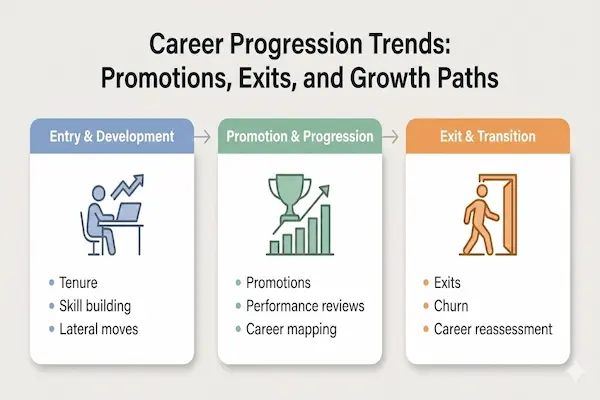
Leading indicators vs lagging indicators for career progress
Leading indicators are the behaviors and inputs you can control, because they measure whether you are doing the work that tends to create progress.
Lagging indicators are the external outcomes that arrive later, because promotions, raises, offers, and recognition often follow evidence with a delay.
Both matter, because leading indicators prevent you from panicking during quiet weeks, while lagging indicators tell you whether your strategy is landing in the real world.
Healthy tracking focuses on a small set, because too many metrics turns growth into surveillance and increases stress.
Examples of leading indicators you can control
- Weekly proof shipped, because outputs create portfolio evidence and make impact visible.
- Practice repetitions for a skill, because skills grow through repetition and feedback, not through intention.
- Stakeholder conversations completed, because relationships and alignment often unlock opportunities.
- Clarity artifacts created, because decision memos, plans, and documentation reduce confusion and increase trust.
- Recovery protected, because sustainable performance depends on energy and not only on effort.
Examples of lagging indicators that reflect external response
- Promotion readiness feedback, because managers usually promote what they can clearly defend with evidence.
- Scope expansion, because being trusted with bigger outcomes is a strong seniority signal.
- Compensation movement, because salary and bonuses often reflect perceived value and market leverage.
- Interview progression, because moving through rounds shows your story and proof are landing.
- Reputation signals, because referrals and being sought out often indicate growing trust.
The four categories of career progress indicators that matter most
Organizing indicators into categories helps you track balance, because career progress is not only performance and is also skills, proof, and sustainability.
These categories keep your system healthy, because they prevent you from measuring only what your anxiety cares about and ignoring what your wellbeing needs.
Category 1: performance metrics and business outcomes
Performance metrics matter because impact is often rewarded, and impact is easiest to communicate when it is tied to measurable outcomes.
Metrics do not need to be huge, because small measurable improvements still demonstrate judgment, ownership, and reliability.
- Cycle time reduced, because faster delivery often indicates better prioritization and process.
- Error rate reduced, because quality improvement shows maturity and systems thinking.
- Customer satisfaction improved, because customer outcomes reflect real value creation.
- Revenue influenced or protected, because commercial impact often accelerates recognition.
- Cost saved or avoided, because operational improvements can create large leverage over time.
Category 2: skill growth and competency development
Skill growth is the engine behind future opportunities, because even when outcomes vary by context, stronger competencies travel with you.
Competency growth becomes trackable when you define behaviors, because “better communication” becomes measurable when it becomes “clearer updates, fewer surprises, better decisions.”
- Stakeholder management skill: fewer escalations, clearer agreements, and faster approvals.
- Communication skill: shorter updates that still answer key questions, and improved audience understanding.
- Prioritization skill: clearer trade-offs, fewer last-minute emergencies, and better focus.
- Analytical thinking skill: stronger hypotheses, clearer recommendations, and better decision quality.
- Leadership skill: mentoring outcomes, better delegation, and increased trust from peers.
Category 3: portfolio evidence and proof of work
Portfolio evidence is a progress indicator because proof converts effort into credibility, especially when you are aiming for promotion or a pivot.
Evidence matters even if you are not in a creative field, because memos, plans, dashboards, process docs, and before-after metrics are all valid proof artifacts.
- Artifacts shipped per month, because consistency builds a library of evidence you can reuse.
- Quality of artifacts, because clarity and usefulness are stronger signals than volume.
- Reusability by others, because reusable work often indicates scalable value.
- Decision influence, because proof is stronger when your work changes priorities or outcomes.
- Story readiness, because a clear narrative about each artifact improves interviews and promotion talks.
Category 4: milestones, scope, and trust signals
Milestones matter because careers often progress through increasing scope, which is usually the clearest sign of readiness for more responsibility.
Trust signals are meaningful indicators, because being trusted with bigger outcomes often precedes the formal title change.
- Scope growth: owning a project end-to-end rather than owning tasks within it.
- Complexity growth: handling ambiguity, trade-offs, and competing priorities without needing rescue.
- Stakeholder breadth: working with more teams, or with more senior partners, with stable communication.
- Autonomy growth: making more decisions independently while keeping alignment clear.
- Leadership growth: mentoring, coaching, or improving systems that raise team performance.
Career progress indicators list: a practical menu you can pick from
Use this list as a menu rather than a mandate, because the healthiest tracking system is the one that matches your goals and your bandwidth.
Pick 6 to 10 indicators total, because fewer indicators are easier to sustain and easier to interpret.
Indicators for career progress at your current job
- One measurable outcome improved per quarter, because improvement demonstrates impact and ownership.
- One cross-functional project owned per quarter, because cross-functional work often signals readiness for higher scope.
- One visibility moment per month, because impact compounds when decision-makers can see it clearly.
- Feedback quality improved, because specific positive feedback often indicates your work is becoming clearer and more valuable.
- Fewer surprises, because predictability is often a hallmark of senior execution.
Indicators for skill growth without burnout
- Weekly practice sessions completed, because repetition is how skills become reliable.
- One targeted feedback request per month, because feedback accelerates improvement when it is specific.
- Evidence of improved behavior, because “I’m better” should become “I did X and the outcome changed.”
- Reduced friction in a recurring task, because efficiency often shows learning and systems thinking.
- Better recovery adherence, because burnout prevention is part of sustainable performance.
Indicators for career change or career pivot progress
- Portfolio artifacts built, because pivot credibility grows through proof.
- Role-reality conversations completed, because exploration reduces risk and improves fit.
- Targeted applications or outreach batches, because a structured approach reduces emotional exhaustion.
- Interview progression rate, because it shows whether your story and evidence align with the market.
- Skill gap closure with proof, because “learned” becomes believable when it becomes “delivered.”
Simple tracking sheet: copy-ready and lightweight
This tracking sheet is designed to be quick, because tracking should support your life, not consume it.
Keep the sheet in one place, because scattered tracking increases friction and reduces consistency.
Weekly tracking sheet template
CAREER PROGRESS TRACKING SHEET (WEEKLY)

Week of: __________

1) My top outcomes (choose 1–2)
- Outcome I’m driving:
- Metric or evidence:
- Current status:

2) My skill focus (choose 1)
- Skill/competency:
- Behavior I’m practicing:
- Repetitions this week:

3) My proof and portfolio evidence (choose 1)
- Artifact shipped:
- Who saw it:
- What changed because of it:

4) My milestones and scope (choose 1)
- Responsibility I expanded:
- Decision I owned:
- Stakeholders I aligned:

5) My sustainability (choose 1–2)
- Hours worked beyond normal:
- Recovery actions protected:
- Stress level (1–10):

6) Notes
- What worked:
- What didn’t:
- One adjustment for next week:
Monthly tracking sheet template
CAREER PROGRESS TRACKING SHEET (MONTHLY)

Month: __________

1) Outcomes delivered (3 bullets):
-
-
-

2) Skill growth evidence (3 bullets):
-
-
-

3) Portfolio evidence shipped (artifacts):
-
-
-

4) Scope and trust signals:
-
-
-

5) Sustainability check:
- What supported my energy:
- What drained my energy:
- Boundary I will protect next month:

6) Next month focus:
- Outcome focus:
- Skill focus:
- Proof focus:
Monthly review ritual: track career progress without turning it into pressure
A monthly review ritual works because it creates a calm reset point, which prevents you from judging yourself daily and overreacting to normal ups and downs.
Monthly timing is ideal for many professionals, because it balances reflection with action without creating constant monitoring.
Your goal is to adjust your strategy, not to punish yourself, because healthy tracking should feel supportive and realistic.
15-minute monthly review ritual
- Review what you shipped and what changed, because outputs and impact are the most concrete progress signals.
- Scan your skill focus and evidence, because skill growth is the foundation of future opportunities.
- Check milestones and scope, because trust signals often precede titles and formal recognition.
- Review sustainability indicators, because progress that costs your health is not progress you can keep.
- Choose next month’s focus in one sentence, because focus reduces overwhelm and increases follow-through.
- Ask: “What created the most impact per hour,” because leverage protects you from burnout.
- Ask: “What felt heavy and why,” because heaviness often indicates misalignment or a process problem.
- Ask: “What would make next month easier,” because improving systems is often the fastest progress accelerator.
- Ask: “What is one boundary I will protect,” because boundaries make progress sustainable.
Common tracking mistakes that increase burnout
Tracking can become harmful when it becomes obsessive, because obsessive measurement turns your career into a performance treadmill.
These pitfalls are common for conscientious professionals, because conscientious people often respond to uncertainty by working harder rather than by measuring smarter.
- Tracking too many metrics, because too many numbers create anxiety and hide what matters most.
- Tracking only lagging outcomes, because promotions and raises move slowly and can make you feel stuck even when you are growing.
- Ignoring sustainability, because progress that drains you will eventually reverse when burnout hits.
- Measuring effort instead of value, because long hours do not automatically translate into better outcomes.
- Comparing to others constantly, because other people’s timelines are not your metrics and can distort your priorities.
- Using tracking as self-criticism, because shame reduces learning and increases avoidance.
- Reduce to a small indicator set, because simplicity is the strongest burnout prevention feature.
- Include at least one sustainability indicator, because health is a prerequisite for consistent growth.
- Track proof shipped, because evidence builds confidence faster than vague effort.
- Review monthly, because monthly rhythm reduces emotional volatility and keeps you focused on patterns.
Build your personal indicator set in 10 minutes
Creating your own set is the final step, because your tracking should match your current goal, whether you are aiming for promotion, skill growth, or a career pivot.
Choose indicators that reflect your life season, because the healthiest career strategy adapts to your current capacity and priorities.
Quick setup instructions
- Pick one outcome indicator, because one clear business outcome creates focus.
- Pick one skill growth indicator, because one skill focus prevents scattered learning.
- Pick one portfolio evidence indicator, because proof turns work into credibility.
- Pick one milestone or scope indicator, because scope growth is often the clearest sign of advancement.
- Pick one sustainability indicator, because sustainable progress is the only kind that lasts.
- Decide your monthly review date, because routine keeps the system alive.
- Promotion-focused set example: scope owned, stakeholder feedback, measurable outcome, proof artifacts, recovery adherence.
- Pivot-focused set example: portfolio pieces shipped, role-reality conversations, skill gap proof, interview progression, stress level.
- Stability-focused set example: workload boundaries, role clarity, manager feedback cadence, predictable outcomes, energy stability.
Final note and independence disclaimer
Healthy career progress indicators help you measure what matters without turning your life into constant pressure, because they keep you grounded in evidence, patterns, and sustainable pacing.
Choose a small set, track it weekly in minutes, review monthly with compassion, and adjust your plan based on what your data and your energy are telling you.
Notice: This content is independent and has no affiliation, sponsorship, or control over any institutions, platforms, or third parties mentioned.