
Vague goals feel safe because they avoid the risk of being “wrong,” yet they often create the exact problem you are trying to solve, which is stalling without progress you can measure.
This guide shows how to apply SMART goals for career growth step by step, with clear examples, a copy-ready worksheet, a review cadence, and the common traps that keep good professionals stuck.
SMART goals for career: why the SMART framework stops stalling
The SMART framework works because it turns an intention into an executable plan, which means you can stop guessing what to do next and start taking actions you can track.
Career goals stall when they are abstract, because “become better,” “grow,” or “advance” cannot be scheduled, measured, or proven in a way a manager or hiring team would recognize.
SMART goal planning creates clarity, because it forces you to define what success looks like, how you will measure it, and what evidence will show you are progressing.
Productivity improves when goals become specific, because you can choose weekly actions that move the goal forward instead of doing busywork that feels productive but changes nothing.
Accountability becomes realistic when the goal is measurable, because you can review progress with data rather than with vague feelings or last-minute scrambling.
- SMART goals reduce decision fatigue, because you no longer have to reinvent your priorities every week.
- SMART goals reduce anxiety, because uncertainty drops when you can see what you are building and how you will know it is working.
- SMART goals increase credibility, because measurable milestones create proof that supports promotion discussions and job searches.
- SMART goals protect against burnout, because a well-designed goal includes an achievable scope and a realistic timeline.
What SMART stands for, and how to use it for career goals
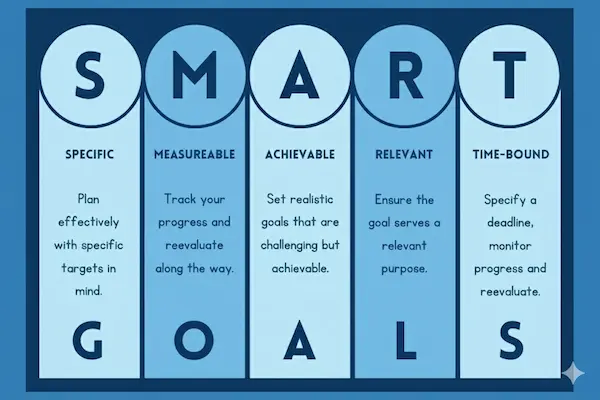
SMART stands for Specific, Measurable, Achievable, Relevant, and Time-bound, and the point is not academic correctness and the point is practical execution.
Career goals benefit from a slightly upgraded SMART approach, because careers often require proof for other people, not just internal satisfaction.
In other words, your goal should describe the outcome you want and the evidence that will convince a decision-maker that you are ready.
S: Specific
Specific means your goal names a target outcome, a role scope, or a concrete deliverable, because specificity makes action planning possible.
- Weak: “Become a better leader.”
- Stronger: “Lead one cross-functional project end-to-end and run weekly alignment meetings.”
- Stronger: “Prepare for promotion by owning an outcome, presenting results, and mentoring one peer.”
M: Measurable
Measurable means you define indicators of progress, because measurement helps you see improvement before a title or salary change happens.
- Numbers count, because metrics are easy to communicate.
- Observable indicators also count, because not every role has clean revenue metrics.
- Evidence counts most, because evidence is what managers and hiring teams can validate.
A: Achievable
Achievable does not mean small, because achievable means feasible given your constraints, your time, your current workload, and your resources.
- A goal is not achievable if it requires constant overtime, because burnout is not a sustainable strategy.
- A goal becomes achievable when you scope it properly, because smaller milestones create momentum and learning.
- Achievable improves when you remove friction, because scheduling time blocks is often more important than motivation.
R: Relevant
Relevant means the goal supports your career direction and your values, because goals that do not matter to you will quietly die when work gets busy.
- Relevance can be internal, because you want work that fits your strengths and energy patterns.
- Relevance can be external, because the goal should align with what your team and organization reward.
- Relevance should include context, because life constraints matter and should shape what you commit to.
T: Time-bound
Time-bound means you set a deadline and milestone checkpoints, because deadlines create urgency and checkpoints keep you from drifting.
- Use a review date, because review prevents panic and helps you adjust early.
- Use 30/60/90-day milestones, because shorter horizons are easier to execute and track.
- Use one weekly action, because weekly rhythm is what turns a goal into reality.
Step-by-step: how to create SMART goals for career growth
Follow these steps in order, because the sequence prevents you from picking an impressive goal before you know how you will measure and prove it.
Keep your goal count small, because focus is the main driver of execution, especially for professionals who tend to set vague goals and stall.
Step 1: choose one primary career outcome
Choose one outcome because one outcome makes your weekly actions coherent, while multiple outcomes often create scattered effort and weak proof.
- Select the outcome type: promotion, role change, scope increase, or skill upgrade.
- Define the “end state” in plain language, because you should be able to explain it quickly.
- Decide who needs to believe it, because the proof you need depends on your audience.
Step 2: define what “measurable” looks like in your context
Measurement can include metrics, artifacts, and behavior change, because career progress often happens through trust and scope before it happens through titles.
- Choose 1–3 indicators, because too many indicators create confusion and reduce follow-through.
- Choose at least one proof artifact, because artifacts make your progress visible.
- Define a baseline if possible, because baselines make improvement easier to demonstrate.
Step 3: make it achievable by scoping the plan, not by shrinking your ambition
Scope is the lever, because you can keep ambition high while reducing risk by breaking the goal into milestones and weekly actions.
- Define a 30-day milestone that creates momentum, because early wins reduce stalling.
- Define a 60-day milestone that creates proof, because proof builds credibility.
- Define a 90-day milestone that increases scope or visibility, because visibility helps outcomes get recognized.
- Schedule one weekly deep-work block, because time protection is what makes the plan feasible.
Step 4: confirm relevance with a quick filter
This filter prevents you from setting goals that look good on paper but do not move your career or your life in the direction you actually want.
- Will this goal increase my future options, because optionality is a strong form of career security.
- Will this goal align with my strengths, because strengths create faster evidence and better sustainability.
- Will this goal be rewarded where I work, because some environments reward certain outcomes more than others.
- Will this goal respect my constraints, because goals that require a different life tend to collapse.
Step 5: add time boundaries and a review cadence
A review cadence is how you avoid stalling, because you build a feedback loop that keeps you moving even when motivation dips.
- Choose a deadline that is realistic, because a fake deadline creates guilt rather than urgency.
- Set a weekly check-in with yourself, because weekly review prevents drift.
- Set a monthly reset, because monthly resets keep your goal aligned with reality.
SMART examples: practical career goals you can copy and adapt
Examples reduce confusion because they show how to translate vague ambition into measurable actions and milestones.
Use these examples as templates, because the best SMART goals for career growth are personalized to your role, your constraints, and your evidence opportunities.
Example 1: promotion planning SMART goal
SMART goal: Within 6 months, earn readiness for promotion to Senior by leading one cross-functional initiative end-to-end, improving a defined metric by an agreed target, and presenting results to leadership, with monthly progress reviews and weekly evidence updates.
- Specific: promotion readiness and leading an initiative.
- Measurable: metric improvement, presentation delivered, evidence updates.
- Achievable: staged reviews, one initiative rather than many.
- Relevant: aligned with scope and leadership expectations.
- Time-bound: 6 months with monthly reviews.
Example 2: skill building SMART goal for executive communication
SMART goal: Over the next 8 weeks, improve executive communication by sending a concise weekly status update using a consistent structure, delivering two short presentations, and collecting feedback from two senior stakeholders on clarity and decision readiness.
- Metrics: weekly updates sent, presentations completed, feedback received.
- Milestones: week 2 first update, week 4 first presentation, week 8 second presentation plus feedback summary.
- Proof: saved updates and presentation notes as portfolio evidence.
Example 3: SMART goal for a career pivot using proof artifacts
SMART goal: In 12 weeks, build credibility for a career transition into [target role theme] by completing two role-relevant projects, producing three proof artifacts, and having six role-reality conversations, while tracking weekly progress and adjusting based on feedback.
- Measurable: two projects completed, three artifacts created, six conversations completed.
- Achievable: weekly rhythm rather than daily intensity.
- Relevant: aligns learning with proof and role reality.
- Time-bound: 12 weeks.
Example 4: SMART goal for workload and scope alignment
SMART goal: Over the next 30 days, clarify role scope by documenting my weekly responsibilities, aligning top three priorities with my manager, deprioritizing at least two low-impact tasks, and setting a recurring biweekly scope review to prevent scope creep.
- Measurable: responsibilities logged, priorities agreed, tasks deprioritized, review cadence established.
- Proof: scope summary message and decision log.
- Outcome: reduced overload and clearer expectations.
Example 5: SMART goal for building a portfolio of measurable results
SMART goal: In 10 weeks, produce three portfolio-ready case studies by documenting three projects with outcomes, constraints, and measurable results, and by getting one round of feedback from a peer or manager for each case.
- Measurable: three cases written, three feedback rounds completed.
- Achievable: one case every three weeks, plus review time.
- Proof: portfolio artifacts stored and reusable.
Goal worksheet: fill in your SMART goals for career growth
This worksheet is designed to be short, because short templates get used, and usage is what prevents stalling.
Copy the worksheet and fill it in one sitting, because momentum starts when you stop negotiating and start writing.
SMART GOALS FOR CAREER WORKSHEET (COPY AND FILL)

1) My career direction (one sentence):
-

2) My primary outcome goal:
- Specific outcome:
- Deadline:
- Why it matters (relevance):
- Who needs to see the proof:

3) SMART breakdown
S (Specific):
M (Measurable indicators, 1–3):
A (Achievable scope and resources):
R (Relevant to my direction and constraints):
T (Time-bound milestones):

4) Milestones (30 / 60 / 90 days)
- 30-day milestone:
- 60-day milestone:
- 90-day milestone:

5) Weekly execution plan
- Weekly deep-work block (day/time):
- Weekly proof deliverable:
- Weekly visibility action:
- Weekly accountability check-in:

6) Proof and portfolio evidence
- Artifact I will save:
- Metric or indicator I will track:
- Story I will be able to tell:

7) Risks and mitigations
- Biggest risk:
- Mitigation action:
- Fallback plan if I miss a week:
Review cadence: the accountability system that prevents stalling
A review cadence is how you keep going when motivation dips, because the system carries you when willpower is busy or low.
Keep it simple, because simple systems are the ones you actually maintain long enough to see results.
Weekly review in 10 minutes
- What did I complete, because completion creates evidence and confidence.
- What moved the goal forward, because activity is not the same as progress.
- What blocked me, because blockers reveal what needs redesign rather than self-blame.
- What is the single highest-leverage action next week, because one strong move beats five shallow tasks.
- What proof will I save, because saved evidence becomes career leverage later.
Monthly review in 15 minutes
- Review milestone progress, because milestones prevent drift.
- Review evidence quality, because proof is what converts effort into promotions and offers.
- Adjust scope if needed, because achievable goals respect reality.
- Choose next month’s focus, because focus prevents vague goal creep.
- Set a calendar block for the next month, because scheduling protects execution.
Common traps with SMART goal planning, and how to avoid them
SMART goals can still fail when people treat them like paperwork, because the framework is only useful when it produces weekly action and visible evidence.
These traps are especially common for professionals who set vague goals and stall, because vagueness often hides fear of committing to a measurable outcome.
Trap 1: making goals “SMART” but not meaningful
A goal can be measurable and still be irrelevant, because you can measure something that does not move your career forward.
- Fix: tie the goal to an outcome decision-makers value, such as scope ownership, measurable impact, or clear proof artifacts.
- Fix: use the relevance filter, because relevance protects your energy and attention.
Trap 2: choosing too many metrics
Too many metrics creates monitoring anxiety, because you start tracking everything and then avoid the tracker when you fall behind.
- Fix: choose one primary metric and two supporting indicators, because simplicity increases consistency.
- Fix: track proof shipped, because evidence is often more useful than perfect numbers.
Trap 3: setting a goal that requires a different life
Goals fail when they assume unlimited capacity, because real life will always introduce stress, meetings, family demands, and unpredictable work cycles.
- Fix: design for a “busy week,” because if the goal cannot survive a busy week it will not survive three months.
- Fix: create a minimum viable weekly version, because continuity beats intensity.
Trap 4: confusing learning with proof
Learning feels productive, yet career movement often requires proof, because managers and hiring teams reward what they can see and trust.
- Fix: attach an artifact to the goal, because artifacts convert learning into credibility.
- Fix: make the weekly deliverable something you can show, because shown work is easier to evaluate and support.
Trap 5: skipping review cadence and hoping motivation holds
Stalling often returns when you stop reviewing, because without reviews you lose feedback loops and drift into busywork.
- Fix: schedule weekly and monthly reviews, because scheduling is the simplest accountability system.
- Fix: review with one person when possible, because social accountability improves follow-through.
Decision-ready checklist: create your SMART career goal today
This checklist is short because the goal is to act, since action is what breaks vague planning loops.
- Choose one career outcome you want in the next 3–6 months, because focus reduces stalling.
- Write the SMART goal in one paragraph, because clarity should fit in your head, not only in a document.
- Choose 1–3 measurable indicators, because too many measures create noise and anxiety.
- Define 30/60/90-day milestones, because milestones create realistic momentum.
- Schedule one weekly deep-work block, because time protection is the difference between intention and progress.
- Define one weekly proof deliverable, because proof is how career goals become credible.
- Schedule a weekly review, because review cadence is the antidote to stalling.
Final note and independence disclaimer
SMART goals for career growth work when they are specific, measurable, and tied to proof, because proof is what turns your effort into trust, opportunities, and momentum.
Keep the plan simple, review it weekly, and ship evidence consistently, because small measurable progress is how vague goals become real outcomes.
Notice: This content is independent and has no affiliation, sponsorship, or control over any institutions, platforms, or third parties mentioned.