
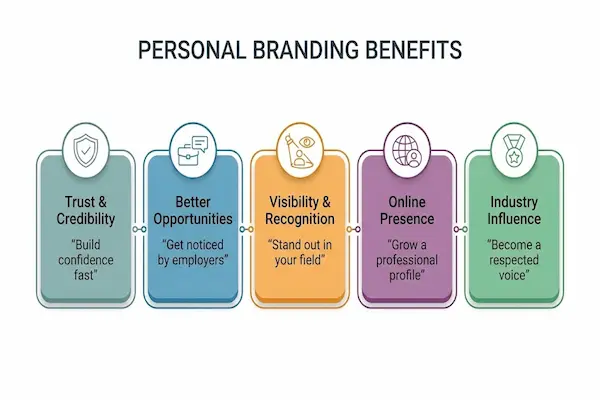
Visibility gets easier when your professional presence tells one clear story, because people cannot remember what they cannot quickly understand.
Better-fit opportunities show up more often when your positioning is consistent across your LinkedIn profile, your portfolio, and the way you talk about your work.
Personal branding strategy: what a personal brand really is
A personal brand is not a logo, a color palette, or a loud online persona, because the real asset is the reputation that forms when others describe your value without you in the room.
Professional reputation grows through repeated evidence, because people trust patterns of outcomes more than they trust bold claims about potential.
Positioning is the short, clear story that makes your brand usable, because a brand becomes valuable only when it helps someone decide how you fit a need.
Coherence matters because mixed messages dilute trust, since a profile that says “strategic leader” but shows only task work creates uncertainty and uncertainty kills momentum.
Authenticity is practical rather than emotional, because the most authentic brand is simply the most accurate representation of how you create value in real projects.
Consistency does not mean you become repetitive, because you can express the same positioning through different examples, formats, and stories while staying aligned.
- Trust increases when your profile shows proof, because hiring managers and clients prefer evidence over adjectives.
- Clarity improves when you pick a lane for now, because focus makes your message easier to remember and easier to share.
- Energy stays healthier when you avoid performance, because building a coherent presence should feel like organizing truth rather than acting.
- Opportunity expands when you become referable, because referrals happen faster when others can summarize your value in one sentence.
How positioning works: the shortest definition you can use
Positioning answers one question in plain language, which is “What do you help with, for whom, and why should I trust you,” because that is what decision-makers are silently asking.
Strong positioning is specific enough to be meaningful, yet broad enough to be flexible across companies and industries, because careers are dynamic even when your core strengths stay steady.
Good positioning avoids buzzwords, because buzzwords sound impressive while offering no decision-making value.
Simple language wins because it lowers cognitive load, since the easier your message is to process, the more likely it is to be remembered.
Credibility appears when you attach evidence, because “I’m great at strategy” is weak while “I reduced cycle time by redesigning a workflow and aligning stakeholders” is believable.
A useful personal branding strategy makes you easier to place, because people can quickly see where you fit and what kinds of problems you can solve.
Positioning framework: build your personal branding strategy in 5 parts
This framework works because it turns fuzzy self-description into a structured set of choices, which you can refine without reinventing your identity every month.
Each part creates an output you can copy into your LinkedIn profile, your portfolio intro, and your bio, because coherence comes from using the same core message in multiple places.
Part 1: define your target audience in a practical way
Audience is not “everyone,” because people remember specialists and clear role themes more easily than generalists who claim to do everything.
Targeting does not trap you, because you can choose an audience for the next season and adjust later as you learn.
- Pick a role theme or problem space, because role themes translate better than job titles across companies.
- Name the stakeholder type you serve, because “operators” and “founders” and “team leads” have different needs and language.
- Choose a context where your work shows up, because “fast-moving teams” and “regulated environments” reward different strengths.
- Write a one-sentence audience statement, because a single sentence keeps your outreach and content focused.
- Audience example: “Cross-functional teams that need predictable delivery and clearer ownership.”
- Audience example: “Leaders who need decisions supported by clear data and trade-offs.”
- Audience example: “Teams adopting complex tools who need enablement and playbooks to perform.”
Part 2: define the value you create in outcomes, not activities
Value should be phrased as an outcome, because outcomes are what organizations pay for and promote.
Activities are not useless, yet they are not enough, because “I run meetings” is an activity while “I reduce confusion and accelerate decisions” is value.
- List three outcomes you have delivered, because past outcomes are the most credible indicator of future value.
- Translate each outcome into a business benefit, because benefits are what stakeholders care about most.
- Choose one primary value theme, because one primary theme makes your message sharper and easier to remember.
- Value theme examples include “reducing operational chaos,” “improving decision quality,” “accelerating onboarding,” and “increasing delivery reliability.”
- Value language should stay plain, because clarity is more persuasive than complexity.
- Value should be testable, because you want a promise you can prove through projects and evidence.
Part 3: specify your method, meaning how you do the work
Method is your signature approach, because it turns your positioning from generic to recognizable.
Methods can be technical or behavioral, because some professionals lead with analysis while others lead with facilitation, systems thinking, or execution discipline.
- Choose 2–3 core strengths you use repeatedly, because repeating strengths becomes your professional pattern.
- Describe those strengths as behaviors, because behaviors are more believable than labels.
- Add one sentence about your working style, because fit matters and your style helps others predict collaboration.
- Behavior examples include “turns ambiguity into a plan,” “documents decisions and trade-offs,” “aligns stakeholders early,” and “simplifies complexity into usable steps.”
- Working style examples include “calm under pressure,” “direct and respectful,” and “system-first rather than hero-first.”
- Method should match your actual practice, because a personal brand collapses when it contradicts lived behavior.
Part 4: build credibility with proof points, not self-belief
Proof points are the fastest trust builder, because they replace persuasion with evidence.
Proof can be numbers, artifacts, or stories, because not every role produces clean metrics and artifacts still demonstrate judgment.
- Collect 5 proof points, because five is enough to feel credible without overwhelming your profile.
- Write each proof point in one line, because brevity increases readability and shareability.
- Attach a context line when needed, because constraints make outcomes more impressive and more believable.
- Metrics proof includes cycle time reduced, error rate lowered, churn reduced, conversion improved, or costs avoided.
- Artifact proof includes decision memos, playbooks, process maps, onboarding guides, dashboards, or project plans.
- Story proof includes a clear before-and-after narrative showing what changed because of your work.
Part 5: differentiate without trashing other people
Differentiation is about contrast, not criticism, because you can position yourself positively without implying others are worse.
A credible differentiator is specific, because “I’m passionate” is common while “I document decisions so teams stop relitigating the same debate” is distinct.
- Identify what you do unusually well, because uniqueness often lives in the details of your approach.
- Choose a differentiator that matters to your audience, because differentiation is only useful when the market cares.
- Write it as a benefit, because benefits make differentiation feel relevant rather than ego-driven.
- Differentiator examples include “clarity-first communication,” “systems thinking under constraints,” “calm execution in messy environments,” and “teaching complex topics with simple tools.”
- Ethical positioning avoids exaggeration, because overpromising creates short-term attention and long-term distrust.
- Practical differentiation should show up in your content and examples, because repetition builds credibility.
Positioning outputs: copy-ready lines you can use immediately
Copy-ready lines reduce procrastination, because you can start with a strong draft and refine later based on feedback and results.
Each line below is designed to be edited, because the best personal branding strategy is built through iteration rather than through one perfect writing session.
One-sentence positioning statement
I help [audience] achieve [outcome] by [method], using proof like [evidence type].Example: I help cross-functional teams achieve predictable delivery by simplifying workflows and aligning stakeholders, using proof like before-and-after metrics and decision logs.
LinkedIn headline formula
[Role theme] | I help [audience] achieve [outcome] | [proof / differentiator]Example: Operations & Program Delivery | I help teams reduce chaos and ship reliably | Process clarity, stakeholder alignment, measurable outcomes.
Short bio formula for introductions
I work on [role theme], focusing on [outcome], often by using [method], and I’m currently looking for [opportunity type].Example: I work on analytics and decision support, focusing on clearer trade-offs and better prioritization, often by translating data into simple recommendations, and I’m currently looking for roles with strong collaboration.
LinkedIn profile checklist: turn your positioning into a coherent presence
A LinkedIn profile works best when it reads like a single story, because scattered claims create confusion and confusion reduces responses.
Recruiters and hiring managers skim quickly, so your top section should carry the whole message, because many viewers never scroll past the first screen.
Top section checklist
- Headline reflects your role theme and outcome, because titles alone do not explain your value.
- About section starts with your positioning sentence, because clarity should appear immediately.
- Proof points appear near the top, because evidence is more persuasive than self-description.
- Current role description includes outcomes, because outcomes show how you create value today.
- Location and work preference are accurate, because mismatches waste time for both sides.
About section structure that stays readable
- Open with your positioning in one sentence, because the first line determines whether people keep reading.
- Add 3 proof bullets, because bullets are skimmable and memorable.
- List your role themes in plain language, because clarity beats internal jargon.
- Close with what you are open to, because a clear ask increases referrals and opportunities.
Experience section upgrades that signal seniority
- Start bullets with outcomes, because impact-first writing reads more senior than task-first writing.
- Include scope words like “owned,” “led,” and “aligned,” because scope signals trust and responsibility.
- Highlight trade-offs and decisions, because decision-making is a core marker of senior performance.
- Add artifacts when relevant, because tangible outputs prove your working style and judgment.
- Keep each bullet tight, because dense paragraphs are rarely read and often skipped.
Portfolio basics: create proof even if you are not in a “portfolio field”
A portfolio is simply a curated set of proof, because proof makes your claims more believable and gives you stronger interview stories.
Portfolios are useful for operators, analysts, leaders, and career changers, because documents, plans, and case studies demonstrate how you think and deliver.
Confidentiality matters, so your portfolio should avoid private data and sensitive details, because trust is part of your professional reputation.
Three portfolio formats that work for most professionals
- Case study format, because a before-and-after story is easy for others to understand.
- Artifact library format, because a set of cleaned, generalizable outputs shows how you work.
- Project narrative format, because a concise narrative demonstrates decision-making under constraints.
Case study template you can reuse
- Problem: describe the real issue in one sentence, because clarity starts with a clean problem statement.
- Context: describe constraints and stakeholders, because reality makes your decisions credible.
- Approach: list your steps, because steps show method and repeatability.
- Output: show what you produced, because outputs make your work tangible.
- Impact: state what changed, because change is the proof people care about.
- Lessons: state what you would do differently, because reflection signals maturity and growth.
Professional reputation: build visibility without becoming “online” all day
Visibility is not the same as constant posting, because your goal is to become known for a clear type of value, not to become a content machine.
Reputation grows when people can rely on you, because reliability is one of the most transferable signals across industries and roles.
Strategic visibility means your work becomes legible, because many careers stall simply because impact is not communicated clearly.
Low-effort reputation builders that compound
- Write short updates that highlight outcomes and decisions, because leaders care about clarity and risk reduction.
- Document workflows and share reusable resources internally, because reusability is a strong signal of scalable value.
- Offer help in high-leverage moments, because timely support builds trust faster than constant availability.
- Close loops consistently, because follow-through is rare and therefore memorable.
- Ask for specific feedback, because targeted feedback accelerates growth and improves your positioning language.
Bio examples by profile: choose one that fits your style
Examples help because they show what “clear” sounds like, while still leaving room for your actual details and evidence.
Each example is designed to be spoken comfortably, because a bio that sounds natural is easier to repeat consistently across interviews and networking.
Profile 1: operations and systems builder
- I help teams reduce operational chaos by building simple workflows, clear ownership, and documentation that makes delivery more predictable.
- My work usually shows up as improved cycle time, fewer handoff errors, and calmer execution during busy periods.
- I’m looking for roles where process improvement and stakeholder alignment are valued and measured.
Profile 2: analytical decision support professional
- I help leaders make better decisions by turning complex data into clear insights and practical recommendations.
- My strength is connecting metrics to trade-offs, so teams prioritize the right work instead of chasing noise.
- I’m seeking opportunities where clarity, rigor, and collaboration matter more than flashy dashboards.
Profile 3: customer-facing problem solver
- I help customers succeed by diagnosing issues quickly, communicating clearly, and creating repeatable guidance that reduces future friction.
- My best work happens when I can translate messy situations into simple next steps that protect relationships and outcomes.
- I’m exploring teams that value customer empathy, clear ownership, and sustainable workload boundaries.
Profile 4: enablement, training, and communication leader
- I help teams perform better by turning complex knowledge into playbooks, training, and habits that stick.
- My approach focuses on clarity and behavior change, so new hires ramp faster and teams execute with more confidence.
- I’m looking for environments that invest in learning and reward documentation-driven execution.
Profile 5: career changer building credibility
- I’m transitioning into [role theme] by leveraging my strengths in structured problem-solving, stakeholder communication, and reliable execution.
- I’m building proof through small projects and artifacts that demonstrate the work, so my pivot is based on evidence rather than hype.
- I’m open to opportunities where I can own outcomes, learn quickly, and contribute with clarity from day one.
Content ideas: build visibility with a simple, non-gimmicky plan
Content should serve your positioning, because random posting creates noise rather than reputation.
A sustainable plan uses reusable themes, because repetition is what makes your audience associate you with a category of value.
Quality beats volume, because one thoughtful post that demonstrates judgment can outperform ten generic posts that say nothing new.
Choose 3 content pillars that match your positioning
Content pillars keep you focused, because they reduce the effort of deciding what to write each time.
- Pillar 1: your domain or role theme, because expertise builds trust when you teach what you practice.
- Pillar 2: your method, because method differentiation makes your brand memorable.
- Pillar 3: your proof and lessons, because learning stories show maturity and credibility.
- Operations pillars might include process clarity, stakeholder alignment, and measurable improvements.
- Analytics pillars might include decision hygiene, metric design, and communicating trade-offs.
- Enablement pillars might include onboarding systems, teaching methods, and behavior change tactics.
Content formats that do not require being a “creator”
- Short lessons learned, because brief reflections are easier to write and still show judgment.
- Templates and checklists, because practical tools create usefulness and shareability.
- Before-and-after stories, because transformation narratives are memorable and evidence-driven.
- Myth versus reality posts, because they clarify misconceptions and position you as someone who understands the work deeply.
- Question-driven posts, because good questions signal strategic thinking and invite conversation without self-promotion.
Weekly content routine in 45 minutes
- Capture one insight from your week, because the easiest content comes from work you already did.
- Write one practical takeaway, because usefulness builds trust faster than opinion alone.
- Add one example or proof line, because evidence keeps the post grounded and credible.
- End with one question, because questions create engagement without forcing a “look at me” tone.
- Save drafts in a simple list, because batching reduces friction and makes consistency easier.
Relationship building: use your brand to create referrals ethically
Referrals happen more often when your positioning is crisp, because people hesitate to refer when they cannot clearly explain what you do.
Ethical outreach is specific and low-pressure, because pressure damages relationships while clarity strengthens them.
Message templates for non-salesy networking
- Role-reality ask: “I’m exploring [role theme] and I’m trying to understand day-to-day work, so could I ask you 3 questions in 15 minutes.”
- Warm reconnection: “I appreciated how you handled [specific moment], and I’m currently focusing on [direction], so I’d enjoy a quick catch-up if you’re open.”
- Targeted insight: “If you had to pick one skill that separates okay from strong in this work, what would it be, and what proof matters most.”
- Referral check: “This role looks aligned with my background in [strengths], so would you be comfortable sharing whether a referral makes sense, with no pressure.”
- Follow-ups should be polite and limited, because one follow-up is professional while repeated nudging becomes pressure.
- Gratitude should include a takeaway, because specific thanks shows you listened and respected their time.
- Closing loops builds trust, because updating someone after they helped you signals professionalism.
Personal brand decision filter: use a scoring method for alignment
A decision filter keeps your brand coherent, because it prevents you from saying yes to opportunities that pull you away from your positioning and your goals.
Scoring reduces emotional whiplash, because it helps you compare options using priorities rather than mood.
Positioning-alignment scoring criteria
- Outcome fit: this role lets me create my core value weekly, because occasional alignment is not enough for long-term satisfaction.
- Method fit: this environment rewards my way of working, because method mismatch creates friction even when the work is interesting.
- Proof potential: this role will generate evidence I can reuse, because portfolio evidence strengthens reputation and future optionality.
- Culture fit: this team environment is respectful and sustainable, because toxic environments erode confidence and health.
- Growth fit: this role expands scope over time, because career growth often requires increasing ownership and decision rights.
Simple scoring matrix template
| Criteria | Weight (1–3) | Option A Score (1–5) | Option A Weighted | Option B Score (1–5) | Option B Weighted | Notes |
|---|---|---|---|---|---|---|
| Outcome fit | 3 | |||||
| Method fit | 2 | |||||
| Proof potential | 2 | |||||
| Culture fit | 3 | |||||
| Growth fit | 2 | |||||
| Total |
Profile checklist: audit your professional presence in 20 minutes
An audit is the fastest way to find gaps, because you can improve your presence without starting from scratch.
Small updates often create large changes, because clarity compounds when every section reinforces the same story.
Coherence audit checklist
- Headline matches the work I want next, because old labels attract old opportunities.
- About section states value and audience clearly, because clarity drives better responses.
- Experience bullets show outcomes, because outcomes prove readiness for better scope.
- Skills listed support the positioning, because unrelated skills create confusion.
- Proof exists in some form, because evidence is the bridge between interest and trust.
- Language is consistent across sections, because consistency makes your brand feel real and reliable.
- Contact and availability info is accurate, because friction can block opportunities even when fit is strong.
Pitfalls to avoid: what breaks a personal branding strategy
Most brand mistakes are not moral failures, because they usually come from trying to sound impressive rather than trying to be understood.
Fixes are often simple, because clarity is a writing problem and not a personality problem.
- Being too broad, because “open to anything” prevents referrals and makes you forgettable.
- Being too abstract, because generic adjectives do not create credibility or differentiation.
- Overclaiming, because exaggeration creates short-term attention and long-term distrust.
- Hiding proof, because buried evidence forces others to guess whether you are credible.
- Chasing trends, because trend-chasing creates inconsistency and weakens coherence.
- Posting without a theme, because random content does not build a recognizable reputation.
- Replace buzzwords with outcomes, because outcomes are testable and persuasive.
- Replace vague strengths with behaviors, because behaviors make you believable.
- Replace scattered skills with a coherent skill stack, because coherence makes you easier to place.
- Replace pressure-driven outreach with a weekly routine, because consistency feels human and builds trust.
30–60–90 day plan: implement your personal branding strategy
A timeline prevents endless tweaking, because your presence becomes better through use and feedback, not through perfection.
Progress indicators keep it healthy, because you should not turn personal branding into a second job or a source of stress.
Days 1–30: clarify and update the basics
- Write your positioning statement and headline, because the top of your profile drives most first impressions.
- Create a proof snapshot with three outcomes, because evidence strengthens everything else.
- Update your About section using the structure above, because readability increases responses.
- Rewrite your last two roles with outcome-first bullets, because recent evidence is the strongest credibility signal.
- Build one simple portfolio case study, because one proof asset is better than none.
Days 31–60: build visibility through usefulness
- Choose three content pillars, because pillars keep your voice consistent without effort.
- Publish one useful post per week, because weekly consistency builds recognition without burnout.
- Send two respectful outreach messages per week, because small relationship-building reps compound.
- Track conversations and insights, because tracking reduces anxiety and improves follow-through.
- Collect feedback on your positioning sentence, because external mirrors help you refine language quickly.
Days 61–90: strengthen proof and increase opportunity flow
- Add two more proof artifacts or case studies, because a set of three makes your narrative stronger.
- Refine your bio and practice it, because spoken clarity improves interviews and networking conversations.
- Use your decision filter to evaluate opportunities, because coherence protects your long-term reputation.
- Ask for one referral or introduction appropriately, because asking becomes easier when your message and proof are clear.
- Run a monthly review and adjust, because iteration keeps the plan realistic and aligned with your life.
Final note and independence disclaimer
A personal branding strategy works when it is truthful, coherent, and evidence-based, because those qualities make you easier to trust and easier to recommend for better-fit opportunities.
Notice: This content is independent and has no affiliation, sponsorship, or control over any institutions, platforms, or third parties mentioned.