
Career choices can feel emotionally loud, especially when every option has real upside and real risk, and your brain keeps changing its mind depending on the day.
This career decision matrix gives you a clear scoring method to compare roles, offers, or paths using priorities, risk assessment, and a worked example you can copy.
Career decision matrix: why a scoring method beats endless pros and cons
Pros and cons lists are useful, yet they often fail when trade-offs are complex, because every “pro” does not carry the same weight in your real life.
A scoring matrix works better because it forces you to choose priorities, which means you stop trying to optimize everything and start optimizing what matters most.
Decision making becomes calmer when your criteria are visible, because you can point to why a choice wins instead of cycling through vague feelings.
Risk assessment becomes clearer when you score it explicitly, because hidden risks tend to grow when they are not named and measured.
Confidence improves when you can explain your decision, because clarity reduces second-guessing and helps you commit to the path you choose.
- A matrix helps when you have multiple good options, because it turns “I can’t choose” into a structured comparison.
- A matrix helps when people pressure you, because your priorities become a boundary you can defend without arguments.
- A matrix helps when you fear regret, because regret drops when you choose intentionally instead of impulsively.
- A matrix helps when you are tired, because the structure does thinking for you when your mind is overloaded.
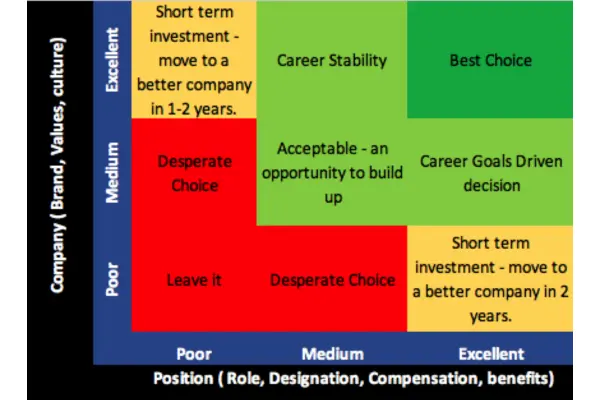
When to use a career decision matrix, and when not to
This method is best when you are deciding between two to four options, because too many options makes scoring noisy and increases analysis paralysis.
It works well for job offers, internal transfers, career paths, specialization choices, relocation decisions, and education decisions, because each involves multiple competing factors.
It is less useful when you are choosing based purely on a non-negotiable constraint, because a single hard constraint can eliminate most options immediately.
It is also less useful when you lack basic information, because scoring with guesses can create false certainty.
- Use the matrix after you have gathered facts like compensation details, role scope, manager expectations, and team structure.
- Avoid scoring “vibes” without evidence, because vibes can be helpful signals yet can also be short-term emotions.
- Use it as a decision aid, because you still get to decide even if the score is close.
- Run the matrix twice if needed, because your priorities may shift after you see the first results.
How to build a career decision matrix in 6 steps
The goal is not perfect math, because the goal is clarity that helps you choose and commit.
Keep the scale simple, because simple scales reduce overthinking and make your scores more honest.
Use weights sparingly, because too many weighted criteria can become a way to force a preferred outcome instead of revealing truth.
Step 1: define your options clearly
Vague options create vague scoring, so name each choice in a way that captures what will actually be different in your life.
- Write each option as a short description, because “Offer A” is less useful than “Offer A: higher pay, more travel, smaller team.”
- Limit options to 2–4, because comparisons become more reliable when your list is focused.
- Confirm non-negotiables before scoring, because hard constraints should remove options early.
Step 2: choose criteria that reflect your real priorities
Criteria are the heart of the matrix, because they convert vague preference into decision-making structure.
Use 8 to 12 criteria, because fewer criteria can miss important trade-offs and more criteria can become noise.
- Compensation and total rewards, because money is a real constraint for most people.
- Role scope and autonomy, because ownership affects growth, satisfaction, and stress.
- Learning and skill building, because your next role should improve your future options.
- Manager quality and support, because your manager can shape your daily experience more than the company brand.
- Team culture and psychological safety, because your performance improves when you can speak honestly and ask for help.
- Workload and sustainability, because chronic overtime can erase the benefits of a higher salary or a better title.
- Stability and risk assessment, because some paths have higher volatility and require more runway.
- Career trajectory and optionality, because you want doors to open, not narrow.
- Mission or purpose alignment, because meaning can affect your long-term job satisfaction.
- Location and commute, because time and energy costs matter every week.
- Flexibility and boundaries, because flexibility changes your life outside work.
- Brand and network exposure, because certain environments provide stronger long-term leverage.
Step 3: assign weights to criteria using a simple rule
Weights matter because not all criteria are equally important, and pretending they are equal is how you get an answer that feels wrong.
Use a 1–3 weight scale to keep this honest, because wider scales can encourage you to manipulate the result unconsciously.
- Weight 3: essential priorities that strongly affect wellbeing or long-term direction.
- Weight 2: important factors that influence satisfaction and growth.
- Weight 1: nice-to-have factors that matter, yet should not override essentials.
- Common weight 3 examples: workload sustainability, manager quality, stability, and location constraints.
- Common weight 2 examples: learning curve, autonomy, and team culture.
- Common weight 1 examples: title prestige and small perks.
Step 4: score each option consistently with evidence
Scoring becomes reliable when you define what the numbers mean, because otherwise you will score based on mood.
Use a 1–5 score where 1 is poor fit and 5 is strong fit, because most people can score quickly without splitting hairs.
- Score 5 when the option strongly supports the criterion with clear evidence.
- Score 3 when the option is neutral or unknown, because uncertainty should not be rewarded like certainty.
- Score 1 when the option clearly conflicts with the criterion or creates repeated strain.
- Evidence examples: written offer details, manager conversations, team norms, project scope, travel expectations, and review cycles.
- Unknowns should be flagged, because unknowns are risk and should trigger follow-up questions.
- When you catch yourself rationalizing, pause, because rationalizing usually means a value conflict is present.
Step 5: calculate totals and review trade-offs
Totals give you a baseline answer, yet the trade-off review is where the decision becomes real, because life is not a spreadsheet.
Small score differences often mean the options are close, so your next step is to look at weight-3 criteria and decide what you are willing to sacrifice.
- Multiply each score by the weight, because weighted scoring reflects your real priorities.
- Sum the weighted scores for each option, because totals show a first-pass winner.
- Compare only weight-3 criteria across options, because essentials usually decide the outcome.
- Write the top three trade-offs for the leading option, because naming trade-offs prevents regret later.
Step 6: run a short “reality check” before committing
Reality checks prevent self-deception, because sometimes you can make the numbers say what you want while your body knows the truth.
- Do the “tomorrow test,” because imagining you choose tomorrow often reveals hidden relief or dread.
- Do the “explain it to a friend” test, because speaking your reasoning out loud reveals weak logic fast.
- Do the “one-year narrative” test, because the best decision usually tells a coherent story over time.
- Do a final risk assessment, because a high score is not worth it if one big risk could collapse your stability.
- Relief is information, because relief often signals values alignment.
- Dread is information, because dread often signals a non-negotiable being violated.
- Ambivalence is information, because it often means you need one missing piece of data.
Career decision matrix template you can copy
Copy the template below, fill criteria and weights first, then score options, because ordering prevents you from choosing a favorite and then designing criteria to justify it.
| Criteria | Weight (1–3) | Option A Score (1–5) | Option A Weighted | Option B Score (1–5) | Option B Weighted | Option C Score (1–5) | Option C Weighted | Notes / Evidence |
|---|---|---|---|---|---|---|---|---|
| Workload sustainability | 3 | |||||||
| Manager quality | 3 | |||||||
| Compensation (total rewards) | 2 | |||||||
| Learning and skill building | 2 | |||||||
| Autonomy and scope | 2 | |||||||
| Stability and risk assessment | 3 | |||||||
| Culture and collaboration | 2 | |||||||
| Flexibility and boundaries | 2 | |||||||
| Career trajectory / optionality | 2 | |||||||
| Commute / location fit | 1 | |||||||
| Total |
Worked example: choosing between two job offers
This example shows how scoring reveals trade-offs, because the “best” offer is usually the one that fits your priorities, not the one with the most impressive headline.
Imagine you are deciding between Offer A and Offer B, where A pays more but is higher risk and higher workload, while B pays slightly less but is more stable and sustainable.
Example inputs
- Offer A: higher salary, fast growth environment, less structure, more travel, unclear workload.
- Offer B: moderate salary, stable team, clearer expectations, stronger manager support, limited travel.
- Your current season priority: protect health and avoid burnout, while still improving long-term growth.
Example scoring snapshot
Scores below are illustrative, because your scoring should reflect your evidence and your priorities.
| Criteria | Weight | Offer A Score | Offer A Weighted | Offer B Score | Offer B Weighted |
|---|---|---|---|---|---|
| Workload sustainability | 3 | 2 | 6 | 4 | 12 |
| Manager quality | 3 | 3 | 9 | 5 | 15 |
| Stability and risk assessment | 3 | 2 | 6 | 4 | 12 |
| Compensation (total rewards) | 2 | 5 | 10 | 4 | 8 |
| Learning and skill building | 2 | 4 | 8 | 3 | 6 |
| Autonomy and scope | 2 | 4 | 8 | 3 | 6 |
| Flexibility and boundaries | 2 | 2 | 4 | 4 | 8 |
| Culture and collaboration | 2 | 3 | 6 | 4 | 8 |
| Career trajectory / optionality | 2 | 4 | 8 | 3 | 6 |
| Commute / location fit | 1 | 3 | 3 | 4 | 4 |
| Total | 68 | 85 |
The matrix favors Offer B because your weight-3 priorities were sustainability, manager quality, and stability, and Offer B wins those essentials by a wide margin.
Offer A is still attractive, yet the scoring reveals its trade-off clearly, which is higher pay and faster growth at the cost of higher risk and higher workload.
Worked example takeaway
- When the difference is driven by weight-3 criteria, the decision is usually more stable and easier to commit to.
- When the difference is driven by weight-1 perks, you may be distracting yourself from what will matter every week.
- If Offer A still tempts you, gather missing data, because unknowns in risk assessment should trigger questions before you decide.
Criteria ideas: choose the right filters for your career choices
Criteria should reflect the real shape of your life, because the “best” job on paper is not the best job if it breaks your health or your family rhythm.
Use the lists below to customize your matrix, because your priorities may differ depending on whether you are optimizing for growth, stability, learning, or lifestyle.
Criteria for growth-focused decisions
- Skill acceleration potential, because some roles compress learning into a shorter timeline.
- Scope and ownership, because owning outcomes is a common path to seniority.
- Mentorship and feedback quality, because feedback speeds up improvement and reduces wasted effort.
- Visibility and exposure, because high-leverage work is often work that decision-makers can see.
- Optionality after 12 months, because the best growth roles open more doors later.
Criteria for stability-focused decisions
- Financial predictability, because predictable income reduces stress and increases decision freedom.
- Workload boundaries, because sustainability protects both health and long-term performance.
- Organizational stability, because instability can increase pressure and reduce control.
- Role clarity, because unclear expectations can create chronic anxiety.
- Support systems, because strong teams reduce the cost of problems and mistakes.
Criteria for pivot-focused decisions
- Transferable skills fit, because higher fit reduces the “starting over” feeling.
- Proof-building opportunities, because pivots succeed when you can create role-relevant evidence quickly.
- Low-risk experimentation, because safe tests let you validate fit before full commitment.
- Market credibility, because certain environments can lower perceived risk for your next move.
- Learning curve realism, because steep ramps require time, energy, and patience.
Pitfalls to avoid when using a career decision matrix
Matrices can be misused, because humans are creative at justifying what they already want.
A few simple safeguards keep the method honest, because the goal is clarity, not manipulation.
- Changing weights after you see the totals, because that is often reverse-engineering the outcome you want.
- Scoring unknowns as high scores, because uncertainty is risk and should push you to gather facts.
- Using too many criteria, because too much detail creates noise and hides what matters most.
- Including duplicate criteria, because double-counting inflates certain factors unfairly.
- Ignoring non-negotiables, because no score should override a hard boundary like health or caregiving capacity.
- Forgetting the time horizon, because the best short-term choice can be a poor long-term move and vice versa.
- Write your criteria and weights first, because front-loading priorities reduces bias.
- List evidence in the notes column, because evidence prevents mood-based scoring.
- Run a second scoring pass one day later, because a small time gap reveals whether your decision remains stable.
- Ask one trusted person to challenge your weights, because an outside lens can catch blind spots without taking your agency away.
Review checklist: decide and commit without constant second-guessing
Decisions become easier to live with when you close the loop, because open loops keep your brain re-litigating the choice.
Use this checklist after scoring, because it turns your matrix into a decision you can commit to with confidence.
- Confirm the top option wins weight-3 criteria, because essentials usually decide whether you will be happy day to day.
- Write the top three trade-offs you accept, because naming trade-offs reduces future regret.
- List the top three risks and how you will mitigate them, because risk assessment is part of responsible decision making.
- Identify one missing piece of data, if any, because missing data should be gathered before you lock in.
- Set a decision deadline, because endless deliberation is a hidden cost that drains energy.
- Once decided, plan your first week, because action creates momentum and shifts your mind from debating to building.
- Commitment signal: you can explain your choice in two sentences without defending it emotionally.
- Clarity signal: you know what you are optimizing for in this season of life.
- Stability signal: you are willing to stop comparing after the deadline and focus on executing your next steps.
Final note and independence disclaimer
A career decision matrix cannot remove uncertainty, yet it can turn uncertainty into a structured comparison that supports clearer priorities and smarter risk assessment.
Once you score your options, choose intentionally, accept trade-offs openly, and commit to the path with a simple first-week action plan, because clarity plus action is how confidence grows.
Notice: This content is independent and has no affiliation, sponsorship, or control over any institutions, platforms, or third parties mentioned.