
A one-page career plan works because it is easy to maintain, and a plan you maintain is the only plan that can actually guide your next months.
This career plan template gives you a fill-in outline, a filled example, clear instructions, and a review checklist you can reuse without overthinking.
Career plan template: how to use this one-page IDP
This template is designed to be copied into a note, a document, or your preferred planning tool, because the best system is the one you will open weekly.
Clarity improves when you keep your plan to one page, because constraints force prioritization and prevent you from turning your career into an endless to-do list.
Consistency increases when you choose fewer goals with clearer milestones, because deep progress comes from repetition rather than from scattered effort across many directions.
Tracking is included because it makes progress visible, and visible progress reduces anxiety and keeps you engaged when results take time.
- Best use case: you want direction, structure, and a simple weekly rhythm, without creating a complicated system you will abandon.
- Not the goal: predicting your entire future, because career plans work best as a living document that updates as you learn.
- Core output: an IDP-style plan with goals and milestones, a competency plan, and lightweight tracking you can review monthly.
- Time to fill: one focused session, because you can refine later instead of waiting for perfection.
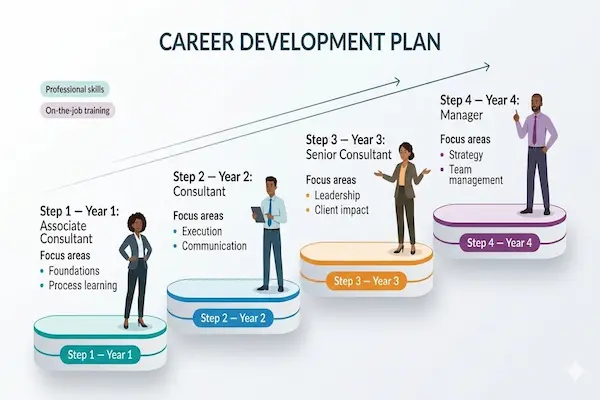
Download-ready outline: one-page career plan template
Copy and paste the template below as-is, then fill each line with short, specific answers, because specificity is what turns a plan into action.
ONE-PAGE CAREER PLAN TEMPLATE (IDP)

SECTION 1) Target Direction (6–18 months)
- Target role/theme:
- Level/scope:
- Industry or domain preference (optional):
- Work style requirements (autonomy, pace, collaboration):
- Non-negotiables (schedule, location, boundaries):

SECTION 2) Outcome Goals (choose 1–2)
GOAL A
- Outcome statement (what will be true):
- Deadline:
- Success measures (1–3):
- Proof I will create (artifact or result):
- Key stakeholders who should see this:

GOAL B
- Outcome statement (what will be true):
- Deadline:
- Success measures (1–3):
- Proof I will create (artifact or result):
- Key stakeholders who should see this:

SECTION 3) Goals and Milestones (30 / 60 / 90 days)
- 30-day milestone:
- 60-day milestone:
- 90-day milestone:
- Biggest risk to the plan:
- Risk mitigation action:

SECTION 4) Competency Plan (skills that unlock the goal)
- Competency #1:
  Current level:
  Target level:
  How I will build it (project/practice):
  How I will prove it (evidence):
- Competency #2:
  Current level:
  Target level:
  How I will build it (project/practice):
  How I will prove it (evidence):
- Competency #3 (optional):
  Current level:
  Target level:
  How I will build it (project/practice):
  How I will prove it (evidence):

SECTION 5) Weekly Execution (simple tracking)
- Weekly deep-work block (day/time):
- Weekly proof deliverable (what ships each week):
- Weekly visibility action (update, demo, presentation):
- Weekly learning action (practice or study):
- Weekly review day/time:

SECTION 6) Tracking (fill weekly)
Week of: ________
- Planned actions:
- Completed actions:
- Progress evidence:
- Blockers:
- Next week focus:

SECTION 7) Accountability (lightweight)
- My accountability person (or system):
- Check-in frequency:
- What they will ask me to show:
- What support I will request:

SECTION 8) Review cadence (monthly reset)
- Monthly review date:
- What I will measure:
- What I will adjust next month:
Instructions: fill this career planning template in 45 minutes
The fastest way to finish is to write short answers and accept “good enough,” because the value comes from using the plan weekly, not from polishing it once.
Start with direction, then define one main outcome goal, then pick competencies, because competencies should serve your goal rather than exist as a random skills wishlist.
If you feel stuck, choose the simplest version that creates motion, because clarity often arrives after you start collecting evidence.
Step-by-step instructions
- Fill Section 1 in plain language, because a clear target direction makes every later choice easier.
- Choose only one Outcome Goal if you are busy, because one well-executed goal beats two half-executed goals.
- Write success measures you can actually track, because tracking prevents vague goal drift.
- Define proof you will create, because proof turns effort into credibility and makes progress visible.
- Set 30 / 60 / 90 day milestones, because milestones create feedback loops and prevent procrastination.
- Select two competencies that unlock the goal, because most progress comes from a small number of high-leverage skills.
- Schedule weekly execution blocks, because anything not scheduled tends to be replaced by urgent work.
- Pick a monthly review date now, because reviews keep the plan alive and adaptive.
- Write numbers when possible, because “increase” is vague while “increase by X” creates accountability.
- Use verbs that show ownership, because ownership language signals readiness for growth and builds confidence.
- Keep your plan visible, because hidden plans do not get executed.
Filled example: one-page IDP for a realistic growth plan
This filled example is intentionally simple, because the goal is to show structure you can copy rather than to suggest one “correct” career path.
Adapt the role theme and competencies to your situation, because a career plan should fit your context and constraints.
FILLED EXAMPLE (IDP)

SECTION 1) Target Direction (6–18 months)
- Target role/theme: Program Coordination / Operations (cross-functional delivery)
- Level/scope: Own a medium-sized initiative end-to-end
- Industry or domain preference (optional): Tech or services, flexible
- Work style requirements: Clear ownership, measurable outcomes, collaborative teams
- Non-negotiables: No chronic overtime, predictable schedule, remote-friendly

SECTION 2) Outcome Goals (choose 1–2)
GOAL A
- Outcome statement: Lead one cross-functional project that improves a key operational metric
- Deadline: 6 months
- Success measures: Reduce cycle time by 15%; reduce rework incidents; hit delivery date
- Proof I will create: Project plan, decision log, before/after metric report
- Key stakeholders: Manager, partner team lead, operations leader

GOAL B
- Outcome statement: Improve executive-ready communication to increase visibility and trust
- Deadline: 12 weeks
- Success measures: Weekly update cadence; two presentations; feedback from 2 leaders
- Proof I will create: Update template, presentation deck notes, feedback summary
- Key stakeholders: Manager, project stakeholders

SECTION 3) Goals and Milestones (30 / 60 / 90 days)
- 30-day milestone: Secure project ownership and define success metrics with stakeholders
- 60-day milestone: Deliver first measurable improvement and share a mid-point update
- 90-day milestone: Deliver a completed phase with documented learnings and next steps
- Biggest risk: Scope creep and unclear ownership
- Risk mitigation action: Weekly decision log and explicit trade-off conversations

SECTION 4) Competency Plan (skills that unlock the goal)
- Competency #1: Stakeholder management
  Current level: Working
  Target level: Strong
  How I will build it: Weekly alignment meetings + structured updates
  How I will prove it: Fewer surprises, clearer decisions, stakeholder feedback

- Competency #2: Project planning and execution
  Current level: Working
  Target level: Strong
  How I will build it: Build timelines, risks, dependencies, and owners
  How I will prove it: On-time delivery, documented trade-offs, stable scope

- Competency #3 (optional): Data storytelling
  Current level: Basic
  Target level: Working
  How I will build it: Monthly metrics review + short recommendation memo
  How I will prove it: Clear before/after metric narrative leaders can use

SECTION 5) Weekly Execution (simple tracking)
- Weekly deep-work block: Tuesday 08:00–10:00
- Weekly proof deliverable: One artifact shipped (plan update, metric summary, memo)
- Weekly visibility action: Thursday stakeholder update message
- Weekly learning action: 45 minutes practicing concise writing
- Weekly review day/time: Friday 16:30

SECTION 6) Tracking (fill weekly)
Week of: 01/06
- Planned actions: Confirm scope; draft plan; send update
- Completed actions: Confirmed scope; drafted plan; sent update
- Progress evidence: Plan approved; success metrics agreed
- Blockers: Data access delay
- Next week focus: Resolve access; baseline metrics; risk register

SECTION 7) Accountability (lightweight)
- My accountability person (or system): Peer accountability buddy
- Check-in frequency: Weekly 15 minutes
- What they will ask me to show: One shipped artifact + next week calendar block
- What support I will request: Review my update for clarity

SECTION 8) Review cadence (monthly reset)
- Monthly review date: First Friday of each month
- What I will measure: Artifacts shipped; milestone progress; stakeholder feedback
- What I will adjust next month: Scope, skill focus, and visibility actions
Competency plan ideas: common core competencies to choose from
Choose competencies that unlock your goal, because a competency plan becomes powerful only when it is tied to outcomes and evidence.
Pick two core competencies and one optional, because focus is what makes a one-page plan work.
Core competency options by theme
- Communication and influence: concise writing, executive updates, presenting trade-offs, negotiation.
- Execution and delivery: planning, prioritization, dependency management, risk management, project tracking.
- Analysis and decision support: metrics definition, root-cause analysis, recommendation memos, dashboard reading.
- Operations and systems: process mapping, standardization, quality improvement, documentation.
- Leadership behaviors: coaching, delegation, alignment, clarity under ambiguity.
Evidence ideas for each competency
- Concise writing evidence: weekly updates that reduce follow-up questions and improve decision speed.
- Stakeholder management evidence: fewer surprises, faster approvals, and documented decisions with clear owners.
- Process improvement evidence: reduced cycle time, fewer errors, clearer handoffs, and reuse of documentation.
- Analytical thinking evidence: recommendations adopted, clearer metrics, and improved outcomes after changes.
- Leadership evidence: others become faster or more confident because of your guidance and coaching.
Tracking: keep your one-page plan alive without turning it into a second job
Tracking should be lightweight, because heavy tracking systems fail when life gets busy.
One weekly review is enough, because weekly rhythm catches drift early and keeps you moving with realistic momentum.
Monthly reviews help you adjust, because careers shift and your plan should adapt instead of breaking.
Weekly review prompts
- What did I ship that creates proof, because proof is the currency of promotions and pivots.
- What moved the milestone forward, because milestones keep the plan anchored.
- What blocked me, because blockers reveal what needs redesign rather than self-criticism.
- What is the single highest-leverage action next week, because one strong move beats five shallow tasks.
- What visibility action will I take, because impact grows when the right people can see it clearly.
Monthly review checklist
- Update milestone status, because clarity depends on seeing what is done and what is still open.
- Adjust competencies if needed, because new information can change what skill matters most.
- Review evidence quality, because your plan should produce artifacts and outcomes, not just effort.
- Confirm the plan fits your constraints, because sustainability is a competitive advantage.
- Set next month’s focus, because focus reduces overwhelm and improves execution.
Common mistakes with an IDP or career plan template
Templates fail when they become too ambitious, because ambition without structure creates guilt rather than progress.
Plans also fail when goals are vague, because vague goals make tracking impossible and encourage procrastination.
Another common issue is choosing too many competencies, because learning becomes scattered and results become invisible.
- Too many goals, because focus is the engine of a one-page plan.
- No proof defined, because effort without evidence rarely changes career outcomes.
- No milestones, because without milestones you cannot tell if you are progressing or drifting.
- No calendar blocks, because unscheduled actions get replaced by urgent work.
- No review cadence, because plans die when they are not revisited.
- Reduce to one outcome goal if you feel overwhelmed, because one goal executed well changes your trajectory more than many goals left unfinished.
- Attach evidence to each competency, because evidence transforms learning into credibility.
- Use small weekly deliverables, because small deliverables keep you moving even during busy periods.
- Review monthly and adjust, because adapting is part of a realistic career strategy.
Final note and independence disclaimer
A one-page career planning template works when you treat it as a living tool, because it keeps your goals, milestones, competency plan, and tracking in one place you can actually use.
As you fill this plan, keep it simple, schedule weekly execution, and build proof steadily, because consistent evidence is what turns career intentions into real outcomes.
Notice: This content is independent and has no affiliation, sponsorship, or control over any institutions, platforms, or third parties mentioned.