
Having many options can feel like freedom, yet it often creates a quiet kind of paralysis where every path looks possible and none feels certain.
This guide shows how to set career goals that turn vague ambition into measurable, realistic career objectives, using a simple framework, examples, and worksheet prompts.
Why unclear priorities make goal setting harder than it should be
Too many choices can overload your decision-making, because each new possibility competes for attention and makes your “best next step” feel invisible.
Ambition stays fuzzy when it is not tied to a clear outcome, since “grow,” “advance,” or “do something meaningful” can mean ten different things on ten different days.
Confidence can drop even when you are capable, because your brain interprets uncertainty as risk and then tries to protect you by delaying commitment.
Progress slows when goals are not measurable, since you cannot tell whether you are improving or simply staying busy with tasks that look productive.
Momentum often returns fast when your goals become concrete, because clarity reduces stress and turns “someday” into an action plan with dates and checkpoints.
- More options demand stronger filters, because deciding what to ignore is usually the first real move in a good career plan.
- Better goals make trade-offs explicit, because every “yes” to one direction is also a “not now” to something else.
- Measurable career objectives cut through doubt, because evidence beats feelings when you are trying to stay consistent.
- Accountability matters most when motivation is low, because the system carries you when willpower is busy or depleted.
How to set career goals by choosing a direction without feeling trapped
Direction does not require a lifetime commitment, because your goal is to pick a clear horizon that guides action for the next 6 to 18 months.
Flexibility becomes easier when you commit to a role family instead of a single job title, since role families allow multiple paths to the same type of work.
Stability increases when goals respect real constraints, because a plan that ignores time, money, health, or caregiving responsibilities tends to collapse at the worst moment.
Clarity arrives faster when you use structured questions, because structured questions prevent your mind from spinning in circles around the same abstract ideas.
The 3-lens filter for choosing your next focus
This filter works because it balances what you want, what you can realistically execute, and what the market rewards, creating a direction that is both motivating and practical.
- Interest lens: identify what work you would still choose even when it is challenging, because durable goals rely on sustained attention rather than excitement spikes.
- Strength lens: map what you do unusually well, because goals built on strengths tend to accelerate faster and create stronger proof for promotions or job changes.
- Opportunity lens: target what organizations consistently pay for, because aligning with market demand reduces friction and increases your options later.
Quick worksheet prompts to reduce option overload
Writing short answers is powerful, because your brain can negotiate endlessly in your head while a page forces you to make decisions visible.
- List three types of problems you enjoy solving, and describe what “solving” looks like in real tasks, not in abstract labels.
- Name two skills you want to use daily, because goals that do not match your preferred daily work often lead to fast burnout.
- Choose one constraint you will honor no matter what, because a goal that violates your non-negotiables becomes a source of stress instead of direction.
- Pick one type of work you want less of, because subtraction is often the simplest way to create space for better objectives.
How to set career goals with SMART goals that still feel human
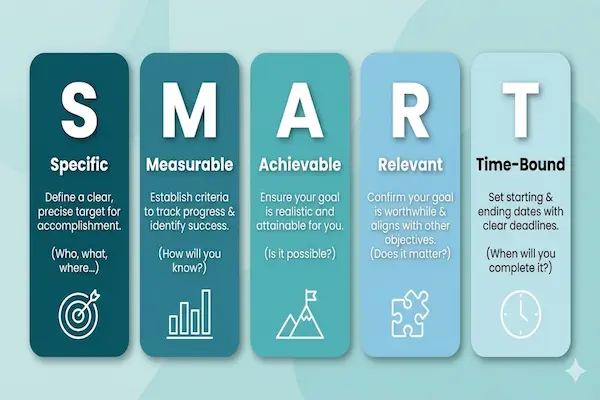
SMART goals are effective when they create clarity, because they force you to define what success looks like and how you will know you reached it.
Rigid SMART goals can fail when they become overly narrow, since careers are dynamic and progress sometimes looks like learning, visibility, and trust before it looks like a title.
A better approach keeps the SMART structure while adding proof, because proof connects your goal setting to the evidence decision-makers actually use.
The SMART-plus format for career objectives
SMART-plus keeps the goal measurable while making it realistic, because it includes outcomes, proof, and the constraints you must respect to stay consistent.
- Specific: define the role direction and level you are aiming for, because specificity prevents random effort and makes your action plan easier to design.
- Measurable: choose one to three metrics or outputs, because a small set of measures keeps focus while still capturing meaningful progress.
- Achievable: match your timeline to your real capacity, because “achievable” is about sustainable effort, not about minimizing ambition.
- Relevant: connect the goal to your priorities, because relevance is what keeps you moving when short-term motivation fades.
- Time-bound: set a review date and milestones, because deadlines turn intention into execution and prevent endless postponing.
- Proof-based: define what evidence will convince a manager or hiring team, because proof is what transforms effort into credibility.
Examples of SMART-plus career goals
Examples are useful because they show what measurable goal setting sounds like, especially when you are used to describing ambition in broad, emotional terms.
- Promotion example: Earn a promotion to Senior Analyst within 9 months by leading one cross-functional project, improving a key metric by an agreed target, and presenting results to leadership.
- Skill example: Become proficient in stakeholder management within 12 weeks by running weekly alignment meetings, documenting decisions, and receiving feedback on clarity from two senior partners.
- Career switch example: Transition into Product Operations within 6 months by completing two role-relevant projects, building a portfolio of artifacts, and conducting structured informational conversations weekly.
- Leadership example: Build management readiness in 180 days by mentoring two peers, owning a process improvement initiative, and demonstrating consistent coaching behaviors in performance feedback.
How to set career goals when you have multiple paths and limited time
Limited time makes priorities sharper, because you cannot pursue everything and still produce the proof required for meaningful career change.
Choosing fewer goals increases the quality of execution, since deep progress usually requires focus rather than scattered learning across many topics.
A simple cap protects your calendar, because you can build momentum without turning your career plan into a second full-time job.
The “one outcome, two drivers” rule
This rule works because one main outcome keeps your direction clear, while two driver goals create a realistic action plan that makes the outcome achievable.
- Select one primary outcome goal, such as a promotion, a new role, a new level of responsibility, or a measurable performance target.
- Add one capability driver goal, such as a key skill that will unlock your next level, because capability reduces risk for decision-makers.
- Add one proof driver goal, such as a project or portfolio artifact, because proof turns your learning into visible evidence.
How to decide what not to pursue right now
Elimination is a career skill, because the ability to say “not now” preserves energy for the work that actually changes outcomes.
- Delay goals that do not strengthen your chosen direction, because misaligned goals create busy calendars and weak narratives.
- Pause goals that require high effort for low impact, because your best returns usually come from the smallest set of high-leverage moves.
- Drop goals that are purely ego-driven, because external validation goals often collapse when the novelty wears off.
- Postpone goals that violate constraints, because an action plan that depends on constant overwork tends to fail and damage confidence.
Build career objectives that translate into an action plan
A career objective becomes practical when it turns into actions you can schedule, because calendars are where goals either become real or quietly disappear.
Action plans work when they include milestones, because milestones create short feedback loops that keep you adjusting instead of guessing.
Consistency improves when actions are small enough to repeat weekly, because repetition builds competence faster than occasional bursts of intense effort.
Create milestones that show progress before the finish line
Milestones protect motivation, because you can see movement even when the final outcome takes months and requires patience.
- Define a 30-day milestone that creates clarity and momentum, such as choosing a focus skill, selecting a project, and writing your goal statement.
- Define a 60-day milestone that creates proof, such as shipping a deliverable, completing a measurable improvement, or producing a portfolio artifact.
- Define a 90-day milestone that increases visibility, such as presenting results, leading a meeting series, or documenting a repeatable process others can adopt.
- Define a 180-day milestone that expands scope, such as owning an outcome, leading cross-functional work, or mentoring others in a way that demonstrates leadership behaviors.
Turn each milestone into weekly commitments
Weekly planning reduces overwhelm, because your brain can handle a small set of next actions far better than a large abstract goal.
- Schedule one deep-work block for skill building, because protected time is more reliable than hoping for “free time” after work.
- Choose one output per week that produces evidence, because shipping something measurable builds confidence and strengthens your story.
- Include one visibility action, because outcomes matter more when the right people understand what changed and why it matters.
- Add one reflection prompt, because noticing patterns helps you adjust your goal setting without losing momentum.
Accountability that supports goal setting without creating pressure spikes
Accountability is not about guilt, because effective accountability is a structure that makes your intentions harder to ignore and easier to complete.
Support systems work best when they are lightweight, since heavy systems tend to break the first week life gets complicated.
External accountability helps when motivation is inconsistent, because a scheduled check-in can pull you back to your action plan before weeks slip away.
Choose an accountability style that fits your personality
Different people stay consistent for different reasons, so choosing a style that matches how you operate is more effective than copying someone else’s routine.
- Social accountability: partner with a peer for weekly check-ins, because knowing someone will ask about your progress encourages follow-through.
- Manager accountability: align goals with your manager when appropriate, because shared objectives can unlock projects, resources, and visibility.
- Self-accountability: use written commitments and tracking, because visible progress reduces the urge to “restart” whenever a week goes poorly.
- Coach-style accountability: use structured prompts and honest feedback, because coaching can shorten the time between effort and insight.
Run a 15-minute weekly accountability review
This review is short on purpose, because the goal is to keep the system alive rather than to turn it into a complicated ritual you avoid.
- Write what you completed last week, because completion builds evidence and reduces the feeling that you are “not doing enough.”
- List what blocked you, because identifying friction points allows you to redesign the action plan rather than blaming yourself.
- Choose the single highest-leverage action for this week, because one meaningful move beats five shallow tasks that produce no proof.
- Schedule it on your calendar, because unscheduled intentions tend to be replaced by urgent work that does not serve your career objectives.
- Decide one visibility step, because results compound faster when decision-makers can clearly see your impact.
Common mistakes in goal setting that keep careers stuck
Career goals fail for predictable reasons, because humans are wired to seek comfort and avoid uncertainty, especially when outcomes affect identity and security.
Busywork is the most common trap, because learning feels safe while doing visible, outcome-driven work can feel risky.
Perfectionism delays progress, because you wait for certainty that only appears after you start acting and collecting real feedback.
Overcommitting creates inconsistency, because a plan that requires heroic effort will eventually collide with real life and then collapse.
- Vague objective mistake: setting a goal like “become more strategic,” because it has no measurable behavior and no clear proof.
- Too many goals mistake: trying to change everything at once, because scattered attention produces weak results and constant frustration.
- Wrong timeline mistake: expecting a major transition in a month, because unrealistic timelines convert normal setbacks into feelings of failure.
- Invisible work mistake: doing great work quietly, because unshared impact often gets overlooked in promotions and hiring decisions.
- Misaligned goal mistake: chasing a title without liking the daily work, because satisfaction depends more on daily tasks than on labels.
How to fix goals that are too vague
Clarity improves quickly when you translate vague words into behaviors, because behaviors can be practiced, tracked, and demonstrated.
- Replace abstract adjectives with observable actions, because “strategic” can become “defines trade-offs, prioritizes outcomes, and aligns stakeholders.”
- Add a measurable output, because outputs create evidence and remove ambiguity about whether you are progressing.
- Define who will notice, because visibility is part of the system and not an optional add-on.
How to set career goals using a simple worksheet you can reuse
Worksheets reduce mental noise, because they guide your thinking through a sequence instead of letting your mind jump between options endlessly.
Reusability matters, because you will update goals as you learn, and a reusable format prevents you from rebuilding the process every time.
CAREER GOAL SETTING WORKSHEET (SMART-PLUS)

1) My current situation in one sentence:
- (What is true right now, without judgment?)

2) My next 6–18 month direction:
- Role family or focus area:
- Level or scope I want:
- Constraint I must honor:
- Work condition I want more of:

3) My primary outcome goal:
- Specific outcome:
- Deadline:
- Measurable indicators:
- Proof I will build:

4) My two driver goals:
- Capability driver (skill/behavior):
- Proof driver (project/artifact):

5) My first milestone:
- 30-day milestone:
- Evidence I will create:

6) Weekly action plan:
- Skill-building block (day/time):
- Proof deliverable for the week:
- Visibility action for the week:

7) Accountability:
- Who or what will check me:
- Weekly review day/time:
- Question I will answer weekly:
Worksheet prompts for people with unclear priorities
Prompting is helpful when you are undecided, because it turns “I don’t know” into smaller questions you can actually answer.
- Which option would I still choose if I could not tell anyone about it, because private preferences often reveal what you genuinely want.
- What do I want to be known for at work, because reputation is a career asset that shapes opportunities.
- Which tasks do I avoid even though they matter, because avoidance often points to the highest-growth skill gap.
- Where do I consistently create value, because patterns of value are clues to strengths you can build career objectives around.
- What is one small bet I can place this month, because experiments create clarity without requiring permanent commitment.
Practical examples of career objectives and action plans
Seeing complete examples is useful, because a finished model reduces the friction of starting and makes goal setting feel more concrete.
Each example below includes a measurable objective, a short action plan, and an accountability step, so you can adapt the structure without copying the exact content.
Example A: promotion-focused goal setting
This example works when you want to advance where you are, because internal promotions often depend on visible scope, consistent delivery, and clear trust signals.
- Career objective: Earn a promotion to a senior level within 9 months by owning a business outcome and leading cross-functional delivery.
- SMART goals measure: Improve a defined metric tied to your work, deliver a project with documented impact, and present results to leadership.
- Action plan: secure a high-impact project within 30 days, deliver a measurable improvement within 90 days, and package results into a clear narrative by 180 days.
- Accountability: schedule a monthly alignment meeting with your manager to review milestones and adjust scope based on feedback.
Example B: career switch goal setting
This example works when you want a new role direction, because transitions become easier when you translate transferable skills into proof that reduces perceived risk.
- Career objective: Move into a new role family within 6 months by building two relevant projects and demonstrating required behaviors in real settings.
- SMART goals measure: complete two portfolio artifacts, practice one core skill weekly, and run consistent conversations for feedback and market insight.
- Action plan: pick one focus skill for 30 days, build a small project that shows the skill in action, then expand to a larger project that demonstrates scope.
- Accountability: track weekly outputs in a simple log and review progress with a peer who will ask for evidence, not just effort.
Example C: clarity-first goal setting for option overload
This example works when you are unsure, because it uses structured experiments that convert uncertainty into data without forcing a risky all-in decision.
- Career objective: Decide on a clear direction within 8 weeks by running two structured experiments and comparing results against a defined priority filter.
- SMART goals measure: complete two small projects, document energy levels and satisfaction after each, and write a one-page decision summary.
- Action plan: run one experiment for four weeks, run a second experiment for four weeks, then choose a direction using your values and constraint criteria.
- Accountability: set two check-ins with a trusted mentor to review what you learned and commit to a next-step plan.
How to keep your goals realistic without shrinking your ambition
Realistic does not mean small, because realism is about matching ambition to a timeline and a system that you can consistently execute.
Ambition becomes achievable when you plan for obstacles, because obstacles are predictable and should be treated as design constraints rather than surprises.
Progress becomes steadier when you build in flexibility, because a plan that breaks after one bad week is not a plan, it is a fragile wish.
Design for setbacks using “if-then” planning
If-then planning helps because it removes decision fatigue in stressful moments, allowing you to keep momentum even when your schedule is disrupted.
- If my week gets overloaded, then I will complete the smallest proof task that still creates evidence, because maintaining the streak matters more than perfect output.
- If motivation drops, then I will do the next scheduled action anyway for 15 minutes, because starting is often what restores energy.
- If I miss a milestone, then I will adjust scope rather than quit, because scaling down preserves progress while protecting confidence.
- If feedback is negative, then I will translate it into one specific behavior to practice, because actionable feedback is fuel for better goal setting.
A quarterly reset process for career goal setting
Quarterly resets work because they provide a natural review rhythm, allowing you to adjust without constantly second-guessing yourself week to week.
Review cycles protect clarity, because careers change through compounding choices that are easier to steer when you check direction regularly.
- Review what you delivered, because completed outputs reveal what you are actually prioritizing in practice.
- Evaluate which actions created the strongest outcomes, because repeating what works is the simplest growth strategy.
- Update your career objectives based on new information, because learning changes what is realistic and what is most valuable.
- Select one primary objective for the next quarter, because focus improves execution quality and reduces scattered effort.
- Choose one accountability mechanism you will use consistently, because the best system is the one you actually maintain.
- Evidence check: document three wins with measurable outcomes, because your story becomes stronger when it is backed by specifics.
- Skill check: list one skill that improved and one that still causes friction, because friction points often indicate the next high-leverage goal.
- Energy check: notice which tasks drained you most, because energy patterns are clues about fit and sustainability.
- Opportunity check: note any new openings or shifts at work, because timing and organizational change can create unexpected paths.
How to set career goals that you will actually follow through on
Follow-through becomes easier when your goals are written simply, because complexity usually hides uncertainty and increases avoidance.
Consistency improves when you treat your career plan as a system, because systems create reliable progress even when emotions and motivation fluctuate.
Trust in yourself grows through proof, because proof turns “I think I can” into “I have evidence I can,” which changes how you show up in conversations and opportunities.
- Write one clear goal statement using SMART-plus, because a single paragraph can anchor months of decision-making.
- Limit goals to one outcome and two drivers, because focus reduces overwhelm and strengthens your results.
- Define proof you will create, because proof is what converts effort into promotions, offers, and new responsibilities.
- Build a weekly action plan with scheduled time blocks, because scheduling is where intentions become real.
- Choose an accountability method and commit to a weekly review, because reflection prevents drift and helps you adjust without abandoning the plan.
Final note and independence disclaimer
Goal setting becomes powerful when it is measurable and compassionate at the same time, because you can pursue meaningful career objectives without turning your life into constant pressure.
Progress will feel more stable when you choose a direction, create an action plan, and use accountability to keep moving, because clarity plus consistent evidence is what turns ambition into reality.
Notice: This content is independent and has no affiliation, sponsorship, or control over any institutions, platforms, or third parties mentioned.