
Feeling stuck at work usually isn’t a motivation problem, it’s a clarity problem, because most professionals never get a simple system for turning ambition into specific, repeatable actions.
This guide gives you an executable career plan you can actually follow, using self-assessment, a skills map, and a career roadmap that turns professional goals into weekly next steps.
Why planning your career matters more than motivation
Motivation rises and falls, yet a career plan keeps you moving when your energy dips, because it replaces vague intention with a clear sequence of decisions you can repeat.
Clarity reduces stress, since you stop guessing what to do next and start choosing actions that match your target role, your strengths, and the constraints of your real life.
Progress becomes measurable when your goals are defined in outcomes and timelines, not just in feelings like “I want to grow” or “I want something better.”
Confidence improves as soon as you can explain your direction in one or two sentences, because you can finally evaluate opportunities based on fit instead of fear.
Options expand when you understand your transferable skills, because you can connect your current experience to new roles without needing to start from zero.
Time stops leaking away when you decide what to ignore, because saying no to the wrong work is often the fastest way to say yes to the right future.
- A career plan helps you focus on the few high-impact skills that unlock your next role, rather than chasing random courses that feel productive but change nothing.
- A career roadmap makes trade-offs visible, so you can choose a path that matches your income needs, your family responsibilities, and your health boundaries.
- A skills map turns feedback into strategy, because you can translate “you need to be more strategic” into specific behaviors you can practice and demonstrate.
- A self-assessment protects you from copying someone else’s version of success, since you can define what “better” means for your values and priorities.
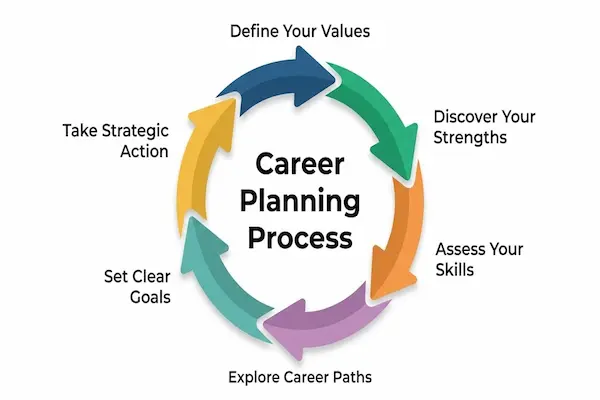
Career planning steps: the framework you will follow
These career planning steps work because they follow the same logic successful career transitions and promotions require, starting with clarity, moving through capability, and ending with consistent execution.
The sequence matters, since picking a goal before you understand yourself often leads to a career plan that looks impressive on paper but feels heavy and unsustainable in real life.
Each step produces an output you can keep, such as a role target, a skills map, a portfolio plan, and a weekly execution checklist, so you never feel like you are “starting over.”
- You will complete a self-assessment that identifies your values, strengths, constraints, and preferred work conditions with enough specificity to guide decisions.
- You will define professional goals by selecting a target direction and translating it into measurable outcomes, timelines, and evidence you can create.
- You will build a skills map that compares your current capabilities to the requirements of your target role, then prioritizes gaps by impact and urgency.
- You will draft a career roadmap that turns the skills map into a staged plan, including projects, visibility actions, and checkpoints across 30, 90, 180, and 365 days.
- You will set up a lightweight execution system that fits your schedule, so weekly actions happen even when work gets busy or life gets unpredictable.
Step 1 in your career planning steps: self-assessment that leads to decisions
A useful self-assessment is not a personality label, because the goal is to produce decision criteria that tell you what to pursue, what to avoid, and what trade-offs you accept.
Start by separating what you are good at from what you enjoy, because the overlap is often where sustainable performance and long-term satisfaction actually live.
Then identify constraints honestly, since the best career plan is the one that respects your real context rather than assuming you have unlimited time, money, and energy.
Clarify values and non-negotiables
Values are practical when you turn them into workplace behaviors, because “growth” means nothing until you define what growth looks like in your calendar and projects.
- Decide what “good work” means to you by listing three moments when you felt proud, then naming the value each moment expressed through action.
- Identify your non-negotiables by writing what you cannot compromise for the next 12 months, such as location, schedule, income minimum, or stability needs.
- Define what you will no longer tolerate by naming the patterns that drain you most, such as constant context switching, unclear ownership, or chronic overtime.
- Choose your “must-haves” and “nice-to-haves” so future opportunities can be evaluated quickly, especially when a job description looks exciting but hides mismatches.
Map strengths and energizers, not just skills
Strengths become strategic when you can describe them as repeatable behaviors, because employers and managers reward what they can see and trust, not what you feel internally.
Energy matters because your career plan needs momentum, and momentum usually comes from work that pulls you in rather than tasks you force yourself to endure.
- Write five tasks you do faster or better than most peers, then describe the behavior behind them, such as simplifying, persuading, structuring, or troubleshooting.
- List five tasks that leave you energized even when they are hard, then note the conditions that make them enjoyable, such as autonomy, collaboration, or problem complexity.
- Gather three pieces of feedback you have heard repeatedly, then translate them into skill language, such as “calms chaos” becoming “prioritization and stakeholder alignment.”
- Pick two strengths you want to build your next role around, because focusing your positioning makes your professional story easier to explain and more credible.
Surface constraints and realistic capacity
Constraints are not excuses, because they help you design a career roadmap that you can execute consistently without burning out, quitting impulsively, or abandoning the plan.
- Time constraints include commute, caregiving, health routines, and recovery time, since sustainable progress requires protected hours that you can actually maintain.
- Financial constraints include runway, debt obligations, and risk tolerance, because a career switch plan looks different when you need stable income immediately.
- Emotional constraints include stress load and resilience, because big changes are easier when you plan support systems and small wins along the way.
- Geographic constraints include location and travel limits, since some roles assume frequent travel even when the job description sounds flexible.
Step 2 in your career planning steps: turn professional goals into a target
Professional goals become actionable when you commit to a direction, because “keeping options open” often becomes a hidden form of procrastination that quietly costs years.
A strong target is specific enough to guide skill-building, yet flexible enough to allow multiple paths, such as choosing a role family rather than one exact job title.
Instead of trying to plan ten years at once, choose a 12 to 24 month destination, because shorter horizons reduce uncertainty and make your next actions clearer.
Choose a target direction with three layers
Direction becomes clearer when you define it in layers, because each layer narrows the search without trapping you in a single narrow definition of success.
- Pick a role family, such as operations, product, sales, finance, people, design, engineering, marketing, analytics, or customer success, based on your strengths and interests.
- Select an industry preference, because domain knowledge can be a lever, yet switching industries can be strategic when you want better growth or better work conditions.
- Define your working style needs, such as solo deep work, high collaboration, high autonomy, or structured environments, because culture fit affects performance and wellbeing.
Convert your goal into proof you can create
Hiring and promotion decisions rely on evidence, because decision-makers want to reduce risk by seeing that you have already done the kind of work you claim you can do.
- Define outcomes you will be able to show, such as revenue impact, cost reduction, cycle-time improvement, customer retention, quality improvements, or stakeholder alignment wins.
- Identify artifacts you can produce, such as process documentation, dashboards, project plans, analyses, written proposals, or training materials that demonstrate your capability.
- Choose behaviors you will practice publicly, such as leading meetings, writing clear updates, negotiating priorities, or mentoring, because visibility changes perception.
- Set a timeline that respects your constraints, because unrealistic timelines create failure feelings and make you abandon a good plan for the wrong reason.
Use a practical “SMART-plus” goal format
SMART goals help, yet career plans work better when you add the “proof” element, because proof connects your effort to the decision criteria employers actually use.
- Specific: name the role family and level you are targeting, so your skill-building choices have a clear direction.
- Measurable: define two or three metrics or outcomes you want to achieve, so progress becomes visible even before you change jobs.
- Achievable: choose a scope that fits your life constraints, because sustainable consistency beats short bursts of intensity that collapse.
- Relevant: tie the goal to values and energizers from your self-assessment, so the plan feels meaningful rather than forced.
- Time-bound: set a review date and milestones, so you can adjust with data instead of waiting until you feel stuck again.
- Proof-based: list the evidence you will build that a manager or hiring team would accept, so your effort translates into credibility.
Step 3 in your career planning steps: build a skills map that prioritizes the right gaps
A skills map is a simple comparison between where you are and where you want to be, because you cannot close a gap clearly until you can name it precisely.
Most professionals waste time learning low-impact skills, since they choose based on curiosity rather than on what the target role consistently requires.
Prioritization is the real benefit, because a good skills map tells you what to do first, what to delay, and what to ignore completely.
Create your target-role requirement list
Requirements are easiest to collect when you look for patterns across multiple job descriptions and performance expectations, because individual postings can be noisy and inconsistent.
- Write the top recurring responsibilities you see for your target role family, because responsibilities show what you will be judged on after you are hired or promoted.
- List the hard skills that appear repeatedly, such as tools, frameworks, methods, or domain concepts, because these often act as screening criteria.
- Include soft skills as observable behaviors, such as stakeholder management, executive communication, prioritization, or conflict resolution, because these often determine seniority.
- Note common “seniority signals,” such as owning outcomes, leading cross-functional work, improving systems, or coaching others, because these are promotion accelerators.
Inventory your current skills honestly
Honesty matters because the goal is improvement, not self-criticism, and a realistic starting point lets you choose actions that build confidence through steady wins.
- List the skills you use weekly, because frequent use usually indicates a stable baseline you can build on.
- Add skills you have used before but not recently, because refreshing a skill is often faster than learning from scratch.
- Capture evidence for each skill, such as a project outcome, a metric, or a concrete artifact, because evidence prevents overestimating or underestimating your level.
- Rate proficiency using simple levels, such as basic, working, strong, and expert, because overly complex rating systems become excuses to avoid action.
Prioritize gaps with an “impact versus effort” lens
Not every gap deserves attention now, because some skills are “nice to have” while others are key unlocks that immediately increase your eligibility and performance.
- High impact and low effort skills come first, because they provide quick returns and build momentum for harder work later.
- High impact and high effort skills become your main focus, because these usually represent the capabilities that define your next level.
- Low impact and low effort skills can be added only if they support a larger project, because busywork learning feels good but changes little.
- Low impact and high effort skills should be postponed, because they are the fastest way to waste months without meaningfully improving your career outcomes.
Step 4 in your career planning steps: design a career roadmap you can execute
A career roadmap is a timeline of actions and checkpoints, because success is rarely one big leap and is usually a series of small decisions repeated weekly.
Roadmaps work best when they include skill-building, proof-building, and visibility-building, because capability without proof is invisible and proof without visibility often goes unnoticed.
The goal is not to predict the future perfectly, because the goal is to reduce uncertainty enough that you can move forward with confidence and adjust as you learn.
Use staged timelines to reduce overwhelm
Staging protects you from all-or-nothing thinking, because you can treat your plan like an experiment with checkpoints rather than a single pass-or-fail test.
- In the next 30 days, focus on clarity and quick wins, such as refining your target, selecting priority skills, and starting one small proof-building project.
- In the next 90 days, build visible momentum, such as delivering one measurable outcome at work or completing a practical portfolio piece you can discuss confidently.
- In the next 180 days, deepen high-impact skills and expand your scope, such as leading a cross-functional initiative or taking ownership of an outcome, not just tasks.
- Within 365 days, aim for readiness, such as having multiple examples of impact, clear positioning, and an execution rhythm that you can sustain through job search or promotion cycles.
Pick projects that create evidence, not just activity
Projects are the most efficient way to build a career plan, because they can improve your skills, create proof, and increase visibility all at once when chosen thoughtfully.
- Select a project that aligns with business priorities, because work tied to real outcomes gets noticed and is easier to justify to decision-makers.
- Choose a project that forces the skill you need, because practicing a skill under real constraints accelerates growth faster than passive learning.
- Prefer projects with measurable impact, because numbers and clear before-and-after stories travel better than vague claims.
- Include a communication component, because writing updates, presenting results, and managing stakeholders are often the difference between mid-level and senior performance.
Define visibility actions that feel natural
Visibility does not require self-promotion theatrics, because it can be as simple as consistent communication, clear documentation, and making your work easier for others to use.
- Write short updates that highlight outcomes, decisions, and next steps, because leaders care about clarity and risk reduction more than technical detail.
- Volunteer to present learnings or results, because presenting builds executive communication and positions you as someone who closes loops.
- Offer to mentor or unblock others, because teaching exposes your thinking and builds leadership signals without needing a formal title.
- Ask for feedback tied to a specific skill, because targeted feedback improves faster than broad “how am I doing” questions.
Step 5: translate your career plan into weekly execution
Execution fails when plans live only in documents, because real progress comes from weekly actions that fit your workload and energy, not from perfect planning sessions.
Consistency is easier when you reduce the plan to a small set of recurring habits, because habits remove decision fatigue and keep you moving during busy weeks.
Small weekly actions compound, because each week you either build skill, build proof, build relationships, or build clarity, and those gains stack over months.
Build a weekly system that fits your reality
A weekly system should feel almost boring, because boring is sustainable and sustainability is what turns a career roadmap into actual career movement.
- Schedule one deep-work block for skill-building, because protecting time matters more than finding “extra time” that never appears.
- Choose one proof-building deliverable per week, because shipping something beats collecting notes that never become outcomes.
- Set one visibility action, because one update, one presentation, or one stakeholder conversation per week is enough to change how you are perceived over time.
- Plan one reflection moment, because noticing what works lets you adjust quickly instead of repeating the same mistakes for months.
Use a simple monthly review to stay on track
Monthly reviews prevent drift, because careers rarely derail in a single day and usually drift through small decisions made without checking direction.
- Review your professional goals and confirm they still match your values and constraints, because life changes and your plan should adapt rather than break.
- Check your skills map and update proficiency ratings based on real evidence, because progress should be earned and documented, not assumed.
- Audit your calendar for alignment, because your calendar reveals your real priorities more honestly than your intentions do.
- Choose next month’s focus skill and focus project, because focus reduces overwhelm and increases the chance of completing meaningful work.
Career planning steps: a one-page career plan template you can copy
This template is designed to be quick to maintain, because a career plan that takes hours to update is a career plan you will abandon when life gets busy.
Keep it to one page so it stays alive, because the purpose is execution, not producing a document that looks impressive but never changes your weekly behavior.
ONE-PAGE CAREER PLAN TEMPLATE

1) Target Direction (12–24 months)
- Role family:
- Level:
- Industry preference:
- Working style requirements:

2) Professional Goals (proof-based)
- Goal #1 outcome:
- Goal #1 proof I will build:
- Goal #1 deadline:
- Goal #2 outcome:
- Goal #2 proof I will build:
- Goal #2 deadline:

3) Self-Assessment Summary
- Top strengths I will leverage:
- Values and non-negotiables:
- Constraints I must respect:
- Work conditions that energize me:

4) Skills Map (prioritized)
- Skill gap A (highest impact):
- Skill gap B:
- Skill gap C:
- Current strengths to emphasize:

5) Career Roadmap (staged)
- Next 30 days:
- Next 90 days:
- Next 180 days:
- Next 365 days:

6) Weekly Execution
- Weekly skill-building block:
- Weekly proof deliverable:
- Weekly visibility action:
- Weekly reflection question:
Examples of career plans you can adapt immediately
Examples help because they show how the same career planning steps adapt to different situations, since a promotion plan looks different from a career switch plan even when the framework is identical.
Example 1: aiming for a promotion in your current company
A promotion-focused career plan works when you align your professional goals with what your organization rewards, because internal promotions are often decided by demonstrated scope and trust.
- Target direction: move from individual contributor to senior individual contributor by owning outcomes and leading cross-functional work.
- Proof to build: deliver a project with measurable impact and create a clear narrative showing what you owned, what changed, and what you learned.
- Skills map focus: stakeholder management, prioritization, and written communication that makes decisions and trade-offs visible.
- Career roadmap: negotiate a project with clear ownership in the next 30 days, deliver measurable progress by 90 days, and present outcomes by 180 days.
Example 2: switching functions without starting from scratch
A career switch becomes realistic when you translate transferable skills into the language of the new role, because you are rarely “unqualified” and more often “unclearly positioned.”
- Target direction: choose a role family adjacent to your current work, because adjacency increases credibility and shortens the learning curve.
- Self-assessment emphasis: identify energizers and strengths you want to use daily, because switching into a role you dislike is an expensive mistake.
- Skills map focus: close one or two core gaps first, because most role changes require a few key competencies rather than a full reinvention.
- Proof plan: create a small portfolio project or internal initiative that mirrors the target role’s responsibilities, because proof reduces perceived risk.
Example 3: rebuilding direction after burnout or a difficult year
Recovery-centered career planning works when you respect capacity, because pushing too hard too soon often repeats the same pattern that caused burnout in the first place.
- Constraints lead the plan: set boundaries on hours, recovery time, and stress exposure, because protecting health is a performance strategy, not a luxury.
- Professional goals are smaller at first: choose stabilization outcomes, such as consistent routines, manageable workload, and one skill refresh with low pressure.
- Skills map focus: strengthen fundamentals you already have, because rebuilding confidence often comes from competence you can rely on.
- Career roadmap: prioritize 30- and 90-day consistency, then expand scope only after you have reliable energy and predictable rhythms.
Common career planning mistakes that quietly stall progress
Many career plans fail for predictable reasons, because humans prefer comfortable activity over uncomfortable clarity, and career growth usually requires the opposite.
Perfectionism blocks action, because you wait for the perfect target role instead of choosing a direction and adjusting with real feedback.
Overlearning blocks proof, because courses feel safe while projects feel risky, yet projects are what create evidence that changes outcomes.
Ignoring constraints creates resentment, because plans that require heroic effort eventually collapse and make you feel like you are “bad at discipline” when the plan was simply unrealistic.
Chasing titles without defining daily work creates dissatisfaction, because the job title may change while the work conditions that drain you stay the same.
- Replace “I need to figure everything out first” with “I will run a 30-day experiment,” because experiments reduce fear and increase learning speed.
- Swap “I will learn everything” for “I will learn the next two skills that unlock opportunities,” because focus is how you create momentum.
- Move from “I will network when I’m ready” to “I will have one useful conversation per week,” because relationships grow through consistency, not intensity.
- Shift “I need confidence before I act” to “confidence will follow evidence,” because action produces proof and proof produces confidence.
Career planning steps checklist you can use every quarter
A checklist helps because it reduces decision fatigue, and it ensures your career plan stays current as your work, life, and priorities evolve.
- Confirm your target direction for the next 12 to 24 months, then rewrite it in one sentence that you can explain without overthinking.
- Update your self-assessment by noting any value changes, new constraints, or new energizers, because your life context affects your best options.
- Refresh your skills map by listing new evidence from recent work, because what you delivered in the last quarter should reshape your positioning.
- Select one focus skill and one focus project for the next quarter, because too many priorities create scattered effort and weak results.
- Define the proof you will build and the visibility actions you will take, because impact is not enough if decision-makers never see it clearly.
- Schedule weekly blocks for skill-building and proof-building, because calendar time is the difference between plans and progress.
- Set a monthly review date and stick to it, because consistent reflection prevents drift and keeps you honest about what is working.
Final note and independence disclaimer
Career planning is powerful because it turns uncertainty into a series of small actions you can control, even when your company, your market, or your personal circumstances change unexpectedly.
Keep the plan simple, follow the steps, track proof, and adjust with real feedback, because a career plan is not a single decision but a repeatable system you can run for life.
Notice: This content is independent and has no affiliation, sponsorship, or control over any institutions, platforms, or third parties mentioned.