
Mentorship can accelerate your learning, or quietly waste your calendar for months.
The difference is choosing the right person and running the relationship with clear goals.
How to Choose a Mentor Without Guessing
Most people pick mentors based on admiration.
Admiration is a nice feeling, yet it is a weak selection method.
Better outcomes come from alignment.
Alignment means the mentor can help with the exact problem you are trying to solve.
Momentum comes next.
Momentum means you can actually meet, ask for feedback, and act on it consistently.
Trust is the third piece.
Trust means your mentor’s guidance is honest, ethical, and grounded in real experience.
What a good mentor is supposed to do
A strong mentor helps you choose priorities when everything feels important.
Good guidance turns your next steps into a small, repeatable plan.
Feedback should make you clearer, not more dependent.
Acceleration happens when advice becomes action within days, not months.
What a mentor is not
A mentor is not a replacement for therapy, legal advice, or financial advice.
A mentor is not obligated to solve your career, rescue your confidence, or answer instantly.
Mentorship works best when you own your decisions and use guidance as input.
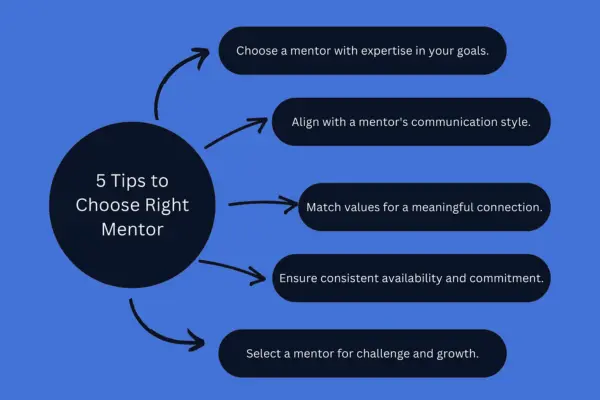
How to Choose a Mentor by Starting With Your Goal
Clarity attracts better mentors because your request becomes easy to understand.
Vague requests create vague conversations.
Specific goals create specific help.
Write your “mentorship mission” in one sentence
Use a sentence you can say out loud without cringing.
- Goal: I want to achieve ________ in ________ months by improving ________ and producing ________ proof.
- Context: I’m currently at ________ level, and my biggest constraint is ________.
- Support: I want guidance on ________, especially around ________ decisions.
That sentence becomes your filter.
That sentence also protects mentors from guessing what you really want.
Choose a mentorship type that matches your reality
Different goals require different kinds of mentors.
- Skill mentor: focuses on craft, practice drills, and feedback on your work.
- Career mentor: focuses on positioning, choices, and navigating hiring or promotion paths.
- Domain mentor: focuses on how the industry actually works, including norms and pitfalls.
- Sponsor-style mentor: opens doors, makes introductions, and advocates for you when you earned it.
Many relationships combine these roles, yet naming the primary type keeps expectations healthy.
Confusion drops when you both know what kind of help you are building.
Selection Criteria That Make Mentorship Actually Work
Choosing a mentor is a hiring decision.
You are not hiring them with money, but you are hiring them with time and trust.
That deserves a real selection process.
Use these five mentor-fit criteria
- Relevance: their experience matches the path you are trying to navigate right now.
- Recency: their knowledge reflects the current market, tools, and expectations.
- Accessibility: their availability fits your cadence, even if meetings are short.
- Communication: their feedback style helps you grow rather than shuts you down.
- Integrity: their approach aligns with your ethics, boundaries, and long-term goals.
One weak area can be manageable.
Multiple weak areas usually create frustration.
Look for “pattern recognition,” not just achievement
Impressive titles do not guarantee helpful mentorship.
Pattern recognition is the real value.
Pattern recognition means they can spot common mistakes and shorten your trial-and-error cycle.
Great mentors explain why a move works, not just what move to make.
Prefer mentors who can critique work, not only give opinions
Opinions sound confident and can still be wrong for your context.
Work-based feedback is harder to fake.
When a mentor can review your draft, your portfolio, your lesson plan, or your project, you get concrete growth.
That is especially important in education roles where outputs matter.
How to Choose a Mentor by Watching Their Behavior First
You do not need a formal mentorship agreement to begin learning from someone.
Start by observing.
Observe how they teach, how they respond to questions, and how they handle disagreement.
Small signals predict big outcomes.
Low-pressure places to “audit” a potential mentor
- Office hours: see how they answer questions when time is limited.
- Public writing: notice whether their ideas are clear, practical, and consistent.
- Workshops: watch how they handle beginners and confusion.
- Communities: track whether they contribute with patience or with ego.
- Feedback moments: notice whether they can critique kindly and specifically.
This approach protects you from choosing based on charisma alone.
It also reduces awkwardness because you already know how they operate.
Behavioral green flags
Consistency is a powerful signal.
Specificity is another.
Humility often matters more than brilliance in long-term mentorship.
- Curiosity shows up when they ask questions before giving advice.
- Clarity appears when they can simplify without being condescending.
- Follow-through is visible when they keep commitments and respect time.
- Boundaries feel healthy when they say no politely and predictably.
- Growth mindset appears when they admit what they do not know.
Behavioral red flags
Red flags do not mean someone is “bad.”
They often mean someone is a poor fit for mentorship with you.
- Dismissiveness shows up when questions are treated like inconveniences.
- Vagueness appears when advice is always motivational and never actionable.
- Volatility appears when feedback swings between praise and harshness unpredictably.
- Self-focus appears when every conversation becomes their story and your goals vanish.
- Pressure appears when they push you toward choices that primarily benefit them.
If you feel smaller after every interaction, trust that data.
Mentorship should challenge you without crushing you.
Where to Find Mentors Without Feeling Awkward
Many professionals stall because they think mentors are found through “networking magic.”
Reality is simpler.
Mentors appear where people do meaningful work and share it.
High-probability places to meet potential mentors
- Workplace projects where you can contribute and earn trust.
- Professional associations related to education, training, or learning design.
- Conferences and meetups where small conversations lead to follow-ups.
- Online communities where thoughtful feedback is exchanged publicly.
- Courses and cohorts where instructors already expect questions and growth.
- Volunteer programs where experienced people support developing professionals.
Contribution makes mentorship easier.
Value given first reduces the fear of “asking for too much.”
A simple “mentor pipeline” approach
Build a short list instead of searching for one perfect person.
Three candidates is enough to start.
Six candidates is plenty.
Then move from light interaction to deeper interaction gradually.
Trust becomes a natural byproduct of repeated helpful moments.
Questions to Ask Before You Commit to Mentorship
Good questions do two jobs at once.
They clarify fit and they demonstrate that you are serious.
A mentor is more likely to invest when your thinking is organized.
Ask these questions about experience and fit
- Which kinds of roles or transitions have you helped people navigate before.
- What do you think is the hardest skill to build in this field right now.
- Where do beginners usually waste time when they try to break in.
- What does “strong work” look like at the junior level in your world.
- Which mistakes do you see on resumes or portfolios that quietly block interviews.
Ask these questions about working style
- How do you prefer to give feedback, written notes or live conversation.
- What cadence works for you, monthly check-ins or shorter sessions more often.
- What should I prepare before meetings so our time is worth it.
- How direct do you like feedback to be, and what is your intent when you critique.
- What boundaries should I know, such as response time or topics you avoid.
Ask these questions about outcomes
- What progress would you expect from me after four weeks of consistent effort.
- Which deliverable would you want to see first, like a case study, lesson plan, or project draft.
- How would you recommend measuring improvement in a realistic way.
- What would make you feel the mentorship is working on your side.
- When would you suggest we stop or pause if the fit is not right.
These questions create a mature tone immediately.
They also prevent the silent disappointment that happens when expectations are unspoken.
Expectations Agreement: The Mentorship “Contract” That Prevents Friction
Mentorship improves when both sides know what they are signing up for.
An expectations agreement does not need legal language.
It needs clarity.
What to include in a simple expectations agreement
- Purpose: the main goal of the mentorship in one sentence.
- Cadence: meeting frequency, typical session length, and preferred channel.
- Preparation: what you will send before each meeting and when you will send it.
- Feedback: what type of critique you want and how direct it should be.
- Boundaries: response expectations, unavailable times, and topic limits.
- Confidentiality: what stays private and what can be shared.
- Duration: a trial period, such as six to eight weeks, before recommitting.
Writing this down protects both of you.
It also reduces anxiety because you know what “good participation” looks like.
Expectations agreement template you can copy
Mentorship Purpose:
- My primary goal for the next [8] weeks is: _____________________________.

Meeting Cadence:
- Frequency: ____________________.
- Duration: _____________________.
- Channel: ______________________.

Preparation:
- I will send [agenda + questions + materials] by: _______________________.

Feedback Style:
- I prefer feedback that is: [direct / gentle / written / live] ____________.
- The work I want reviewed most is: ____________________________________.

Boundaries:
- Typical reply window: ________________________________________________.
- Topics out of scope: _________________________________________________.

Trial Duration:
- We will review fit and progress on: __________________________________.
That template keeps things responsible and respectful.
It also makes it easier for busy mentors to say yes.
Goal Template: Turn Mentorship Into Weekly Progress
Mentorship becomes powerful when goals become actions.
Actions become outcomes when they are small enough to finish.
Use a goal template that forces reality.
The “one outcome, one proof” goal format
Pick a single outcome.
Attach proof.
Then define the next smallest step.
- Outcome: What will be true in 30 days that is not true today.
- Proof: What artifact can I show to demonstrate progress.
- Practice: What skill will I repeat weekly to improve quality.
- Constraint: What limitation must the plan respect, like time or tools.
- Support: What feedback do I need, and from whom.
A practical mentorship goal template you can copy
30-Day Outcome:
- In 30 days, I will: _________________________________________________.

Proof Artifact:
- I will publish/submit: ______________________________________________.

Weekly Practice:
- Every week, I will practice: ________________________________________.

Constraints:
- My realistic weekly time budget is: _________________________________.

Feedback Plan:
- I will request feedback on: _________________________________________.
- I will apply feedback by: ___________________________________________.

Success Check:
- I will know this worked when: _______________________________________.
This structure keeps mentorship from turning into “nice conversations.”
It also protects you from overcommitting and then ghosting.
How to Run Mentorship Meetings So They Feel Worth It
Busy mentors stay engaged when meetings are efficient.
Efficient meetings come from preparation and follow-through.
Follow-through is the real love language of mentorship.
A simple meeting agenda that works almost every time
Keep the agenda short enough to fit on one screen.
- Win: share one concrete improvement or completed deliverable.
- Blocker: name the single obstacle that is slowing progress.
- Decision: present one choice you need help making.
- Feedback: request critique on one specific artifact or section.
- Next step: confirm the one action you will complete before the next meeting.
Send a pre-read to earn better feedback
Send your material early enough for realistic review.
Provide context in two sentences, not two pages.
Ask for targeted feedback, not “any thoughts.”
Targeted questions produce targeted help.
Close meetings with a commitment sentence
End with a single sentence that defines the next deliverable.
Write it down during the call.
Repeat it back to confirm alignment.
That tiny habit prevents misunderstandings and makes momentum feel real.
Education-Focused Examples of Mentorship Goals and Proof
Examples reduce guesswork, especially in education careers.
Use these as inspiration and adapt them to your role direction.
Example goals for teachers and trainers
- Create a lesson redesign and measure clarity by running a short think-aloud test.
- Build an assessment set with a rubric and improve alignment by mapping items to objectives.
- Design a feedback workflow and validate it by applying it to three sample submissions.
- Develop a training session plan and refine timing through a rehearsal and debrief.
Example goals for instructional designers
- Produce a storyboard for a microlearning module and revise it after peer review.
- Write a needs analysis summary and stress-test assumptions with stakeholder-style questions.
- Create a scenario-based activity and improve it based on confusion points observed in testing.
- Publish a case study showing decisions, constraints, and evaluation method.
Example goals for students or junior professionals
- Build a “proof portfolio” page with three artifacts and a clear narrative for each.
- Rewrite resume bullets to connect learning to outcomes and validate with mentor critique.
- Practice one interview story weekly using a structured framework and improve clarity.
- Ship a small project every two weeks and track improvements in feedback quality.
Proof turns guidance into credibility.
Credibility turns learning into opportunities.
How to Ask Someone to Be Your Mentor Without Making It Weird
The cleanest ask is specific, time-bounded, and respectful.
Long, emotional messages create pressure.
Short, clear messages create choice.
A simple mentorship request script
Subject: Quick mentorship request (8-week goal)

Hi [Name],

I’m working toward [goal] over the next [8] weeks.
Your work in [specific area] stands out to me, especially [specific reason].

Would you be open to [one meeting per month / two short check-ins] to review my progress and give feedback on [specific artifact]?
I can send a short agenda and materials in advance to keep things easy.

If now isn’t a good time, I completely understand.
Either way, thank you for the work you share.

Best,
[Your Name]
This script is honest, non-needy, and easy to answer.
Time-bounding removes the fear of an endless commitment.
Offer a “trial” instead of a lifetime promise
Suggest a two-meeting trial if you want to reduce friction further.
Trials feel safer for mentors and still give you meaningful input.
Strong mentorship often starts small and grows naturally.
Maintaining Boundaries and Ethics in Mentorship
Healthy mentorship respects time, privacy, and power dynamics.
Responsible mentees protect mentors from awkward situations.
Responsible mentors protect mentees from dependence.
Boundary guidelines that prevent regret
- Keep asks proportional to the relationship stage, especially early on.
- Separate mentorship from hiring decisions unless the mentor offers sponsorship explicitly.
- Avoid sharing sensitive third-party information that is not yours to disclose.
- Respect response windows and avoid urgent messaging unless truly necessary.
- Credit guidance appropriately without implying endorsements you do not have.
Handle conflicts of interest early
Conflicts can happen in small industries.
Naming them calmly prevents future discomfort.
When in doubt, ask what topics are off-limits and honor the answer.
Troubleshooting: When Mentorship Is Not Working
Sometimes mentorship fails because expectations are unclear, the fit is wrong or your life got busy and momentum disappeared.
Signs the mentorship needs a reset
Repeated cancellations can signal a mismatch in availability.
Constant vagueness can signal a mismatch in communication style.
Growing dread can signal a mismatch in psychological safety.
Stalled progress can signal goals that are too large or too fuzzy.
A reset conversation script
Hi [Name],

I want to make sure I’m using our time well.
Over the last few weeks, I’ve noticed [specific issue, stated calmly].

Could we adjust the cadence or narrow the goal for the next month?
If the timing isn’t right, I’ll understand, and I’m grateful for what you’ve already shared.

Thank you,
[Your Name]
Clarity protects the relationship.
Grace protects your reputation.
Ending mentorship respectfully
Ending can be a sign of maturity, not failure.
Thank them for specific help you received.
Share the progress you made because of their guidance.
Leave the door open without demanding ongoing support.
Credibility Checklist for Choosing the Right Mentor
This checklist helps you choose based on evidence, not hope.
Use it before you make a formal ask.
Mentor selection checklist
- Alignment exists between my goal and their proven experience.
- Availability realistically matches the cadence I need.
- Feedback style feels constructive and specific in prior interactions.
- Ethics and boundaries feel compatible based on behavior, not claims.
- Practical proof is possible through review of real work artifacts.
- Motivation comes from growth, not from status or proximity to power.
- A clear trial period is defined to reduce pressure on both sides.
When the checklist feels solid, your confidence becomes quiet and steady.
That steadiness makes mentorship easier to sustain.
Independent Content Notice
Notice: this content is independent and does not have affiliation, sponsorship, or control by any entities mentioned.
Any institutions, platforms, tools, or third parties referenced are examples only, and you are responsible for your choices and usage.
Next Step: Choose One Mentor Candidate and Run a Two-Week Test
Pick one person who matches your goal and whose behavior you already respect.
Send a short request with a clear timebox and one deliverable for feedback.
Complete the deliverable quickly and apply the feedback within days.
That cycle will tell you more than months of “thinking about mentorship” ever will.